The Last Epoch Acolyte Builds Guide#

The Acolyte runs on Intelligence and commands death and decay. Its three masteries are the most thematically unified of the five base classes: all three deal with “life” — one through minions, one by transforming herself, one through curses.
The Three Masteries at a Glance#
| Mastery | Role | Difficulty | Damage Style |
|---|---|---|---|
| Necromancer | Undead army | Low | Minion-focused |
| Lich | Undead avatar | Medium-high | Melee body and damage over time |
| Warlock | Curse spells | Medium-high | Curse stacking |
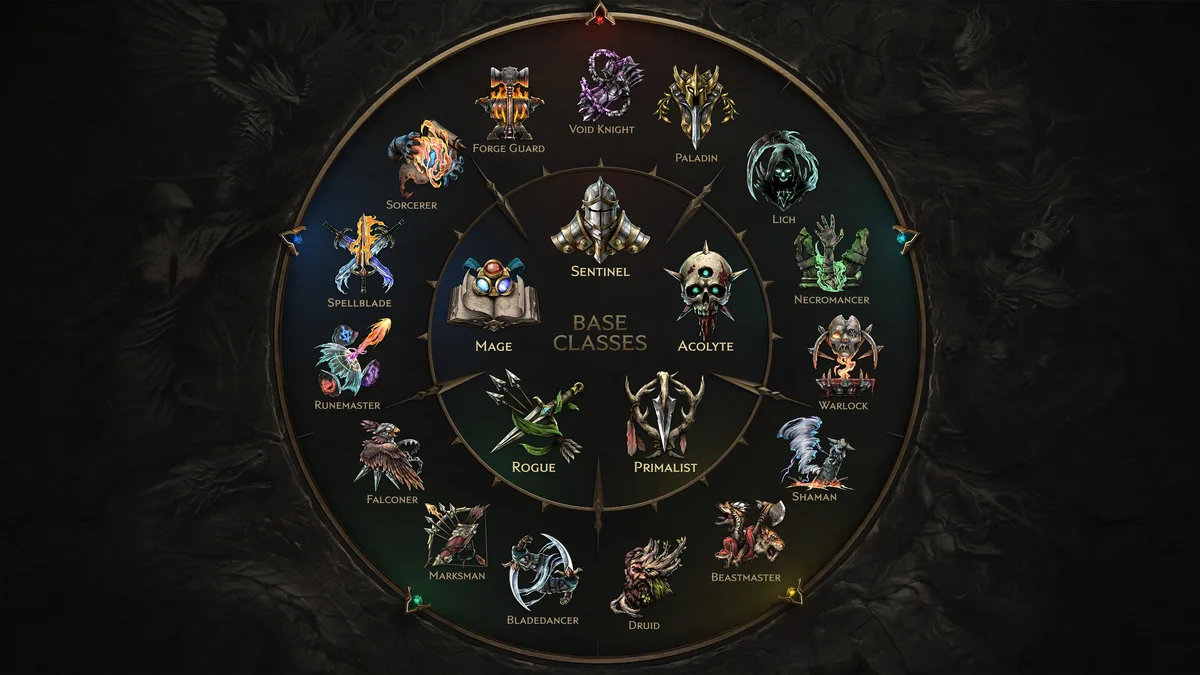
1. Necromancer#
The Necromancer is one of the most comfortable leveling paths in the game, built around summoning a sizable undead force.
| Aspect | Details |
|---|---|
| Main damage | Minions carry the damage, leaning physical and necrotic |
| Minion types | Melee, ranged and heavy tank lines |
| Strength | Lowest input burden, steady clear |
| Weakness | Minion power depends on minion affixes on gear |
The core build question for a Necromancer is minion composition. Stacking a single minion type leaves obvious gaps: all-melee lines struggle against ranged enemies, while all-ranged lines cannot hold a frontline. The workable pattern is to keep heavy units up front and damage-dealers behind them.
2. Lich#
The Lich transforms into an undead form, trading life and shape for high output.
| Aspect | Details |
|---|---|
| Main damage | Necrotic and damage over time |
| Core mechanic | Two-sided offense and defense from the undead form |
| Strength | High damage ceiling, extreme playstyle |
| Weakness | Pays life for damage, low room for error |
The Lich’s central tension is resource management. Because life is spent to amplify damage, the build must balance conversion efficiency against recovery speed. When recovery falls behind, high-end content turns into a constant near-death cycle.
3. Warlock#
The Warlock revolves around curses and death spells, amplifying output by stacking curse effects.
| Aspect | Details |
|---|---|
| Main damage | Necrotic and poison |
| Core mechanic | Curse stack counts and durations |
| Strength | Stackable damage, strong against high-health targets |
| Weakness | Requires maintaining curse uptime, mechanically demanding |
The Warlock’s key metric is curse coverage. Curses have durations, and any gap in uptime means damage falls off sharply. So the build priority is cast frequency and duration first, raw hit damage second.
Gear and Affix Direction#
| Mastery | Priority stats |
|---|---|
| Necromancer | Intelligence, minion damage and life, minion count related |
| Lich | Intelligence, necrotic damage, damage-over-time modifiers, life recovery |
| Warlock | Intelligence, curse modifiers, necrotic and poison damage |
The Acolyte shares the Mage’s predicament of having no heavy armor, but answers it differently: the Necromancer hides behind minions, the Lich behind form and control, the Warlock behind slows and area pressure. None of the three depends on mobility skills, which is the main feel difference from the Mage.
Handling Resistances and Survival#
| Stage | Approach |
|---|---|
| Leveling | Resistances first; the Necromancer can park minions in front |
| Mid game | Add one steady recovery source, especially on Lich and Warlock |
| Endgame | Cap all resistances and treat minions or curse uptime as part of your defense |
Common Mistakes in Last Epoch Acolyte Builds#
| Mistake | Reality |
|---|---|
| Necromancers stack one minion type | Different minion types fill different roles; composition matters |
| The Lich is a suicide build | It demands careful recovery management, not careless life swapping |
| The Warlock can skip curses | Curse uptime is the precondition for damage; a gap costs half your output |
| The Acolyte needs no resistances | Minions cannot soak area damage; your own resistances still matter |
| The three can be mixed | Masteries are locked once chosen, and their affix directions diverge widely |
One-Line Summary#
What the three Acolyte masteries share is that output never depends entirely on your own actions, so the demand on reflexes and aiming is lower than on the Mage or Rogue. The Necromancer is the easiest to start, the Lich has the highest ceiling but demands resource management, and the Warlock is the most mechanically complex yet the strongest against high-health targets.
Minion Roles#
More minions is not automatically better for a Necromancer — what matters is whether the division of labor is complete.
| Role | Job |
|---|---|
| Frontline | Hold enemies back and buy space for you and the back line |
| Damage | Provide the main output |
| Ranged | Handle distant targets and scattered packs |
| Burst | Dump damage in short windows |
The classic symptom of a broken composition is “fast clear on trash, slow boss fights” — usually a missing burst role.
Two Approaches to Resource Management#
All three masteries manage some resource, but the resource differs.
| Mastery | Managed resource | Risk |
|---|---|---|
| Necromancer | Minion count and survival | Units dying interrupts your output |
| Lich | Life and form resources | Over-conversion leads to near-death states |
| Warlock | Curse coverage and stacks | A gap collapses your damage |
The shared solution is coverage before power. While coverage is unstable, every stat boost is wasted.
Gear Swap Checklist#
| Order | Check |
|---|---|
| 1 | Are resistances still capped? |
| 2 | Did any minion or curse affix get weaker? |
| 3 | Does recovery speed still match spending? |
| 4 | Is the main damage type still consistent? |