Where the Seeds Fall Guide Hub: The Complete Flower Descent Companion#
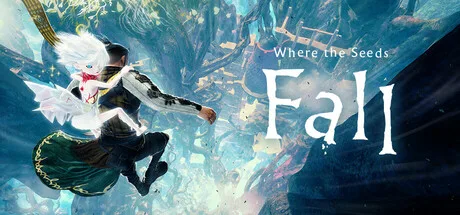
Pollution turned the surface into wasteland, and humanity fled to a colossal World Tree, building new nations on its branches. But the feuding never stopped, the taint crept upward, and one soldier who lost his daughter — traveling with a Tainted Child girl who resembles her — set out on a journey that only goes down. That is the opening of Where the Seeds Fall, the first title from CygamesEdge, a new brand under Cygames. The official tagline calls it a “spectacular falling action adventure”: instead of climbing up, you descend from the World Tree all the way to the long-abandoned surface.
This section is built around that descent. The core loop is one sentence: read the wind, plan your landing, throw the bud at the right moment, and let it bloom into the platform you land on. Simple to say — but every descent is irreversible. You will not retry upward the way climbing games let you; you live with the consequences of every choice in an environment that keeps changing.
This page is the section’s entrance: first the fastest possible pass over the game overview, worldview and core mechanic, then the full navigation. New players should read the beginner’s guide first in navigation order; players already sold can jump to the purchase or platform pages; veterans who finished the story should head straight for the postgame block.
Game Overview at a Glance#
One table to establish the basics:
| Item | Detail |
|---|---|
| Chinese title | 崩落之国 |
| Official English title | Where the Seeds Fall |
| Development | CygamesEdge (lead) with ZEREO Inc., a core team of about 10 |
| Publisher | Cygames, Inc. |
| Release date | November 5, 2026 (the Steam store page shows November 4 — a time-zone difference) |
| Platforms | PS5, Nintendo Switch 2, PC (Steam) — digital-only |
| Price | 42 CNY (China) / 1,100 JPY (Japan) / $9.99 (US) / 198 TWD (Taiwan) |
| Genre | Action adventure (store tags: action, adventure, casual, indie) |
| Languages | English, Simplified Chinese, Traditional Chinese, Japanese, Korean |
| Story length | About 3 hours |
| Postgame | Harder maps, time-attack mode |
| Demo | Free demo available — officially confirmed to represent the full game’s core experience |
| Official site | cygames-edge.com/where_the_seeds_fall |
Two numbers deserve their own sentence: the 42 CNY China price is officially derived from the budget and cost structure, and it pairs with a roughly 3-hour story — this is not a game that competes on volume, but one that staked everything on polishing a single core verb: moving downward. The project was originally planned for a half-year sprint; it actually took 1 year and 5 months.
Store Features Checklist#
The Steam feature list is also a “is it worth it” reference, especially for hardware and controller-minded players:
| Feature | What it means for this game |
|---|---|
| Single-player | No online elements anywhere — pure experience |
| Achievements / Cloud saves / Leaderboards | Leaderboards pair with time attack; cloud saves ease multi-machine play |
| Full controller support / gamepad recommended | The official recommendation is a gamepad; feel is tuned for one |
| DualSense / DUALSHOCK support | PS5 pad features are usable |
| No quick-time events | The game explicitly does not challenge your reaction speed with QTEs |
| Volume controls / stereo / surround | Ambient sound is a major part of the atmosphere |
| HDR available / Family Sharing | Color presentation and library sharing both covered |
The “no QTEs” line is easy to skip past, but it is effectively an official footnote to the game’s difficulty philosophy: what is hard is reading space and making judgments — not hand speed.
The Worldview and the Three Commandments#
The setting compresses into three layers:
- The tainted surface: endless human warfare let “the taint” render the ground uninhabitable; survivors fled.
- Nations on the tree: survivors escaped to the giant World Tree and built new homes on its branches — but fights over limited territory never stopped, and the tree itself is slowly being tainted too.
- The Tainted Child: a calamity born from the taint, viewed by the tree-nations as an omen to be destroyed (the official Chinese renders it as “calamity child”; this section uniformly says Tainted Child).
In that world, the tree-nations keep three survival commandments:
- Humans must not fight one another.
- Whoever is tainted must be made to fall.
- Tainted Children must be destroyed.
The protagonist soldier’s story starts at the third commandment: he draws his sword on a Tainted Child girl in the opening — and because she resembles his late daughter, he cannot cut. He reaches out both hands instead, and the two begin the journey downward, fleeing pursuers. The pair share no language; their bond deepens through scenery, staging and small gestures — the signature of this game’s storytelling: it explains nothing and lets you feel.
Note how the second commandment locks into the gameplay: in this world, falling is the execution of the tainted, and the player’s only direction of movement is falling. Rule and mechanic overlap on one action — the sharpest design touch in the game.
The Core Loop: Flower Dive and Two Aerial Tools#
The core mechanic is the Flower Dive: pick a bud on the World Tree, throw it at where you intend to land, and it blooms midair into a platform that absorbs your impact. Around it sits a whole environment design:
- Wind: howling gusts blow your descent off line — read the wind before you jump;
- Crumbling footholds: not every perch holds; some shatter underfoot;
- Rare safe zones: safe landing spots are scarce, deliberately squeezing your margin;
- Irreversible choices: the team deliberately kept a realistic weight in the controls — you never float through a stage; every jump and throw is one-way;
- Checkpoints: a missed jump or botched landing kills you — but only back to the last checkpoint, keeping the cost of experimentation low.
Besides the Flower Dive there is a second aerial tool newcomers overlook: the Tainted Child on your back grants short-range gliding (slowing your fall) and a double-jump-like boost, reaching spots normal jumps cannot. It drains a dedicated energy gauge and cannot be spammed — treat it as emergency insurance, not daily transport.
Media have compared the experience to a reversed rage-climbing game: climbing games send you up and falling back down repeatedly, while this one sends you down with no return. The difference is in difficulty design — AUTOMATON’s preview reporter’s own summary: fell countless times, never once felt it wasn’t fun.
The 20-Page Navigation#
All twenty subpages, ordered along the learning curve:
| # | Page | One-liner |
|---|---|---|
| 1 | Beginner’s Guide | Nine things to know before your first descent |
| 2 | Story and Worldview | The tainted land, the World Tree and the three commandments in full |
| 3 | Flower Dive, Explained | Throw timing and usage principles of the core mechanic |
| 4 | Wind Reading and Landing Plans | Turning lethal falls into precise landings |
| 5 | Descent Techniques | Landing every drop inside the plan |
| 6 | Fall Survival Manual | Crumbling perches, gusts and safe zones |
| 7 | Stage Structure | How the top-to-surface descent is designed |
| 8 | Story Pacing | The most comfortable way through the ~3-hour run |
| 9 | Narrative and Presentation | Silence, scenery and the pair’s bond |
| 10 | Controls and Feel | The camera shake and momentum debate |
| 11 | Difficulty and the Skill Floor | A rage-climbing game’s gentler difficulty |
| 12 | Postgame Overview | Harder maps and time attack |
| 13 | Hard Map Challenges | The next drop for advanced players |
| 14 | Time Attack Deep Dive | Route optimization and mistake control |
| 15 | Demo Guide | What the free demo covers, how it differs |
| 16 | Platform Choice | PS5, Switch 2 or PC |
| 17 | Purchase Decision | 42 CNY, 3 hours, and who it suits |
| 18 | Reviews Roundup | Praise and controversy |
| 19 | FAQ and Glossary | Tainted Child, calamity child, Flower Dive — all defined |
| 20 | The Brand Story | Why a giant studio ships a small premium title |
Reception and Controversy#
Feedback around launch converged on two threads:
- Praise centered on “one verb carrying an entire game.” The 7/10 review put it plainly: the core idea is instantly legible and genuinely tense, the World Tree’s vertical scale and the pressure of looking down are superb, and the story is quiet and sincere — it says what it needs to with very few lines.
- Controversy centered on “three hours is too short” and camera momentum. The same review listed “I wanted more” as its main complaint; during the demo window, players split into two camps over the deliberately heavy controls and camera shake.
Those two threads are two faces of the same positioning: the game does not compete on volume and does not tune its feel to please everyone. The fastest way to know if it suits you remains the free demo.
Who It Suits, and How to Start#
Weighing the official positioning against media and player feedback:
| Player type | Fit | Why |
|---|---|---|
| Players with some 3D action experience | High | The officially targeted audience |
| Fans of hardcore climbing platformers | Fairly high | A fresh reversed loop — difficulty reads space rather than tortures |
| Players wanting a one-evening short game | Fairly high | ~3-hour story, well-reviewed gamepad and handheld fit |
| Players chasing long grind content | Low | Refined volume; postgame is self-challenge only |
| Players sensitive to camera shake | Weigh it | Shake and momentum are genuinely divisive per feedback |
Three starting tips: play the free demo first to confirm the feel before buying; once in, do not rush — stabilize the Flower Dive timing in the early stages and everything after flows; and after the credits, do not quit — the hard maps and time attack are the game’s real second layer.
The team has moved on to pre-production of its next project; this game shipped as its final version with only technical fixes planned — so this guide reflects the launch state and will track official patches.
Two background notes for judging whether to follow this section: first, the brand’s efficiency pitch — teams of no more than 10, two to three titles a year, this one born from an internal game-jam contest with its originator now creative director and level designer; second, a offline chance to try it — the game exhibits at G-EIGHT, December 4–6, 2026, at Taipei Expo Park’s Wu-Chih Hall, with playable stations and giveaways.