Probably Stolen Guide Hub: From Scavenger to Pawn-Shop Owner#
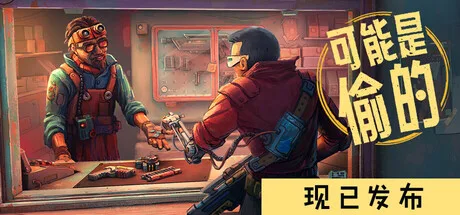
Probably Stolen looks like a shop-keeping game, but it is really a “bottom-tier survival model behind a shop counter”. You are not an invited entrepreneur — you are a scavenger in the Underdeck, the lowest level of a massive space station, who takes over a run-down pawn shop with a high-interest, compounding loan, and tries to buy the whole shop outright before the ever-rising rent crushes you.
That premise frames every system in the game: appraisal is not a mini-game puzzle but the craft of converting information gaps into cash; fraud is not an easter egg but a lifeline when rent is due; faction reputation is not a friendship meter but the license that decides whether you can keep doing business down here. Every number on this hub carries its source label (store page / official announcements / guide-site compilations / community testing) so you can tell what to copy and what to treat with caution.
Core Premise: You Owe Money, and Rent Comes Weekly#
The goal never changes: buy the shop before the rent buries you. A few rules generate all the pressure:
- The shop was bought on a high-interest loan: interest compounds on top of principal — the longer you drag, the more the same shop costs.
- Rent is collected weekly and only rises: there is no “pay less this week, make it up next week” negotiation; the curve is one-way upward.
- Missing rent cascades: shop appeal drops → customer flow dries up → income stops growing → you are forced into dirtier work to fill the hole, a proper death spiral.
- The system allows dirty work with no confirmation dialog: slapping genuine-product labels on cheap fakes, cutting water sold to the poor with ice to make it addictive, adding rat droppings to low-grade water to speed filtration — all permitted, none of them prompt you twice.
- The community’s favorite line is a product of exactly this structure: “If you lose money, you can earn it back. If you lose your conscience… you earn even more.”
In other words, moral choices carry weight here not because a morality meter exists, but because rent converts morality into a cost you can price in credits. Keep that in mind and the appraisal, haggling and industry systems all read the same way: they are cash flow.
Three things will follow you from day one, and understanding them matters more than early profit:
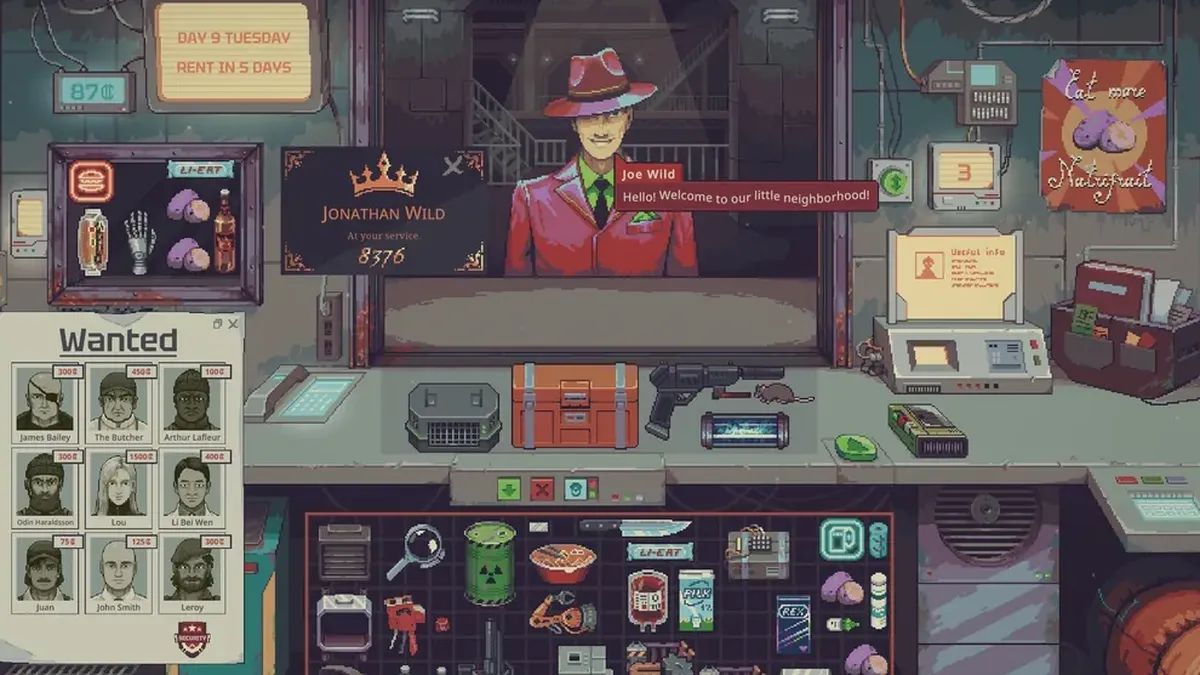
- The top-left HUD: day, cash and rent countdown — the interface permanently shows the current day, cash balance and days until rent (in English it reads like DAY 5 FRIDAY and RENT IN 2 DAYS). Of the three numbers, watch the countdown, not the cash.
- The bounty wall on the left of the counter — the Security Department gives you a wanted poster and pays instantly for identifying and reporting suspects: Arthur Ravler (a failed revolutionary), Li Beiwen (claims to research a non-addictive painkiller and stepped on capital’s toes), Odin Haraldsen (active revolutionary offering to buy arms long-term), and a man named Zhang Wei who insists his name is just very common.
- The stock slots under the counter and the compartment marked Smuggler — open inventory and hidden compartment are two sets of books; the hidden one decides how much contraband you dare take in.
Release, Price and Platform Facts#
| Item | Value | Source |
|---|---|---|
| Release date | October 28, 2026, on Steam | Store page |
| App ID | 4348910 | Store page |
| Developer / publisher | Questing Goose Studio (Montreal, Canada, about 8 people) / tinyBuild | Store page / media |
| Genre tags | Indie, RPG, Simulation, Strategy | Store page |
| China price | ¥55 | Store page |
| Launch discount | 10% off (¥49.50) through November 11, 2026 | Store page |
| Sales | 200,000+ copies within hours | Official announcement |
| Peak concurrency | 86,000+ within 90 minutes, a publisher record | Official announcement |
| Review score | 95% positive (about 400 reviews at announcement time) | Official announcement |
| Global top sellers | No. 2 | Official announcement |
| Simplified Chinese reviews | 1,369 at 95% positive (October 30, 2026 snapshot) | Community statistics |
| First-month forecast | 237,000 copies (range 118,500–474,200) | Third-party forecast, not official |
Watch the conflations: “200k copies”, “86k peak”, “95% positive” and “No. 2 top seller” are all official announcement figures; the third-party first-month forecast is a separate model, and media have noted that inferring sales from review counts skews low — do not convert between them. Review percentages also have multiple snapshots (98% demo period, 96% store snapshot, 95% across 1,369 Chinese reviews, 96.5% across another sample) — always cite the timestamp.
Also confirmed on the store page: 8 languages with full Simplified Chinese coverage; single-player, cloud saves, Family Sharing; fully offline, no multiplayer; a Supporter Bundle is also sold.
Specs and Presentation#
| Item | Requirement | Source |
|---|---|---|
| OS | Windows 10 64-bit | Store minimum |
| CPU | Intel Core i3 or equivalent | Store minimum |
| RAM | 8 GB | Store minimum |
| GPU | GTX 650 Ti equivalent or better | Store minimum |
| DirectX | 10 | Store minimum |
| Storage | 1 GB free (about 1 GB installed) | Store page |
| Aspect ratio | Native 16:9 pixel art; 21:9 and 32:9 work fine | Store page |
The barrier is nearly nonexistent: an old i3 laptop with 8 GB of RAM runs it, and 1 GB barely touches your SSD. For a game that lives in the background and gets checked in every couple of days, that is a real virtue.
Six accessibility options (store page): adjustable text size, custom volume, stereo audio, no quick-time events required, playable with mouse only, playable at your own pace. The last two matter most — time does not pass at the counter, so you can appraise and lowball at leisure with zero reflex demands.
Visually it is 2D hand-drawn pixel art soaked in cyberpunk: the dim, rusted Underdeck, neon light against corroded machinery, richly detailed character portraits. Pixel does not mean crude — the atmosphere is carried almost entirely by lighting and portraits, which is why users tag it “pixel graphics”, “cyberpunk” and “dystopian”.
Who It Suits — and Who It Doesn’t#
Good fit for:
- People who enjoy converting information into money: appraisal means magnifier details checked line by line against category handbooks; lowballing and markup both carry costs; every deal is a bet on your own eye.
- Players who can accept repeated bankruptcy: the tutorial is thin and going bust in the first three hours is normal — bankruptcy is part of the design.
- Story readers: regulars like Giorgio, Eleanor and Officer Lun carry story chains spanning dozens of days; the narrative lives in character-line density.
- Modders: during the demo period a well-known modding site saw 170+ mods in one month, most adding content along the game’s logic rather than reskins.
- Anyone wanting cheap trial and error: ¥49.50 launch price plus 1 GB of disk space makes the experiment nearly free.
Poor fit for:
- Controller players: no controller support marked; keyboard and mouse only.
- Players who want strong guidance: tutorials are thin; many rules you learn by hitting walls.
- Simplified Chinese text purists: the localization is mediocre — the demo period officially miswrote the Chinese subtitle until players flagged it.
- Players who need a complete main plot: a long review noted the 1.0 main story isn’t finished (player assessment, not an official statement); narrative rides on character lines.
- Long-goal players: once one industry line is online, the drive to continue fades.
Full Edition Additions and the Store Feature List#
| Addition | Notes | Source |
|---|---|---|
| 9 starting scenarios | Apprentice, Water Dealer, Fence, Gunsmith, Chemist, Hydroponic Farmer, Fish Farmer, Rat Keeper, Penniless | Official announcement |
| 4 difficulty options | From beginner-friendly to ultra-hard; official names unpublished | Official announcement |
| The shop can truly be bought | Impossible in the demo; the endgame goal is now real | Official announcement |
| Completed NPC lines | Regulars’ story chains now resolve | Official announcement |
| 21 achievements | Covering industry lines, reputation, endgame | Guide-site compilation |
| Vending machine | New facility in full edition | Player reports / guide sites |
| Three industry lines | Water, brewing, smelting | Player reports / guide sites |
| Workshop mod support | Player mods appeared within two days of launch (night auctions, food line) | Media / community |
Two notes for returning players: saves carry over, but the developer strongly recommends a fresh start so you don’t miss the new story lines; the demo has been delisted and demo-era mods may not work in the full game. If you sank dozens of hours into the demo, restarting is worth it.
The store page lists 12 features — effectively the system checklist of the game:
- Run a shop in a dystopian space station
- Attract the right customers and balance supply and demand
- Appraise rare goods for authenticity and profit from them
- Haggle — every deal has a price
- Master more trades: water seller, hydroponic farmer, organ dealer
- Manage machines and production chains to craft valuable relics
- Unlock advanced licenses and enter the black market
- Navigate politics; trade exclusive deals for faction ties
- Sell fakes to arrogant elites
- Exploit the weak, or help them
- Manage ever-expanding inventory
- Hide contraband — getting caught can be bought off
The last four tell you the game’s stance: it does not want you to be a respectable merchant. It wants you to do accounting between “helping the poor” and “fleecing the poor”, with rent always on the other side of the ledger.
Three Industry Lines and a Few Counter-Intuitive Rules#
The full edition makes three industry lines the cash pillars of mid/late game, each with a counter-intuitive twist:
- Water: grades run from ditch water and rust water up to premium and pure (one account says six tiers including ghost water — both accounts coexist). Past a certain tier the eye is useless: test strips or an analyzer are required, measuring heavy metals, chemical residue and microbes. What decides the price is usually the label on the bottle, not the contents.
- Brewing: dial 8376 to reach Choco and unlock brewing. Grape scoring is explicit (standard purple +1, small purple +2, unripe orange and purple-red 0, moldy skin −1, two grapes per bottle +1). Water quality affects quality — use premium or basic water; pure water lacks the minerals fermentation needs and is actually worse, and anything below basic tanks quality.
- Smelting: perfect ingots require no flux. Without the blast furnace mod, 2 ore plus 200% quality suffices; a blast furnace ignores the 100% tier so it needs 300%, scrap metal 400–500%. Power is equally strict: machines need supply, power units stack, and efficiency changes energy cost in steps of exactly 12.5% (at 12% you still pay 8 energy/day).
These numbers come from guide sites and community testing, not verified official documents — trust your own build’s behavior first.
Full Section Navigation#
| Page | What it covers |
|---|---|
| Getting Started: Nine Opening Scenarios | Every origin’s kit, cash, rent and the four difficulty tiers |
| The Daily Loop, in Six Steps | From newspaper to rent: one executable day |
| Goods, Categories and the Label System | Who buys what, who sees through fakes, how labels price things |
| Rent (Chinese) | The one opponent that only rises, and the cash-flow priority table |
| Appraisal (Chinese) | Magnifier, handbook comparison and the quote panel |
| Factions (Chinese) | Five factions plus the Sector 13 cartel, reputation methods and risks |
| Wanted List (Chinese) | The bounty wall, to report or not, regular schedules |
| Androids (Chinese) | Spotting them, keeping or reporting them, assimilation endings |
| Water Line (Chinese) | Six tiers, test strips and analyzers, label pricing |
| Brewing (Chinese) | Grape scoring, water choice, recipe order |
| Smelting (Chinese) | Flux, blast furnace and perfect ingot conditions |
| Power Efficiency (Chinese) | Power stacking and the 12.5% rule |
| Scavenging (Chinese) | Trips, injury odds, no-departure-while-injured rule |
| Warehouse and Crafting (Chinese) | Slots, cages, smuggling layers and recipes |
| Showcase and Pricing (Chinese) | What’s in the window decides who walks in |
| Fraud Economics (Chinese) | Labels, ice-cutting and rat-dropping filtration priced out |
| NPC Stories (Chinese) | Giorgio, Eleanor and the Security Department lines |
| Mods and Community (Chinese) | Workshop status and demo-mod compatibility |
| Achievements and Endgame (Chinese) | 21 achievements and buying the shop |
FAQ#
What kind of game is Probably Stolen?#
A pixel-art shop-management RPG built on “survival behind a counter”: with a high-interest loan you take over a run-down pawn shop in a space station’s Underdeck and, through appraisal, haggling, fencing and industry lines, try to buy the shop before ever-rising rent crushes you. The system permits dirty work — fake labels, ice-cut water — and morality is priced directly in cash flow.
When did it launch, on what platform, and how much?#
October 28, 2026 on Steam, ¥55 in China with a 10% launch discount through November 11, 2026. Official announcement figures: 200,000+ copies sold within hours, 86,000+ peak concurrent players within 90 minutes, 95% positive reviews.
Who is Li Beiwen?#
One of the wanted suspects: he claims to be researching a non-addictive painkiller and got wanted for stepping on capital’s interests. He’s second on the bounty wall. He is not just a bounty target — he is the entrance to an industry line.
How do I get Li Beiwen’s painkiller formula?#
Let him go. He will return to buy chemicals; the more you sell him, the faster his research progresses, until he hands over the non-addictive painkiller formula — the core unlock for the chemist playstyle. Reporting him on sight permanently closes the line.
What are the androids?#
Former humans whose bodies have been taken over by rogue AI in their brain implants — not robots, not aliens. The community calls them fakes/fleshfakes. They queue among your regular customers.
How do I identify androids?#
Three clues: augmentation chips, pupil traits and expression checks. The full checklist is on the Chinese androids page. Misjudging and reporting a real customer also costs you — do not go on gut feeling.
Should I shoot androids or let them go?#
A classic dilemma: Security orders them destroyed on sight with instant bounty; but androids are the best customers — simple-minded, gullible, buying only materials and medicine, a stable high-value income source in mid/late game. The tradeoffs are compared on the Chinese androids page.
Are the specs demanding?#
No: Windows 10 64-bit, i3, 8 GB RAM, GTX 650 Ti class GPU, 1 GB storage (store minimum). An old ultrabook runs it, and 21:9/32:9 monitors work fine.
Is there Chinese?#
Eight languages with full Simplified Chinese interface and subtitles; fully offline. Fair warning: the Simplified Chinese text quality is mediocre — the demo period even had an official typo in the subtitle, fixed after player feedback.
Related Pages#
- The Daily Loop, in Six Steps — the first page a new owner needs
- Goods, Categories and the Label System — the label mechanics behind every trade
- Getting Started: Nine Opening Scenarios — pick your origin wisely