The Daily Loop, in Six Steps#

A day in this game is not an “open door, earn money, close up” cycle — it is a pipeline from information to cash: read the paper for today’s information gap, then decide what to buy in, who to mark up, and what to hide in the compartment. Rent comes weekly, so a day’s value is not what it earned but how much closer it moved you to rent day.
Below, the day splits into six steps. The first three are about knowing; the last three are about daring. Going bust in your first three hours is normal — that is by design — and smoothing out this loop is what turns a scavenger into a shop owner.
The Six Steps at a Glance#
| Step | What you do | Cost of getting it wrong |
|---|---|---|
| 1 | Read the paper before opening: shortages and faction movements | Buy the wrong stock; inventory becomes dead money |
| 2 | Customers arrive — read the person before the goods | Miss a bounty or fence hot stolen goods |
| 3 | Appraise: drag to the magnifier, check the handbook line by line | Misjudge, eat the loss yourself |
| 4 | Quote: adjust with +/- buttons and send | A wild quote sends the customer walking |
| 5 | Take delivery: open shelves or the smuggler compartment | Compartment found; contraband confiscated |
| 6 | Pay rent: weekly, only rising | Miss it and appeal, footfall and income cascade down |
Only step six is a hard deadline; the other five all happen at the counter — and time at the counter does not pass. That deserves its own section later, because it is the resource beginners waste most.
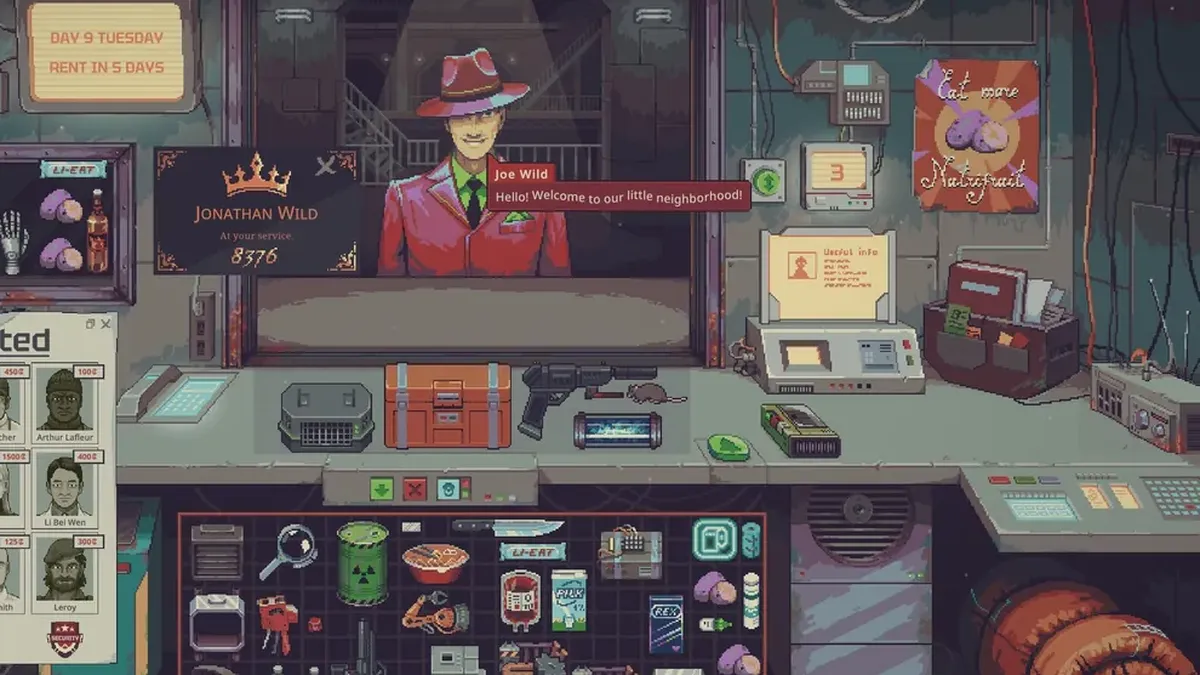
Step One: Read the Paper Before Opening#
Before the door opens, read the front page. It tells you two things that decide the day’s stocking:
- What is short: shortage categories mean someone will pay above odds today, and that the stock you’ve been sitting on can finally price up.
- Who is checking what: what the Security Department is currently cracking down on decides what you dare take in today; the black market buys what others fear, but losses there count double.
From that, three action lines for the day:
- Paper says a category is short → put your matching stock in the window and raise your buy-in price a touch to grab supply.
- Paper says a faction is watching a category → that category goes to the hidden compartment only, or stays untouched.
- Categories the paper ignores → low-volatility staples; keep them as the cash-flow floor and don’t bet big.
Reading the paper has no numeric penalty for skipping, but it is the only free information gap in the pipeline. Skip it and the other five steps become blind gambling.
Step Two: Read the Person Before the Goods#
People come first because a customer decides three variables of the deal: budget, fake-detection ability, and whether they bring other trouble today.
- Read the class tier: the world splits Upper, Middle and Underdeck; you live at the bottom. Detection ability differs sharply by tier — selling fakes to arrogant elites is officially listed gameplay, but fleecing your own Underdeck poor settles accounts differently.
- Check the wanted wall: the poster left of the counter pays instantly for identifying suspects — Arthur Ravler (failed revolutionary), Li Beiwen (non-addictive painkiller researcher who crossed capital), Odin Haraldsen (active revolutionary seeking long-term arms purchases), and a Zhang Wei who insists his name is just very common.
- Check for androids: humans taken over by rogue AI in their implants, mixed into the customer queue — check the implant chip, pupils and expressions. Security wants them destroyed on sight, but androids are the best customers: simple-minded, gullible, buying only materials and medicine. Keep one around too long and assimilation can end your run.
- Know the regulars’ schedules (guide-site compilation): Giorgio the legendary scavenger sells scrap on day 6, bottles on day 9, a big kids’ backpack on day 12, hires himself out for 50 credits on day 15 (scavenging with zero injury chance and 5 extra trips), fake cigarettes on day 18, contraband on day 22. Eleanor buys food on day 23, daily goods on day 25, sells luxuries on day 27, and brings a planted luxury case to frame you on day 28. Officer Lun buys food on day 11, and medical supplies and anesthetics on day 12 after being shot.
Fix the order permanently: wanted list first, android check second, goods last — the first two carry rewards and risks that dwarf any single deal’s margin.
Steps Three and Four: Appraise, Then Quote#
Appraisal runs on two tools: the magnifier window at the counter and the category handbook on the right. Drag an item into the magnifier to enlarge label text, colors and seal placement; open the matching handbook for genuine-vs-fake comparison images; compare line by line, then judge.
- Cigarettes: check the seal — position and integrity are the tells.
- Water: it must be tested — past a certain tier the eye is useless; test strips or an analyzer measure heavy metals, residue and microbes.
- Weapons: license required — no license, no touching.
- Antiques: wear is the tell — wear marks map to authenticity; older does not mean pricier.
- Misjudgments are yours to eat — no insurance, no undo.
The quote panel, using the prosthetic arm example (guide-site compilation): the handbook fixes the base price at 100 credits, lowballable to 50; material tiers (aluminum, carbon fiber, gold-plated) add price upward; condition and function damage subtract. Adjust with −100/−10/−1/+1/+5/+10/+100 buttons and send. For appraisal services, your estimate must land within 50–150% of true value; each failure adds 49 impatience, and at 100+ the customer walks.
Step Five: Take Delivery and Decide Where It Lives#
After a successful buy, the first move is not celebrating — it is choosing the shelf:
- The stock slots under the counter: open inventory, one category per slot — guns, rats and private stock each in their place.
- The compartment marked Smuggler: the hidden book for contraband. The black market sells an improved compartment with higher capacity and lower raid-detection odds.
- Who will search it: Leroy is a fake cop who flips your compartment and confiscates contraband — report him on sight; Officer Lun comes for ice on day 24.
- The fallback: hiding contraband is official gameplay and getting caught can be bought off — but that money is cash flow too.
The rule is one line: if being caught would cost more than the item’s profit, it goes in the compartment; if the compartment is full, don’t take the deal.
Step Six: Pay Rent and Close the Books#
Rent is weekly and only rises. It is not a negotiable number — it is the game’s real opponent, and missing it cascades: appeal drops → footfall dries up → income stalls → dirtier work fills the hole.
Close each day in this order:
- Check the countdown first: the HUD shows day, cash and days-to-rent (like DAY 5 FRIDAY, RENT IN 2 DAYS). Watch the countdown, not the balance.
- Compute the week’s gap: cash on hand + realizable compartment goods + unpaid bounties, against the rent.
- Only then decide on dirty work: when the gap can’t close, fake labels and ice-cutting enter — no confirmation dialog, no absolution.
Counter-Time Never Passes: The Leisure Advantage and a Copyable Day#
Time at the counter does not flow — you can investigate, compare and lowball indefinitely with zero reflex pressure. Spend it deliberately:
- Investigate fully before pricing: magnifier, then handbook, then quote.
- Buy wholesale lots: when a customer brings a batch, take it at wholesale and split the valuables for retail.
- Test markups in tiers: +10%, +25%, +50% all have odds; overmarking drains the customer’s budget, so read the person first, then pick the tier.
- Keep two sets of books: the leisure advantage is that you can decide where every item goes before you act.
Thread the six steps into a concrete day: HUD says day 5, Friday, rent in 2 days, 300 credits on hand —
| Order | Action | Reason |
|---|---|---|
| 1 | Read the front page; circle shortages and watched categories | The page sets today’s stocking direction |
| 2 | Adjust the window: shorts go to the door, watched goods come down | The window decides who walks in |
| 3 | Open; scan the wanted wall first | Bounties pay instantly — the fastest cash |
| 4 | First customer: class tier and android check, then the goods | The person sets budget and detection |
| 5 | Drag to the magnifier; check the handbook images | Misjudgments are yours to eat |
| 6 | Quote with buttons; test markups at 10/25/50% | Overmarking drains budgets |
| 7 | Stock the open shelves; contraband to the compartment | The compartment sets how much you dare take |
| 8 | Close: total cash and realizable goods against rent in 2 days | Watch the countdown, not the balance |
| 9 | Only now consider fake labels and the like | Dirty work is the last resort, not step one |
Note where step 9 sits: always last. Players who treat fraud as routine usually skipped step 1 — no information gap means paying for cash with risk.
Related Pages#
- Goods, Categories and the Label System — the label mechanics behind appraisal and fraud
- Getting Started: Nine Starting Scenarios — what your origin changes about the loop
- Probably Stolen Guide Hub — back to the top