Goods, Categories and the Label System#

Probably Stolen is developed by Questing Goose Studio of Montreal (about eight people, per media; no official headcount published) and published by tinyBuild. It launched on Steam October 28, 2026 at ¥55 in China, with a 10% launch discount (¥49.50) through November 11 (store page). This page is the master key to the three industry lines: how goods are classified, how labels work, and who is buying. Water’s six tiers and testing methods get their own page.
Your counter is not a jumble sale. Everything through the door carries a label, and the label decides its category, its slot, and which customers it pulls in. The Underdeck rule: what’s in the bottle matters less than what’s written on it.
Once that clicks, the game truly begins. Below, each category in turn, then the who-buys-what table.
What Each of the Five Categories Does#
The store page lists “manage expanding inventory” and “hide contraband, buy your way out” among its twelve features — classification is not decoration. Warehouse slots, breeding cages and smuggling layers each hold their own type, one category per slot, and upgraded storage adds slots (guide-site compilation). Category also routes crafting: yeast, sugar or 750 ml of water plus a bunch of grapes into a barrel makes wine when the clock runs out (guide-site compilation).
| Category | Role in the shop | Typical sources | Main buyers | Fraud and risk |
|---|---|---|---|---|
| Food | Keeps regulars coming; the Underdeck’s footfall floor; all food has calories and feeds rats for meat | Juan the food-plant worker’s stolen factory goods, scavenging, rat farming, hydroponics | Underdeck residents; same-name unfortunates like Zhang Wei and John Smith buy weekly | Ice-cutting water sold to the poor makes them addicted, with bigger budgets later — the cost is roughly your conscience |
| Materials | Production feedstock for smelters, disassemblers and recipes | Scavenging, Giorgio’s scrap and electronics, wholesale lots | Androids buy only materials and medicine; revolutionaries buy arms long-term | Stolen goods carry heat — hotter goods get found by Security sooner and buy in cheaper |
| Medicine | Highest markups in mid/late game; high value, slow turnover | Exchange medical crates, bought cheap and split for retail | Android bulk-buys at premium; Officer Lun buys medical and anesthetics after being shot | Relabeling caffeine and immunizers for androids is the stable big-ticket income |
| Daily goods | Low value but constant volume; keeps daily cash flow alive | Wholesale lots split into singles | Middle-deck residents; Eleanor buys on day 25 | Low detection threshold; Underdeck regulars see through fakes — no big relabels here |
| Water | Enormous price gaps across six tiers; the most profitable category | Moisture collector, purifier, sewer taps, Giorgio’s big empty bottles | Upper-deck water hoarders drink premium and pure only; the Underdeck drinks anything | See the water-line page; testing details not covered here |
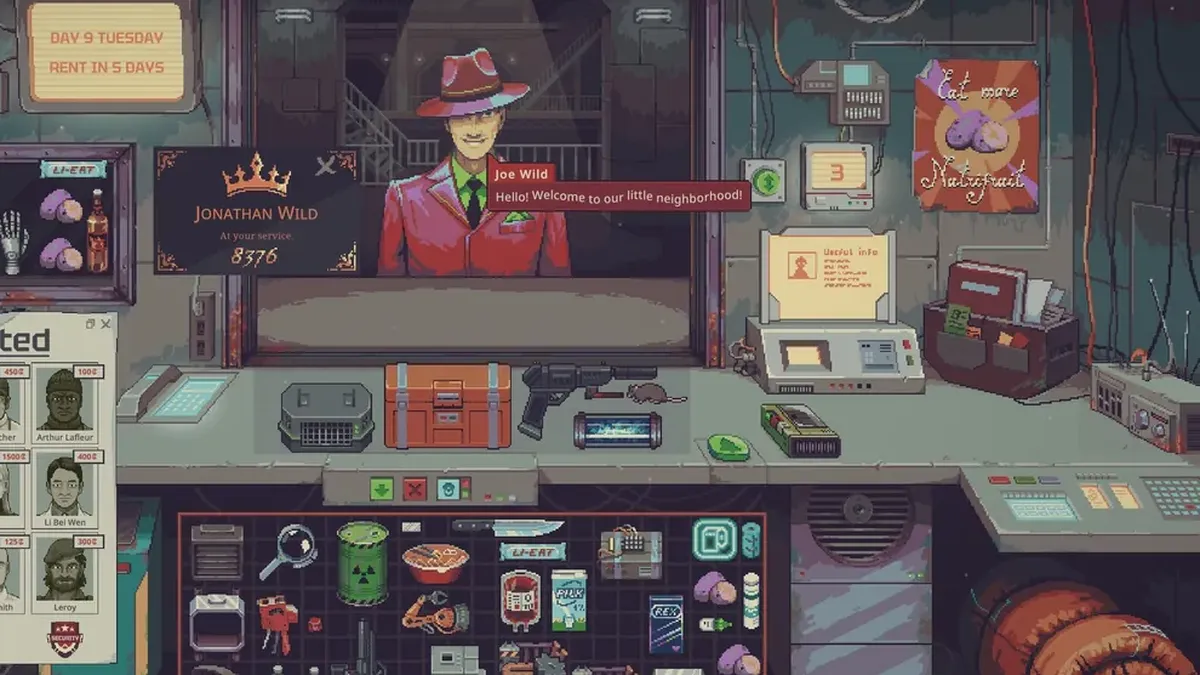
The Label Is the Price#
The sticker on the bottle decides the price (Tencent News, October 29, 2026). The rule looks water-specific but runs through the whole fraud system: relabel cheap fakes as genuine and the sunk cost doubles instantly — provided you aren’t caught (long-form review).
In practice, labels have three properties:
- Labels are editable, with no confirmation dialog. Judge a fake right at buy-in and you resell it at genuine price; judge wrong and you eat the fake price (guide-site compilation). Nothing pops up to stop you.
- Labels decide who comes, not just what you earn. The window’s contents decide the day’s customers, and displayed item value sizes their wallets (media). A pure-water sticker pulls upper-deck hoarders — big budgets, built-in testing.
- Labels and appraisal are two ends of one motion. On the buy side, magnifier and handbook peel the label to find the truth; on the sell side, relabeling stitches it back.
One counter-intuitive catch: relabeling is a markup, and markups cost reputation — mark up to someone and their reputation falls, discount to them and it rises (media). Labels are not just pricing tools; they are faction-relation switches.
Who Buys What: The Master Table#
Customer type, usual categories, what to display, and whether to cheat — in one table. Window rules are media-sourced; usual categories come from guide-site regular schedules; neither is official design documentation.
| Customer | Usual buys | Window display | Cheat? | Notes |
|---|---|---|---|---|
| Underdeck residents | Food, cheap water, daily goods | Food | Strongly discouraged | They know fakes best; caught once, the whole group’s trust drops |
| Middle deck | Cigarettes, alcohol, daily goods, bottled water | Cigarettes and alcohol | Small relabels OK | Mid budgets; cheaper consequences than the Underdeck |
| Upper-deck elites | Premium water, pure water, luxuries | Expensive goods | Yes, highest risk | Low wariness — but water hoarders carry testers |
| Androids | Materials, all medicine | Medicine and materials | Strongly recommended | Simple-minded and gullible; relabeled caffeine and immunizers are the stable income line |
| Security Department | Medicine, anesthetics | No contraband on display | Never | May be a sting; caught goods can be bought off — at a price |
| Revolutionaries | Arms, materials | Weapons and materials | Reputation-gated | Both buyers lock behind reputation; trade alone won’t open the door |
| Black market | What others fear | Dim lighting | Allowed | Buys dirty goods; every loss counts double |
The row to remember is androids: the game’s best customers — simple, gullible, buying only materials and medicine (long-form review). Note they mostly sell nothing — they are buyers, so don’t expect to source from them at a markup (guide-site compilation).
Detection Runs in Three Tiers#
Detection ability differs sharply by class (media). Community playtesting splits it into three:
| Tier | Detection | Strategy | If caught |
|---|---|---|---|
| Underdeck | Strongest — raised on fakes | Sell honest, or profit on margins without touching labels | Group trust drops; footfall shrinks |
| Middle deck and tourists | Medium — one layer of experience short | Small relabels, one tier at a time | Goods resell at fake price; profit resets to zero |
| Upper deck | Low wariness | The main target for relabeled fakes | Small reputation hit — except built-in testers |
One easily missed exception: the upper-deck water hoarder carries his own testing kit and cannot be fooled (community compilation). So “richer means easier” fails on water — sort your water by label before deciding whom to sell it to.
One veteran water-trader’s lesson: hanging a pure-water sticker on ghost or basic water to hook the big-budget hoarder is a gamble. The stable money printer is the opposite direction — hang a water sign to attract sellers of ghost and basic water, then filter it into premium with a filter tip or purification tablets (community compilation). That earns margin, not scam money, and barely touches reputation.
Which road to take comes down to one question: is this batch a one-time sale, or are you in this market for the long run? One-time: gamble on labels. Long-term: gamble on filtration.
After a Scam Is Caught: Reputation, Footfall and Letters#
Being caught sinks your reputation in that group and cuts foot traffic (media). Over time it shows up three ways:
- Fewer customers. That group’s randoms appear less often, compressing daily deal count.
- Harder negotiations. Markups come in 10/25/50% tiers with shifting odds; overmarking drains budgets, and with poor reputation even fair deals collapse (guide-site compilation).
- Letters arrive. Sell defective goods and complainants show up — one letter in the stack is a customer demanding answers about a bottle of water that hurt someone (guide-site compilation).
The system allows all of it, with no confirmation dialog (long-form review). Hence the community’s favorite line: lose money and you can earn it back; lose your conscience and you earn even more (media).
The Three-Step Label Workflow#
Stringing the sections together, the standard daily motion is:
- Step 1: judge authenticity at buy-in. Magnifier first — label text, color, seals; then the handbook’s genuine/fake comparison images, line by line (guide-site compilation).
- Step 2: decide whether to touch the label, by customer tier. Underdeck never, middle deck slightly, upper deck freely, androids without hesitation — per the three detection tiers above.
- Step 3: keep an exit. Contraband into the smuggling layer; the Exchange’s improved compartment raises capacity and lowers detection odds (guide-site compilation). Getting caught can be bought off — that’s an official store feature.
One pacing warning: inventory is finite, so no blind shopping sprees (media). Relabeling profits are margins, and margins assume you could afford the batch. Rent rises weekly and waits for no one — reconcile cash against this week’s rent before every scheme.
Related Pages#
- Water line: six tiers and testing (Chinese) — where this page’s labels meet test strips
- Fraud economics (Chinese) — ice-cutting and rat-dropping filtration priced to the extreme
- The Daily Loop, in Six Steps — where label work sits in a day
- Showcase, haggling and wholesale (Chinese) — what the window decides, and markup odds