Skyrim Art and Gallery Guide#
Why Skyrim’s Visuals Deserve a Closer Look#
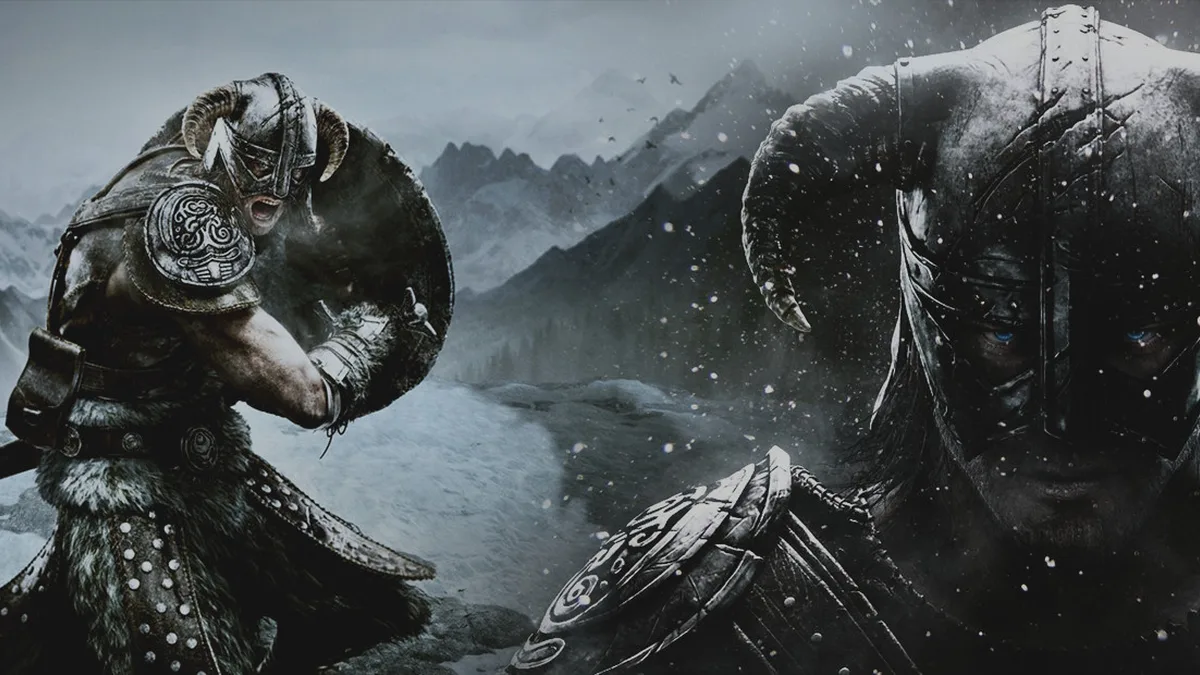
The art core of The Elder Scrolls V: Skyrim is not opulence — it is restraint and unity. One Norse-inspired visual motif runs across the entire map: timber longhouses, stone forts, sheer snow peaks, snow-bent pines, and ruins scattered between them. The game never chases polygon explosions; it builds its far-north desolation through low-saturation cold palettes, wide horizons, and spectacular weather and day-night cycles.
This page skips vague praise and breaks down the elements you can recognize at a glance: architecture, ruins, faction dress, dragons and dragon script, and the HUD. Learn to identify them and you will always know where to point the camera.
1. The Scenery Motifs of Skyrim Province#
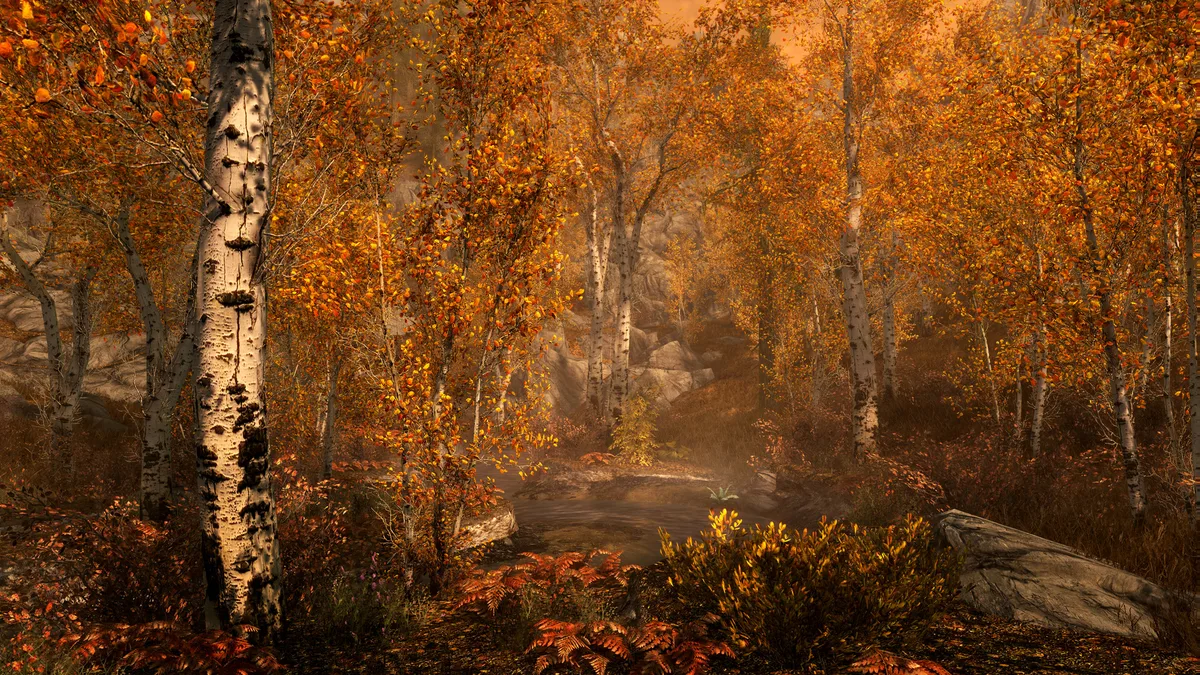
A handful of recurring motifs stitch the map together — wherever you are in the province, you know you are in Skyrim.
| Motif | Representative Areas | Art Features | How to Frame It |
|---|---|---|---|
| Snowy taiga | The Rift, the Pale | Near-black pines massed together, snow on the boughs, clearly tower-shaped crowns | Tree shadow against snow gives high contrast — ideal for cold documentary shots |
| Vertical peaks | Around Windhelm and Winterhold | Steep exposed rock, knife-sharp ridge lines | Low-angle shots exaggerate the mountain’s weight |
| Tundra plains | Whiterun’s plains | Vast grey-yellow grass, boulders and lone trees | Wide horizons suit long-lens composition |
| Marshland | Around Morthal | Low fog, dead trees and pools, grey-green tint | Misty weather brings its own atmosphere |
| Coast and cliffs | Solitude, Dawnstar | Cliffside cities, open sea, distant ice | At dusk the water reflects warm light — a natural warm plate |
Quick rule: most of Skyrim’s diagonal compositions come from the angle between ridges and the skyline. Shooting along the slope or the road shows depth far better than facing a building head-on.
2. Recognizing Nord Architecture#
Nord building style runs through every town — the fastest way to identify Skyrim.
| Part | Common Form | Notes |
|---|---|---|
| Structure | Timber + grey stone | Load-bearing stone below, stacked logs above; grey, brown, and off-white dominate |
| Roofs | Steeply pitched gables | Built to shed snow — the shelter-style slope is the Nord signature |
| Towers and keeps | Square stone towers with crenellations | Dragonsreach in Whiterun and the Blue Palace in Solitude both follow the fortress layout |
| Doors and beams | Heavy timber frames with carved motifs | Beam ends and lintels often carry vine-scroll or dragon carvings |
Player homes, too: at Breezehome in Whiterun or in any Hearthfire build you can see the timber framing, stone chimney, and customizable fittings — the furniture itself is a miniature of Nord country style.
3. Dwemer Ruins: A Mechanical Aesthetic of Metal and Brass#
Where the Nords built wood and stone, the Dwemer left the game’s most distinctive interiors.
| Feature | What You See |
|---|---|
| Materials and color | Brass and bronze metal tones, smooth geometric surfaces |
| Structures | Huge spherical domes, ring corridors, stacked platforms |
| Machines | Automata with rotating heads and steam vents: sphere guardians, four-legged spider constructs, and towering centurions |
| Set dressing | Metal pipes, gears, rails, glowing central consoles |
| Mood | Cold and still, filled with steam and metal groans — a sharp contrast to the damp gloom of Nord tombs |
Shooting tip: Dwemer metal is highly reflective. After entering, use the one light beam from the entrance and let it rake the brass — the texture is superb. Ruin locations are mapped on the World Guide page.
4. Nord Tombs, Draugr, and Word Walls#
Exploring Nord barrows is a window into the game’s death aesthetic: dim stone chambers, dusty sarcophagi, and dragon script carved into the walls.
- Stone doors and mechanisms: barrow doors open by lever and pressure plates, with carved faces and a very ceremonial mechanical grind.
- Draugr: undead ancient Nord warriors in broken iron and hides — slow but numerous, the standard tomb residents.
- Word Walls: every major barrow’s key chamber carries a wall of dragon-script runes — the source of shout words. The runes’ sparse, wedge-like lines are extremely photogenic.
- Dragon Priest masks: deep in the tombs, dragon priests wear distinct metal masks — the most collectible individuals in this art sequence.
5. Faction Colors and Dress#
Each major force carries a distinct palette — one glance at a uniform tells you the side, which also makes faction-standoff screenshots easy to stage.
| Faction | Colors | Dress Signature | Where You See Them |
|---|---|---|---|
| Imperial Legion | Red and white | Standard issue armor with red cloaks, cheek-guard helmets | Solitude and Imperial camps |
| Stormcloaks | Blue and grey | Deep-blue tunics, bear pelts, rugged and hairy | Windhelm and rebel camps |
| Thalmor | Gold and white | White robes with gold accents, disciplined | The Solitude embassy and elven outposts |
| Forsworn | Hides and masks | Tattoos, fur clothing, antlered or bone masks | Wild camps around the Reach |
| Companions | Grey iron | Heavy plate with wolf emblems, grey-iron tones | Skyforge, Whiterun |
| Thieves Guild | Deep brown and black | Hooded cloaks, muted leather | The Ratway, Riften |
Quick rule: for “civil war” shots, visit camps where Imperials and Stormcloaks face off; for “wild origin” shots, find Forsworn hide camps. One warm palette against one cold — the contrast sings together.
6. Dragons and Dragon Script#
Dragons are the game’s largest and most striking visual symbol. Scale colors shift with type and power — pale browns, greys, dark reds, and the skeletal dragon that is bare bone. Whatever the variant, the spread-wing silhouette, the long neck and tail, and the breath from the jaws are the most recognizable shapes in Skyrim’s skies.
The companion symbol system is dragon script: word walls carved into the ground and stone, dragon words materializing mid-air during an attack, and the rune that flashes as you shout. The script’s long strokes and sharp turns hold up even in close-ups. The full word-wall route lives on the Shouts Guide page.
7. The HUD’s Information Layers#
Knowing the HUD’s anatomy is how you hide it cleanly in shots.
| Element | Position | Purpose |
|---|---|---|
| Compass | Horizontal band at bottom center | Heading and nearby location markers |
| Health, Magicka, Stamina | Three vertical bars at bottom left | Your three core resources |
| Hotbar | Numbered slots for weapons, spells, items | Quick swapping via number keys |
| Shout indicator | Icon at bottom center | Current shout and its cooldown |
Once you know the layout: hide the bottom band and the frame instantly cleans up (next section).
8. Taking Clean, Atmospheric Screenshots#
Good Skyrim screenshots come from hiding the HUD and choosing the moment, not post-processing.
| Step | How | Effect |
|---|---|---|
| Hide the HUD | Open the console on PC and type tm |
Removes every HUD element |
| Restore the HUD | Type tm again |
HUD returns |
| Switch view | Press V or scroll the mouse wheel |
Character close-ups or wide environment shots |
| Free camera | Console command tfc |
Move the camera anywhere without moving the character — ideal for dragons and vistas |
| Release the camera | Type tfc again |
Back to the normal view |
Framing rules (these directly raise your keeper rate):
- Chase the light: the hour around sunrise and sunset warms snow and rock and stretches shadows — the best front-light window.
- Chase the weather: blizzards crush visibility and are perfect for desolation; clear post-storm nights show auroras — Skyrim’s signature night sky.
- Mind the angle: shoot dragons and castles from low angles for grandeur; characters within environments hold better at medium-far range.
- Add foreground: a snow-bent pine, a boulder, or a stretch of word wall in front of your subject instantly adds depth.
9. How Time and Weather Shape the Frame#
Skyrim runs a dynamic day-night and weather loop — the reason no visit to the same spot looks the same.
- Aurora nights: on clear nights, green and purple auroras drift over the province — the most dreamlike night scene this far north.
- Weather transitions: clear, overcast, rain, snow, and blizzard blend into one another, and each region has its dominant weather — windy in the Reach, snowy in the Pale.
- Regional light: cold white at noon, warm orange at dusk, blue at night — the same house reads as a different mood by hour.
Use the loop deliberately: wait for a specific weather to reshoot the same scene. That is exactly the value of waiting or console-tuning time between locations.
10. Landmarks Worth a Photo Stop#
| Landmark | Region | How to Shoot It |
|---|---|---|
| The Throat of the World | The peak north of Whiterun | Cloud-wrapped summit — a panorama of the Greybeards’ retreat |
| Whiterun | The central plains | The fortress city from afar, or the plains from Dragonsreach’s battlements |
| The Blue Palace, Solitude | The northwest coast | The cliff city’s silhouette against sea and dusk |
| College of Winterhold | The frozen north shore | The magic tower’s silhouette against the ice |
| Dwemer ruin interiors | Every hold | Metal domes with the entrance light beam |
| Windhelm | The frozen east | Snow-covered ancient walls and hot-spring mist |
11. Going Further with Screenshots#
If you want to push further, all of these directions expand your camera freedom:
- Free camera plus patience: use
tfcwith a fixed wait point — find the light before pressing the shutter. - Multi-character composition: place your follower where the scene needs them, then switch to free camera to set the shot.
- Light post-processing only: Skyrim’s screenshots are already tonally clean — a slight lift in brightness or contrast is enough; heavy grading breaks the cold palette.
- Exit combat first: enemies and warning boxes ruin framing — disengage before composing.