The Last Epoch Core Systems Guide#
Last Epoch splits character growth into six interlocking systems. Each one is simple in isolation; the difficulty is understanding how they feed into each other — why resistance fills should come from forging first, why blessings are more reliable than swapping gear, and so on.
The Six Systems and What They Produce#
| System | What you do in it | What it produces |
|---|---|---|
| Skill trees | Spend skill-specific points on each active skill | A single skill’s behavior and damage make-up |
| Passive trees | Spend points on class and mastery stats and mechanics | The character’s baseline offense and defense |
| Forging | Spend shards and runes to modify gear | Affix tiers and finished equipment |
| Idols | Socket idols into a dedicated grid | Affix top-ups and class-specific bonuses |
| Blessings | Earn permanent bonuses from Timeline bosses | Global attribute and loot gains |
| Factions | Choose self-found or trading | The efficiency and path of gear acquisition |
The recommended order across the six: settle skills and passives first, fill the details with forging and idols, then raise global efficiency with blessings. Doing it in reverse is painful.
System 1: Skill Trees#
Every active skill has its own skill tree. Spending its dedicated points changes how the skill behaves, not just its numbers — the same skill plays completely differently in different hands.
The key constraint: skill tree points can only go to equipped skills, and each skill has its own point cap. So the core build question is “which main skill” — not “how to max everything”.
System 2: Passive Trees#
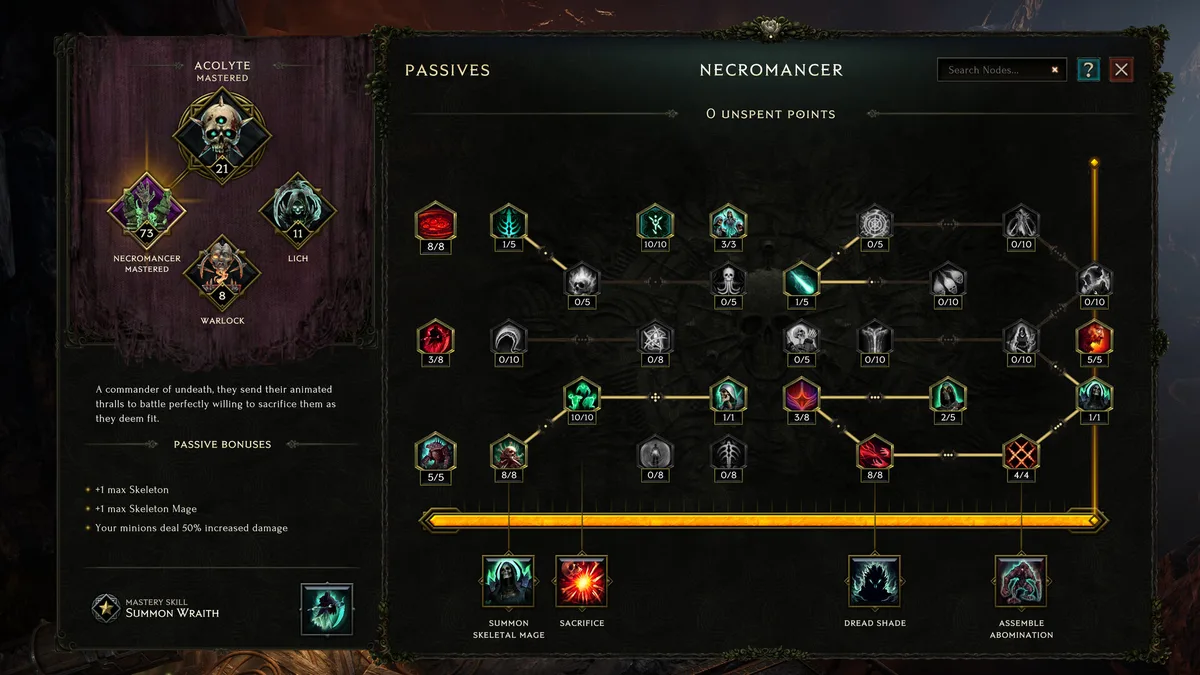
Passives come in two layers: base class passives and mastery passives. Base passives open from the start; mastery passives unlock column by column as invested mastery points cross thresholds.
The classic passive mistake is “spread points everywhere”. Because node unlocks key off total invested points, thinning yourself out delays the nodes that matter and worsens the early game.
System 3: Forging#
Forging is the most distinctive design in Last Epoch. Its core parameter is Forging Potential: every craftable item carries an amount, and every operation consumes some.
| Concept | Detail |
|---|---|
| Forging Potential | The total crafting an item can take; at zero it cannot be modified further |
| Affix Shards | The base material for adding and upgrading affixes — from shattering gear |
| Runes | Items that perform transformative results — shatter, remove, ascend and more |
| Glyphs | Support items that change the outcome of an operation alongside shards or runes |
Because success odds and costs are visible before you commit, you can actively judge whether an operation is worth it. That is the biggest difference from most similar systems.
System 4: Idols#
Idols are a separate item system socketed into a dedicated panel. They come in seven sizes from one to four tiles, and larger idols usually lean toward class-specific bonuses.
Their value is covering the affixes that will not fit on gear. When a key stat refuses to stack high enough anywhere else, idols are usually the easiest fix.
System 5: Blessings#
Blessings come from killing Monolith of Fate Timeline bosses — permanent global bonuses that occupy no gear slot. They exist in normal and empowered versions, with empowered timelines rolling clearly higher values.
The key advantage is reliability. Compared with waiting on a perfect gear drop, raising your global stats through blessings has far more certain returns.
System 6: Factions#
At Chapter 9 you must choose between two item factions.
| Faction | Core system | Suits |
|---|---|---|
| Circle of Fortune | Prophecies that steer drops toward what you want | Players who enjoy finding gear themselves |
| Merchants’ Guild | The Bazaar, server-wide item trading | Time-limited players who want to gear up fast |
The choice can technically be changed, but items obtained while in one faction cannot be equipped after switching — so in practice it is a near-permanent decision.
How Cycles Work#
Last Epoch’s seasons are officially called Cycles. Each Cycle brings its own theme mechanic, new uniques and sets, and Cycle-exclusive activities.
| Concept | Meaning |
|---|---|
| Cycle characters | Characters created within the Cycle — they can only interact with other Cycle characters |
| Legacy | The long-term storage realm characters transfer into after a Cycle ends |
| Cycle mechanic | The season-only gameplay that retires when the Cycle ends |
| Cycle rewards | Usually cosmetic supporter packs — never power |
Notably, the game explicitly promises no pay-for-power: every purchase is cosmetic, and character strength can only be earned in game. A comparatively rare stance in the genre.
The Chain Between Systems#
Understand this chain and you understand Last Epoch’s progression logic:
- Skills and passives settle your damage types and defenses
- Forging raises gear affixes to the tiers you need — resistances and main stats
- Idols fill the few key affixes that will not fit on gear
- Blessings lift your global numbers and drop efficiency
- Factions decide whether you farm gear yourself or buy it at the Bazaar
- Monolith Corruption raises difficulty and rewards, pushing the loop onward
Missing any link shows up the moment you enter higher-Corruption timelines. That is why “master one layer, then advance” beats “spread across all six at once”.
The Layered Order#
The classic beginner error is opening all six systems at once and finishing each at thirty percent. The workable order is layered.
| Layer | First | Then |
|---|---|---|
| 1 | Settle skills and passives | Then plan gear affix directions |
| 2 | Hit resistance and survival targets | Then stack damage affixes |
| 3 | Fill details with forging | Then bring in idols and blessings |
| 4 | Pick a faction | Then optimize endgame efficiency |
The reason is plain: each earlier layer constrains how you choose the next. Damage type undecided, gear affixes cannot be picked; resistances short, loot blessings cash in for nothing.
Seasonal vs Permanent Systems#
| Type | Retires with the Cycle? |
|---|---|
| Skills, passives, forging, idols | Permanent — unchanged across Cycles |
| Blessings, Monolith, dungeons, arenas | Permanent |
| Faction rules | Permanent, with per-Cycle adjustments |
| Cycle mechanics and new items | Updated each Cycle |
The distinction matters: the “true today, possibly stale next year” parts of any guide live almost entirely in Cycle mechanics and new uniques, while the underlying systems keep their value for a long time.