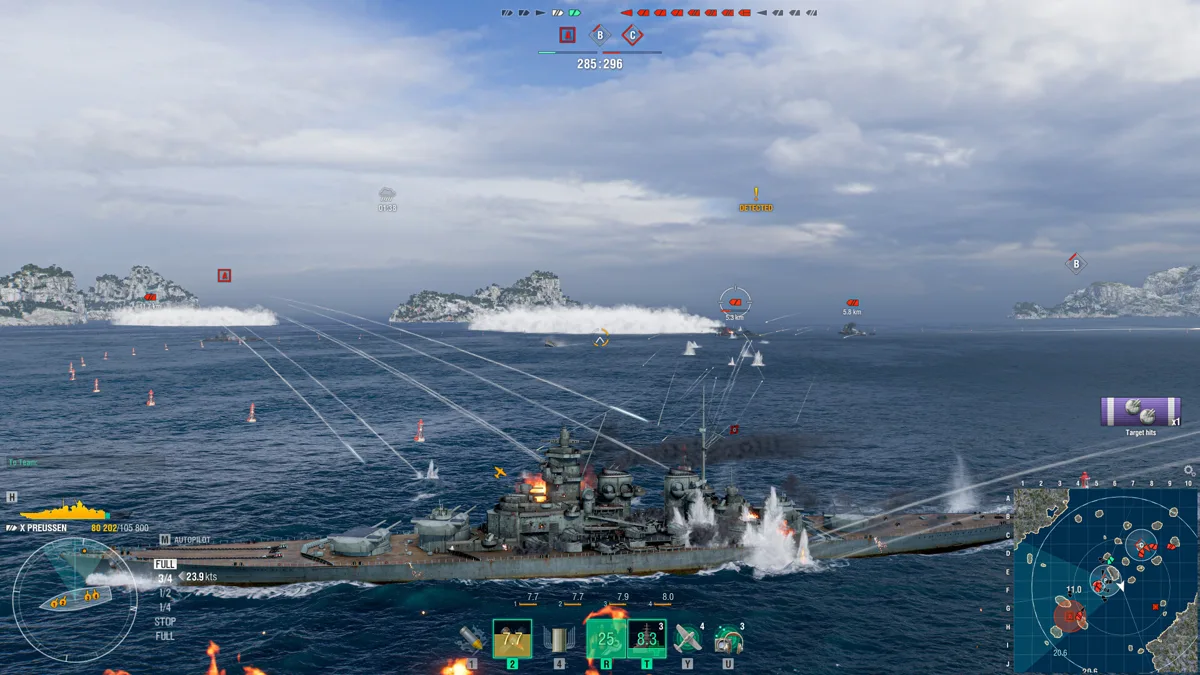
World of Warships Guide Hub: Ships, Combat, Economy#
World of Warships is a team naval combat game developed and published by Wargaming, built around warships from the early twentieth century through the Cold War era. Every battle puts you in command of one ship, and victory comes from capturing and holding key areas, dealing damage, and sinking enemies alongside your team. Unlike shooters that reward raw reflexes, outcomes here hinge on three things: where you position your hull, how your class complements your teammates’ classes, and whether you can steadily convert resources into the next ship on your line.
This section turns scattered official tutorials, mechanics pages, and community write-ups into one executable path: pick a class first, understand the mechanics next, and learn the economy last. Whether you have just installed the game center launcher or have logged hundreds of battles and still cannot afford repairs, there is a clear entry point below.
Per the official developer blog’s eleventh-anniversary coverage for update 15.8, the game first launched in 2015. As of November 2026 the game runs the 15.x series, with update 15.10 released on October 26, 2026. That context explains the game’s stage of life; every mechanical conclusion in this section defers to the official pages for the current version.
What This Game Is Not#
Three misconceptions shape most bad first hundred battles, so clear them before you leave port.
- It is not a twitch-shooter. Shells take real time to travel from barrel to water, so long-range fire demands lead prediction; ships take time to turn, so positioning decisions must be made ten or more seconds before they matter.
- It is not a solo game. A battleship without spotting support can barely land effective shots, and a destroyer without firepower support cannot convert its caps into wins. Class synergy is the core.
- It is not decided in one battle. A single match only pays experience and credits; what actually shapes your experience is tech tree progress and resource reserves, which demand a long-horizon view.
On platforms: the game runs on PC through the official game center launcher and is also on Steam. Your account, premium ships, and resources are one system across both entry points, and switching launchers does not reset progress.
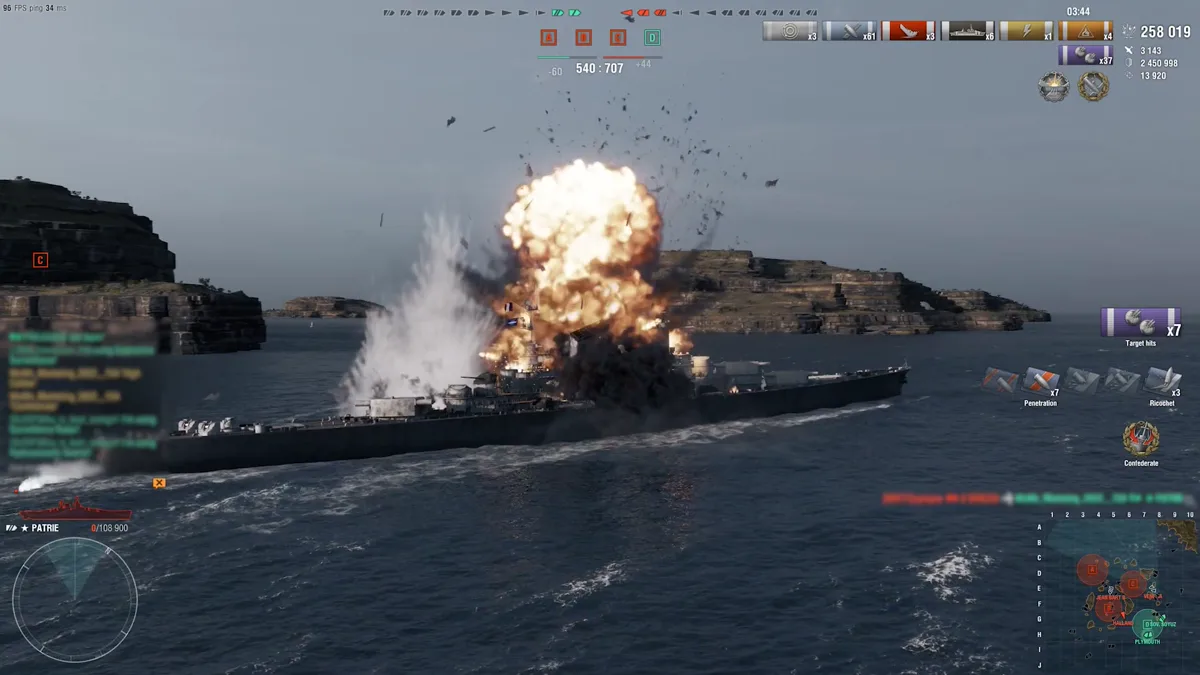
Four Classes and the Submarine Branch#
The game splits playable ships into four classes: battleships (BB), cruisers (CA/CL), destroyers (DD), and aircraft carriers (CV), with submarines existing as a separate underwater branch in the current version.
| Class | Core identity | Team job | Forgiveness | Difficulty |
|---|---|---|---|---|
| Battleship | Thickest armor, highest per-shot damage | Absorb damage, strike from range, press enemy battle lines | Highest | Low, best starting point |
| Cruiser | Firepower plus utility backbone | Anti-air cover, radar spotting, flank pressure | Moderate | Medium |
| Destroyer | Best concealment and torpedoes | Scout, capture points, torpedo ambushes, smoke cover | Lowest | Highest |
| Carrier | Global-perspective aircraft platform | Spot targets, punish stragglers, contest enemy air | Moderate | High, different control scheme |
| Submarine | Underwater stealth approach | Ambush from below, disrupt enemy formations | Moderate | High |
The first piece of advice falls straight out of this table: give your account’s first two hundred battles to battleships. Their armor and hit point pools mean a positioning mistake usually leaves room to recover, while a destroyer that gets spotted and focused can be crippled or sunk within seconds, with no margin to correct.
A carrier is not “a harder battleship” but a different dimension of play: you do not steer the hull directly, you sortie aircraft squads at targets from a global view, and you juggle several squads at once. Treating the carrier as “a ship that shoots by itself” is the most common source of new-player frustration.
The Combat Triangle: Vision, Firepower, Survival#
Core play revolves around the vision-firepower-survival triangle. The three are not equals: vision is the precondition, firepower is the means, and survival is how long you get to keep shooting.
- Vision decides who gets to fight at all. Destroyers use smoke and speed to contest caps while other classes lean on radar and hydroacoustic search consumables. Spotting an enemy lets your team shoot from safety, while staying unspotted lets you choose your fights.
- Firepower is not raw damage stacking but landing correct hits inside the windows when an opponent shows weakness: armor-piercing shells for broadside cruisers and battleships, high-explosive shells for fires, destroyers, and module damage.
- Survival comes from angles and terrain, not from hit point totals. Bow-in play reduces your broadside exposure; showing full side invites citadel hits; angling 30 to 45 degrees can ricochet incoming shells and make your armor work as designed.
The triangle also explains why firing is a priced action in this game: shooting usually raises your detectability, which means trading concealment for output. Knowing when that trade is worth it, and when you must hold fire, is what separates veterans from beginners.
The Economy Skeleton: What Six Resources Do#
In-game resources fall into four layers — general currency, experience, special resources, and clan resources — and understanding the division of labor matters more than memorizing any income table.
| Resource | How it is earned | What it buys |
|---|---|---|
| Credits | Rewarded for positive battle actions | Ship purchases and repairs, modules, upgrades, signal flags, camouflages |
| Ship XP | Earned by the ship that fought | Researching modules and higher-tier ships |
| Commander XP | Earned by the commander who fought | Promoting ranks, learning and retraining skills |
| Global XP | A share of each battle’s total XP converts automatically; XP on elite, premium, and special ships can be converted too | Commander training, researching ships and modules across all nations and branches |
| Doubloons | Purchased, or earned from ranked seasons, campaign missions, events, and containers | Premium account, premium ships, converting elite ship XP, speeding commander training |
| Coal / Steel | Combat missions and containers; exchanged in the Armory | Coal for premium ships, special upgrades, camouflages, flags; steel for rare ships |
| Oil | Clan players only, from clan battles, containers, and Naval Battles | Developing the Naval Base for permanent clan-wide bonuses |
The official economy page lists six categories of positive actions that earn credits, and this list is the most direct answer to “what should I be doing this match”:
- Capturing and defending bases or key areas
- Damaging or destroying enemy ships
- Shooting down enemy aircraft
- Spotting ships, aircraft, and torpedoes
- Potential damage (damage absorbed for your team)
- Assisted damage from spotting for teammates
Note that three of the six have nothing to do with raw damage output. A damage-only playstyle is economically inefficient; capping, spotting, and tanking are stable income streams.
On global XP conversion rates, the official ASIA and CN pages state different figures, so this section prints no unified number — trust your server’s in-game explanation. What is certain: a share of every battle’s total XP converts automatically, and XP earned on elite, premium, or special ships can be converted additionally, with conversion requiring doubloons.
Growth: Commanders, Upgrades, and Economy Boosters#
Ships are vehicles; commanders are the asset that actually accumulates.
- Skill points: the commander skill point cap was raised from 19 to 21 in one version overhaul. Commanders below the cap also earn a small stream of elite commander XP every battle.
- Per-type skill zones: each commander keeps separate skill setups per ship type, and only the zone matching the ship type in battle is active. One commander can hold multiple class loadouts.
- Recommendations and resets: the official skill recommendation system exists, and overhauls have auto-redistributed all commanders’ skills with one free reset offered.
- Elite commander XP: raises commander rank, speeds retraining, redistributes skill points, and can be converted into global XP with doubloons; dismissing unused commanders also refunds part of their XP.
On the ship side, upgrade module slots unlock progressively with ship tier, reinforcing main battery, torpedoes, anti-air, or mobility. For income, economic boosters open at access level 7 in two forms: consumable boosters in four grades (standard, special, rare, unique — one of each type per battle, consumed after) and permanent boosters installable on researched ships from Tier V, which bind to the ship and stack with consumables.
A Steady First Thousand Battles#
Given class forgiveness and the economy structure, a stable opening route looks like this:
- Step one: start with battleships. The US line (Wyoming to North Carolina to Iowa) pairs strong anti-air with balanced armor; the Japanese line (Kawachi to Fuso to Yamato) trades thinner armor for bigger guns and higher per-shot reward.
- Step two: add a cruiser to learn utility. The US cruiser line (Cleveland to Des Moines) is beginner-friendly and its skills include smoke generator and scout aircraft, teaching radar and anti-air duties.
- Step three: learn vision with destroyers. Japanese destroyers specialize in torpedoes while US and Soviet lines gun better; touch this class only after maps and vision rules feel natural.
- Step four: leave carriers and submarines for last. Both demand that you already understand global tempo, or you will float through battles unsure of your own contribution.
- Throughout: do not rush to spend doubloons. Premium account days raise income most directly, then premium ships; converting XP or rushing commander training is usually the worst value.
Where to Go Next#
Three English pages carry the highest-intent questions, and each mirrors a page in the Chinese tree:
- Ship classes compared: BB, CA, DD, CV roles — which class to play first and why
- Beginner roadmap: from your first battle to steady growth — lines, stages, and credit priorities
- Commander guide: skills, ranks, and retraining — the asset that outlives every hull
For everything deeper — main gun ballistics, torpedo mechanics, armor and damage models, concealment rules, credits and doubloons, clans and naval bases, battle modes, glossary and FAQ — the Chinese section of this game carries 24 subpages; start at the World of Warships Chinese hub. Players who want the other side of military online combat can read the War Thunder English hub, which covers combined-arms battles with tanks and aircraft.