WoWS Ship Classes Compared: BB, CA, DD, CV Roles#
The first decision that actually matters in World of Warships is not which ship to buy but which class to train first. Your class sets your operating rhythm, what your team expects from you, and how expensive your mistakes are. Picking wrong does not just cost a few losses — it can bake habits into your first two hundred battles that you will have to unlearn at high tiers.
This page compares the four classes and explains why a battleship is usually the right first line, why destroyers and carriers are poor entry points, and where the submarine branch stands in the current version.
The Four-Class Comparison#
The game splits playable ships into battleships (BB), cruisers (CA/CL), destroyers (DD), and aircraft carriers (CV). The table below lines them up across team role, forgiveness, difficulty, and the typical cost of one serious mistake.
| Class | Core team job | Forgiveness | Difficulty | Typical cost of one bad mistake |
|---|---|---|---|---|
| Battleship | Absorb damage, strike from range, press the enemy battle line | High | Low | Lose a chunk of health, retreat and repair |
| Cruiser | Anti-air cover, radar spotting, steady flank damage | Medium | Medium | Crippled by one battleship salvo, forced to disengage |
| Destroyer | Scout, capture points, torpedo ambushes, smoke cover | Low | High | Spotted and focused, sunk in seconds; team loses vision |
| Carrier | Global spotting, punishing stragglers, contesting enemy air | Medium | High | A squad wiped, no output for a stretch |
The column that matters most is forgiveness. Forgiveness does not mean hit points — it means whether a mistake leaves you a second chance. A battleship that shows broadside usually eats one citadel salvo and retreats to repair; a destroyer in the same position often just dies, because it has neither the armor nor the health pool to absorb a focused barrage.
Battleship: The Right First Line#
Battleships carry the thickest armor and the highest per-shot damage, and that combination makes them the recommended starting class.
- Friendly rhythm: main gun reload and shell travel both take time, leaving gaps to read the minimap and adjust your angle instead of juggling turns, torpedo fans, and enemy vision all at once.
- Correctable errors: overextended positioning or a bad angle usually costs health, not your ship — you can disengage, pop Repair Party, and come back.
- Direct output logic: a well-aimed salvo pays immediately, with no torpedo spreads, bomb drops, or squad management to understand first.
- Clear lines to climb: the US battleship line (Wyoming to North Carolina to Iowa) offers strong anti-air and balanced armor; the Japanese line (Kawachi to Fuso to Yamato) offers bigger guns and higher per-shot reward on thinner armor.
“Forgiving” does not mean you may sit still and shoot. The core battleship discipline is angle management, which its dedicated guide page covers in depth.
Across a battle, the battleship’s job shifts three times:
- Opening: trail your team’s destroyers by one or two ship lengths so they establish vision and you can immediately punish whatever they spot.
- Midgame: hold a position that covers both the capture zones and the enemy’s likely approach, using presence to make opponents afraid to turn — do not chase a single ship out of your line.
- Endgame: if your team leads on health, push and clean up; if it trails, open the range diagonally, because a living battleship deters far more than a sunk one.
All three decisions happen on a ten-plus-second clock, which is exactly why battleships teach positioning so well to newer players.
Cruisers: Light and Heavy Are Different Ships#
Cruisers split into light cruisers (CL) and heavy cruisers (CA), and the two play like different classes; do not train them interchangeably.
| Dimension | Light cruiser | Heavy cruiser |
|---|---|---|
| Main battery | Fast reload, smaller caliber | Larger caliber, slower reload |
| Torpedoes | High torpedo damage, a real output tool | Most lines do not lean on torpedoes |
| Armor | Thin; battleship hits hurt badly | Thicker; can share some battleship duties |
| Typical play | Harass enemy destroyers and battleship flanks | Push front lines, support the battle line, hold caps |
| For beginners | Demands strong positioning and shell selection | Easier, but never sail alone |
A light cruiser’s value is sustained harassment: constant fires from rapid reload, torpedo lanes that make destroyers afraid to contest caps. A heavy cruiser plays closer to a pushing gun platform, with the armor and caliber to stand in a firefight and take over part of the battleship’s damage role.
By nation, US cruisers emphasize radar and defensive firepower, Japanese lines lean long-range, and German lines favor close brawling. The US line from Cleveland to Des Moines is the friendliest entry: its skills include smoke generator and scout aircraft, so one line trains damage, anti-air, and team support together.
Destroyer: Do Not Make It Your First Class#
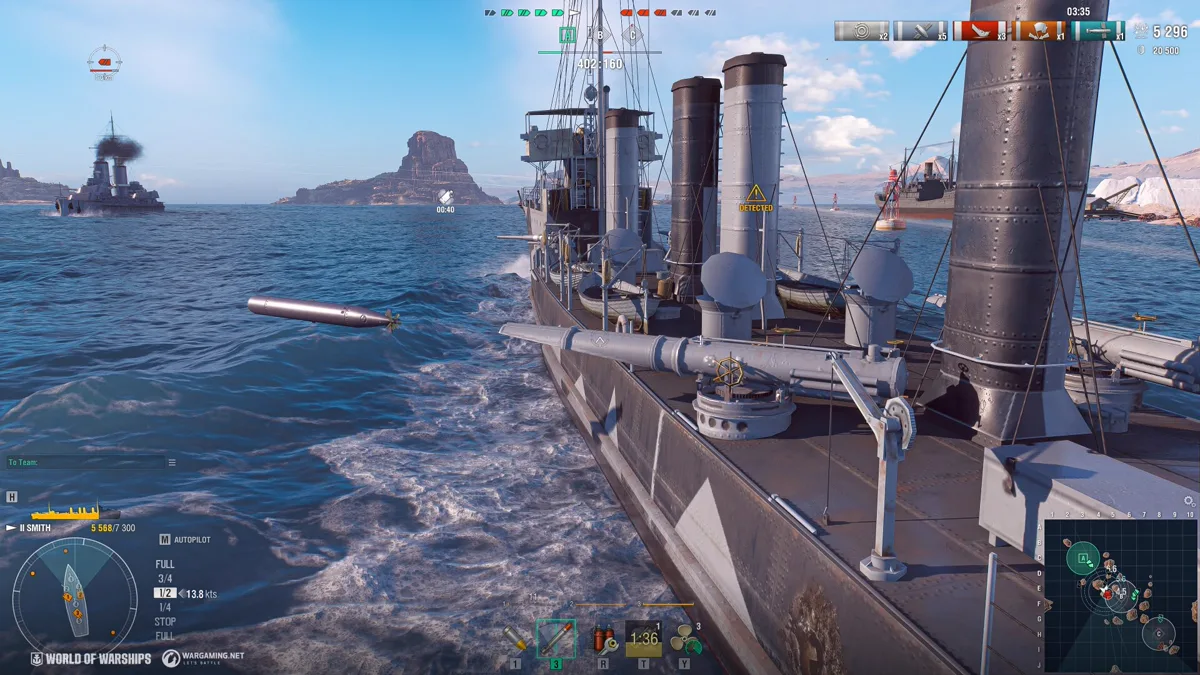
Destroyers are the hardest class to operate: minimal health, minimal armor, but the best torpedoes and concealment in the game. Their core loop — scouting, capping, and torpedo ambushes from stealth — collapses the moment they are spotted.
Putting destroyers first forces you to learn three conflicting skill sets at once:
- Vision management: knowing your detectability range, knowing when firing expands it, and guessing where the enemy destroyer is lurking.
- Torpedo decisions: spreads have width, reload takes time, and one wasted salvo leaves you without deterrence for a long stretch.
- Team coordination: capping needs follow-up firepower, and spotting needs teammates willing to shoot what you light up — neither is guaranteed at low tiers.
If you already have hundreds of battleship or cruiser battles and understand maps and vision, the destroyer becomes the highest-ceiling class in the game. By nation, Japanese destroyers specialize in torpedoes while US and Soviet lines gun better.
Carrier: Not a Ship, a Squadron Manager#
Aircraft carriers do not steer like surface ships. You sortie aircraft squads at targets from a global view and manage several squads at once, which makes the learning curve unlike anything else in the game.
Three differences do most of the work:
- Different control object: you fly the squads; the hull usually stays far back, so surface-ship fundamentals like turning and throttling barely apply.
- Different camera: a global view means you read the whole map — which target is isolated, which lane needs scouting, which squad should recall — not the water ahead of your guns.
- Parallel tasks: strike squads, fighters, and hull positioning all need attention simultaneously, and any one of them slipping drags your contribution down.
So the carrier is a poor first class and a poor second one. The sensible order is battleship to learn surface engagements and map structure, cruiser to learn anti-air and vision, and only then carrier. Note that update 15.7 reworked carrier and anti-air mechanics, so feel in the live version may differ.
Two practical rules for surface ships fighting alongside a carrier:
- Do not turn and flee the instant you are spotted. Aircraft hit retreating targets more easily; keep your heading, make small S-turns, and close on allies with strong anti-air.
- Do not steal kills from your own carrier’s strikes. Confirm the target is actually pinned before committing a full salvo, or switch to the next target.
Submarines: The Current Underwater Branch#
Submarines exist as an independent branch with their own tech tree and supporting mechanics, still expanding with new national lines.
- Identity: an ambush class built around underwater stealth approach — it trades sustained firepower for sudden threat.
- Counterplay: official mechanics pages list submarine surveillance equipment that force-spots submerged submarines in range, plus reserve battery units and enhanced rudder shift consumables.
- Version momentum: Italian submarines arrived as an early-access line in 2026, a sign the branch is still growing.
- Psychological pressure: as long as a submarine may be present, enemy battleships and cruisers must pre-emptively alter course and hold evasion — that is area denial without a shot fired.
- New-player advice: treat it like carriers — learn surface vision rules first, or you will neither deal damage nor understand why you keep getting spotted.
Starting Advice by Player Type#
| Your situation | Recommended first class | Why |
|---|---|---|
| Brand new to naval combat | Battleship (US line) | Slow tempo and high forgiveness free you to learn positioning and shell choice |
| Loves big-gun alpha strikes | Battleship (Japanese line) | Large caliber and high per-shot reward, on thinner armor |
| Wants a utility role | Cruiser (US, from Cleveland) | Radar and defensive firepower plus smoke and scout aircraft |
| Loves close brawling | German cruiser or battleship | German designs lean close-range fighting and secondaries |
| Loves fire damage over time | Battleship (British line) | British designs lean fires and repair |
| Chases high skill ceiling | Destroyer (second or third line) | Best concealment and torpedoes, brutal cost of error |
| Wants global command play | Carrier (fourth line) | A fully different control scheme that rewards prior grounding |
Whichever line you pick, one principle is universal: train mechanics at low tiers, train decisions at high tiers. Making angling, shell selection, and disengagement automatic before pushing up will pay far more than rushing into high-tier rooms and being farmed.