WoWS Beginner Roadmap: First Battles to Steady Growth#
World of Warships, developed by Wargaming, puts you in command of early twentieth century to Cold War era warships. The difficulty of getting into this game is not controls — it is decision density: one battle asks you to handle positioning, angling, shell choice, vision, and consumable timing all at once. So the goal of the beginner phase is not winning; it is cutting the number of decisions down to something you can process.
The most effective way to cut decisions is to pick a forgiving class, climb one stable line, and practice the same set of actions on it repeatedly. This page is built around those three moves, plus a stage-by-stage growth table. It deliberately prints no battle counts, XP figures, or credit amounts — those numbers drift with versions and account states, and hard-coded thresholds only mislead.
Why Battleships Should Be Your First Class#
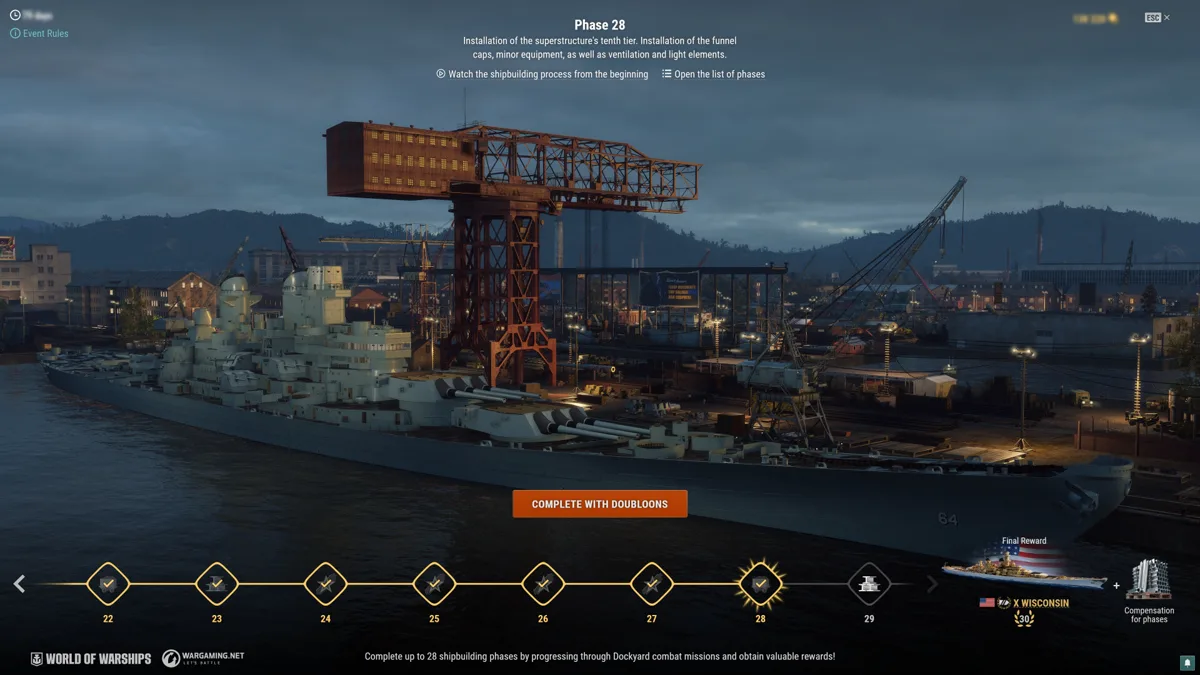
Battleships (BB) carry the thickest armor and the highest per-shot damage, which makes them the recommended starting class. What that really means is: a battleship lets you retreat, repair, and regroup after a mistake — it does not let you ignore angling and eat damage for free.
| Battleship trait | What it means for a new player |
|---|---|
| Thickest armor | A positioning error does not sink you; you have time to correct |
| Highest per-shot damage | One salvo is expensive to aim but pays well, building positive feedback |
| Deep hit point pool with repair | One bad trade does not end your battle; rejoin the line |
| Long engagement range | More time to read the battlefield instead of making instant decisions under fire |
| Long main gun reload | Forces a “judge first, fire second” habit rather than hiding aim problems behind volume |
That last row deserves its own paragraph. A long reload looks like a drawback, but for a beginner it works as a rhythm coach: it refuses to let you probe with constant fire, and it demands that every salvo be preceded by a check of the target’s angle, distance, and your next move. Build that habit once and it transfers to every class you pick up later.
One misconception to clear early: battleships depend on teammates for vision, because main gun range usually exceeds the ship’s own detectability-based spotting range. So a battleship player’s first lesson is not aiming — it is watching where your team’s destroyers are.
Why Destroyers and Carriers Come Later#
Neither of these classes is “slightly harder.” They demand abilities that do not overlap with the foundation a new player has built.
| Class | What it demands | The wall a beginner hits |
|---|---|---|
| Destroyer (DD) | Strongest torpedoes and concealment; core loop is stealth scouting, capping, and torpedo ambushes | Low health, thin armor; once spotted, survival odds are poor — without a feel for concealment and vision you are exposed on entry |
| Carrier (CV) | Does not steer the hull; attacks by sortying aircraft squads | Global camera plus simultaneous squad management; a steep, unfamiliar learning curve |
The destroyer’s problem is the immediacy of punishment. A battleship that mispositions can still limp away; a destroyer that gets spotted usually has no withdrawal window at all. And the value it delivers depends on exactly the skill set a beginner has not built: judging when you would be spotted, when enemy radar or hydroacoustics might be up, and whether islands cut the sightline.
The carrier’s problem is the dimension of cognitive load. Every other class operates one hull; a carrier operates a hull plus several aircraft squads, from a top-down global view instead of a bridge view. Before you understand how classes counter each other, you cannot judge where aircraft should even go.
The sensible order: battleship first for gunnery and positioning, then cruiser (CA/CL) to learn consumables and support duty, and only then destroyer and carrier.
Three Verified Beginner-Friendly Lines#
Climbing one line is valuable because ships on the same line share a style — motions learned at low tiers transfer upward intact. All three lines below have clear sources and distinct personalities; pick one by taste.
| Line | Nation style | Why it suits beginners |
|---|---|---|
| US battleships: Wyoming to North Carolina to Iowa | Strong anti-air, balanced armor | No glaring weakness, so no compensating playstyle to learn around |
| Japanese battleships: Kawachi to Fuso to Yamato | Big caliber, high per-shot damage, thinner armor | Direct firepower feedback that drills angling fundamentals hard |
| US cruisers: Cleveland to Des Moines | Skill tree includes smoke generator and scout aircraft | Full consumable toolkit means many recovery options while you learn support duty |
The choice logic compresses neatly: want the least friction, take US battleships; want the most direct firepower feedback, take Japanese battleships and accept thinner armor; want to learn consumables and team roles early, take US cruisers.
What not to do: climb multiple lines in parallel. Ship purchases, upgrades, and commander training all draw on the same credits and XP, and the most common outcome of parallel climbing is several lines stalled halfway.
The Growth Table: Stage, Goal, Action#
The table below splits progression by how gameplay changes with ship tier, not by battle count or hours. Stage names stay qualitative because progression speed varies wildly between players.
| Stage | What battles feel like | Core goal | Concrete actions |
|---|---|---|---|
| Low-tier familiarization | Few ships, slow tempo, short ranges | Build gunnery and positioning muscle memory | Climb one fixed line; track a single metric each battle: did I show broadside for long stretches? |
| Mid-tier divergence | Class roles sharpen; vision becomes scarce | Understand the vision-firepower-survival triangle | Read teammate positions; confirm target angle before firing; start using consumables deliberately |
| High-tier specialization | Damage and punishment scale together | Polish one ability into reliable output | Review the battle report’s detailed screen; switch shell types by target class; try a second class |
There is exactly one signal for advancing between stages: the metric you set for the current stage no longer requires conscious thought. Low-tier familiarization ends when angling becomes reflex; mid-tier divergence ends when you start predicting opponents’ movement instead of reacting to it.
Where Early Credits Should Go#
Credits are the game’s main currency, used to buy and repair ships and to obtain modules, upgrades, signal flags, and camouflages. Those five directions are the complete list for early spending — there is no sixth.
- Buying ships: required to keep your line climbing; protect main-line continuity first.
- Repairs: incurred every battle, a fixed cost — never skip sorties to save repair bills.
- Modules and upgrades: module slots unlock with tier, and higher tiers open more slots; equip your main ship fully before side projects.
- Signal flags: performance items purchasable with credits; use them for battles that matter.
- Camouflages: purchasable with credits, mixing appearance with performance properties.
The classic mistake is scattering credits across multiple lines before you have even picked a main class. Credit income depends on positive battle actions — capturing and defending key areas, damaging or destroying ships, shooting down aircraft, spotting ships, aircraft, and torpedoes, potential damage, and assisted damage — but spending is immediate, and scattered purchases are hard to claw back.
Two Long-Term Income Levers#
Once you clear the low-tier stage, income shifts from “how much did I play” to “how much does one battle pay.” Two levers do most of that work.
- Economic boosters open at access level 7, raising the experience, credits, global XP, and commander XP a battle pays out.
- Permanent boosters install from Tier V. They bind to a specific researched ship, raise its credit and all three XP yields, are never consumed in battle, and stack with consumable boosters.
- Consumable boosters come in four grades — standard, special, rare, unique. One of each type can be installed before a battle and is consumed after; holding more of the same type auto-installs the next.
- Joining a clan lets you upgrade the Naval Base for permanent bonuses. Base upgrades run on oil, a resource only clan players earn.
- Premium account days round out the list of battle-reward boosters.
| Lever | Unlock condition | Income character |
|---|---|---|
| Consumable economic boosters | Access level 7 | One-time use; save for key grind battles |
| Permanent boosters | Installable from Tier V | Bound to a ship, long-term, stackable |
| Clan and Naval Base | Join a clan and contribute | Permanent bonuses covering the whole clan |
Priority among the three: join an active clan first, because it costs nothing extra and is permanent; install a permanent booster on your main ship next; keep consumable boosters for the battles where you are actually pushing a line.
Where This Fits in the Section#
- Ship classes compared: BB, CA, DD, CV roles — the full class-by-class comparison behind this route
- Commander guide: skills, ranks, and retraining — how the long-term asset layer works
- The World of Warships Chinese hub — 24 subpages covering economy, mechanics, and every class guide