World Lore Deep Dive#
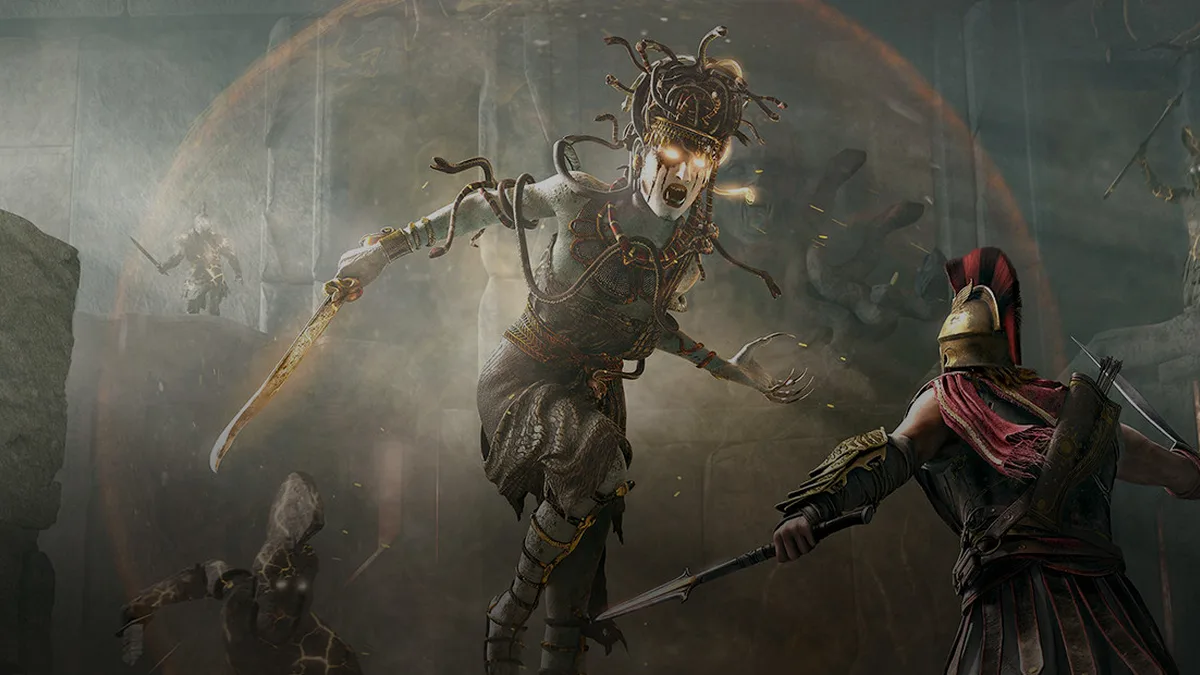
Assassin’s Creed Odyssey drops you into the Greek world on the eve of the Peloponnesian War, then buries a layer of Isu science fiction beneath that history. This page lays out the historical backdrop and the Isu setting, and gives the full upgrade table for the Spear of Leonidas (the Isu spear) — the spear’s level directly determines the core parameters of the combat system, and every player should know it inside out.
Ancient Greek Historical Background#
The Peloponnesian War#
| Item |
Details |
| Period |
431 BC - 404 BC |
| Belligerents |
The Athenian alliance against the Spartan alliance |
| Game’s timeframe |
Roughly 431 BC, the opening stage of the war |
| Cause of the war |
Athens’ rise puts Sparta on guard |
| Outcome of the war |
Sparta wins in the end (the story only covers the early phase) |
| Figure |
Role |
Portrayal in game |
| Perikles |
Leading Athenian general |
Major ally, host of the symposium |
| Socrates |
Philosopher |
Dialogue and philosophical debate |
| Hippokrates |
“Father of medicine” |
Can heal the protagonist |
| Kleon |
Athenian politician |
Antagonist, Cult member |
| Aristophanes |
Comedy playwright |
Comic interactions |
| Alkibiades |
Athenian general and politician |
Romance option |
| Alkidas |
Spartan general |
Military ally |
| Leonidas |
King of Sparta |
Memories of Thermopylae, previous owner of the Spear of Leonidas |
Greek Geography in the Game#
| Game region |
Real-world counterpart |
Historical importance |
| Attika |
The Attika peninsula |
Heart of the Athens city-state |
| Lakonia |
Lakonia |
Heart of the Sparta city-state |
| Phokis |
Phokis |
Home of the Sanctuary of Delphi |
| Elis |
Elis |
Olympia stadium |
| Boeotia |
Boeotia |
The ancient city of Thebes |
| Korinthia |
Corinth |
The Isthmus of Corinth |
The First Civilization (Isu)#
Overview of the Isu Civilization#
| Item |
Details |
| Origin |
A sapient civilization far older than humanity, later revered as gods |
| Technology |
Far beyond humanity’s current level |
| Creations |
Humans, Pieces of Eden and other artifacts |
| Signature ruins |
Atlantis and Isu installations scattered around the world |
| End |
Ended by the Toba Catastrophe together with the human rebellion |
| Figure |
Role |
Relation to the protagonist |
| Hephaistos |
The Isu smith god |
His Forge (the Ancient Forge) can upgrade Isu artifacts |
| Aletheia |
Guardian of the Staff of Hermes |
Uses the staff and visions to guide the protagonist through the trials of Atlantis |
| Poseidon |
The Isu god of the sea |
Ruler of Atlantis in The Fate of Atlantis expansion |
| Hades |
The Isu lord of the underworld |
Ruler of the underworld realm in the expansion |
| Hermes |
The Isu messenger |
Original owner of the Staff of Hermes |
| Aphrodite, Hera and others |
Members of the Isu pantheon |
Mentioned in the expansion and series lore |
Isu Artifacts#
| Artifact |
Portrayal in game |
Series connection |
| Spear of Leonidas |
The protagonist’s heirloom, a upgradable core weapon |
An Isu creation, kin to the Pieces of Eden |
| Apple of Eden |
Mentioned in several quests |
Core artifact of the series |
| Staff of Hermes |
Core item of the expansion |
Grants its holder immortality |
| Atlantis |
Core location of the expansion |
Ruins of the Isu civilization |
| Pyramid artifact |
Symbol of the Cult’s soul’s power |
An Isu device for controlling minds |
Spear of Leonidas Upgrade Path#
The Spear of Leonidas has 6 levels in total and requires 5 upgrades to max out. Upgrades happen at Hephaistos’s Ancient Forge on Andros Island and consume Artifact Fragments obtained by killing Cult of Kosmos members.
Key points of the upgrade mechanic:
- The spear’s level determines three things: the maximum number of Adrenaline segments, the amount healed after using an ability, and the usable ability wheels plus maximum ability levels.
- The level 2 upgrade happens automatically during the main quest “Awakened Memory”, so there is no need to travel to the Forge specially; every other upgrade requires going to the Ancient Forge on Andros in person.
- Artifact Fragments can only be obtained from Cult of Kosmos members, and every member on the hunt list drops one.
| Level |
Upgrade method |
Artifact Fragments required |
Adrenaline segments |
Ability healing |
Unlocks |
| Level 1 |
Starting state |
— |
4 segments |
+5% |
Ability level 1 |
| Level 2 |
Automatic during the main quest “Awakened Memory” |
— |
5 segments |
+6% |
Ability level 2 |
| Level 3 |
Ancient Forge upgrade |
3 |
6 segments |
+7% |
Unlocks the second weapon wheel, Warrior ability level 2 |
| Level 4 |
Ancient Forge upgrade |
7 |
7 segments |
+8% |
— |
| Level 5 |
Ancient Forge upgrade |
9 |
7 segments |
+9% |
Ability level 3 |
| Level 6 |
Ancient Forge upgrade |
22 |
8 segments |
+10% |
Fully maxed, unlocks the “Legendary Revival” achievement |
Additional notes:
- “Ability healing” refers to healing a percentage of your maximum health after spending one Adrenaline segment on an ability; the ratio rises with each spear level.
- The three fragment upgrades require 3+7+9+22 = 41 Artifact Fragments in total; the Cult roster has 42 members (including the hidden Cult’s soul), so hunting all of them yields enough fragments to cover every upgrade with a slight surplus.
- Spent fragments cannot be refunded, so before maxing out, leave no gaps in the Cult hunt, especially among the branch leaders.
- The ability level cap at each rank follows the actual unlock notices in the in-game skill tree; the game may adjust numbers slightly with version updates, and the table above is baseline data cross-checked between the community and official guides.
Forerunners of the Assassins and Templars#
The Cult and the Roots of Assassin Ideals#
| Organization |
Position |
Goal |
Later development |
| Cult of Kosmos |
Order and control |
Control Greece by manipulating events |
The seed of Templar ideals |
| Anti-Cult factions |
Freedom and choice |
Resist the Cult’s manipulation of Greece |
The seed of Assassin Brotherhood ideals |
| Aspasia |
The Cult’s soul (mastermind behind it) |
Manipulates the war “in the name of creating order” |
The one who finally reveals the truth of the Cult |
Place in the Assassin’s Creed Timeline#
- Roughly 75,000 years ago: the Isu civilization at its height
- Roughly 75,000 years ago: the Toba Catastrophe ends the Isu civilization
- Roughly 431 BC: the story of Assassin’s Creed Odyssey ← you are here
- Roughly AD 873: the story of Assassin’s Creed Valhalla
- Series entries and lore material differ in how they date Isu chronology; the list above uses the “how many years before the modern day” measure, and exact years follow the official setting.
Cult Organizational Structure#
Cult Branch Structure#
| Structural level |
Content |
| Mastermind behind it |
The Cult’s soul, whose identity is revealed step by step along the main story |
| The seven branches |
Eyes of Kosmos, Champions of Kosmos, Peloponnesian League, Delian League, Vein of Silver, Gods of the Aegean, Worshippers of the Bloodline |
| Roster size |
42 members in total (including the Cult’s soul), each tracked down through a chain of clues |
Cult members are the only source of upgrade materials for the Spear of Leonidas, so “hunting the Cult” is both a story line and the mandatory route to strengthening the protagonist. Clues in each branch usually lead from low-ranking members to higher-ranking leaders, and killing a leader unlocks deeper hidden members.
Reach of Cult Infiltration#
| Field |
Portrayal in the story |
| Athenian politics |
Politicians like Kleon are manipulated by the Cult and profit from the war |
| Course of the war |
The Cult stokes and prolongs the Peloponnesian War from behind the scenes |
| Economy |
Controls silver mines and trade routes to amass wealth |
| At sea |
Funds pirates and fleets to raid Aegean shipping lanes |
Greek Mythology and the Game#
Mythical Creatures and Where They Appear#
| Mythical creature |
Location in game |
Mythological origin |
| Cyclops |
Kephallonia |
The Cyclops of Homer’s epics |
| Kalydonian Boar |
Phokis |
The legend of Artemis’s hunt |
| Nemean Lion |
Argolis |
The Twelve Labors of Herakles |
| Sphinx |
Boeotia |
The riddle monster of the Oedipus legend |
| Medusa |
Lesbos |
The three Gorgon sisters |
| Minotaur |
The labyrinth on Crete |
The legend of King Minos’s labyrinth |
| Hydra |
Leader of the Cult’s “Gods of the Aegean” branch |
The Lernaean Hydra |
Temples and Sanctuaries#
| Sanctuary |
Location |
Role in game |
| Temple of Apollo at Delphi |
Phokis |
The Pythia priestess, closely tied to the Cult |
| Temple of Zeus at Olympia |
Elis |
Olympia stadium |
| Parthenon in Athens |
Attika |
Athenian landmark, political center |
| Temple of Artemis on Naxos |
Naxos Island |
Aegean exploration hub |
Isu Civilization Glossary#
| Term |
Explanation |
| Isu |
A sapient species appearing long before humanity, the “Precursors”, later revered as gods |
| First Civilization |
The series’ other name for the Isu civilization |
| Toba Catastrophe |
The astronomical disaster that destroyed the Isu civilization, a key node in the series’ cosmic history |
| Pieces of Eden |
Artifacts made by the Isu that can influence minds and nature; the Spear of Leonidas belongs to this class |
| Isu DNA |
The high-concentration Isu genetic material preserved in some human bloodlines, a prerequisite for using Isu artifacts |
| Sage |
A human inhabited by the reincarnated consciousness of an Isu, appearing in several series entries |
Detailed History of the Isu Civilization#
Timeline#
| Period |
Event |
| Golden age (roughly 75,000 years ago) |
The Isu rule the Earth and build wonders such as Atlantis |
| Creation of humanity |
The Isu create humans as an obedient workforce |
| Human-Isu war |
Adam and Eve steal an Apple of Eden and humanity launches a massive rebellion |
| Toba Catastrophe (roughly 75,000 years ago) |
An astronomical disaster (a solar flare) devastates the Isu; war and disaster together end Isu rule |
| Aftermath |
Surviving Isu grow ever fewer, and their image evolves in human memory into mythical gods |
| Odyssey era (roughly 431 BC) |
Isu ruins and artifacts lie scattered across Greece, forming the core of the main story and The Fate of Atlantis expansion |
Series entries and lore material do not date the Isu chronology entirely consistently; the table above uses the relative measure of “how many years before the modern day”. The main story setting sits roughly 75,000 years after the Toba Catastrophe, and exact absolute years follow the official setting.
Isu Technology#
| Technology |
Description |
Later influence |
| Genetic engineering |
Creating and modifying humans |
Isu DNA lingers in human bloodlines |
| Consciousness and memory tech |
Storing and revisiting memories |
The setting origin of Animus technology |
| Supernatural power |
Influencing minds and nature through artifacts |
The source of the Pieces of Eden’s abilities |
| Immortality |
The Staff of Hermes keeps its holder ageless |
Kassandra’s centuries-long life |
| Megastructures |
Atlantis and underground facilities worldwide |
The core stage of The Fate of Atlantis expansion |
Myth and Reality Interwoven#
How the Game Handles Myth#
| Mythical figure |
Treatment in game |
| Hydra, Medusa, Minotaur and others |
Appear as legendary beasts or mythical bosses, dropping unique loot when defeated |
| The Olympian gods |
Appear as Isu in The Fate of Atlantis expansion (for example Poseidon and Hades) |
| Artifacts such as the Golden Apple |
Isu creations, continuing the series’ tradition of “myth is Isu technology” |
Tip Understanding the lore directly affects how you build your character: every upgrade of the Spear of Leonidas is real, tangible combat power, so hunting Cult members for fragments is the most cost-efficient growth route early on. And the series’ core conflict — freedom versus order — is expressed in this game as the struggle between the anti-Cult factions and the Cult of Kosmos.
— Long Zhuiri, Editor-in-Chief, NTGame