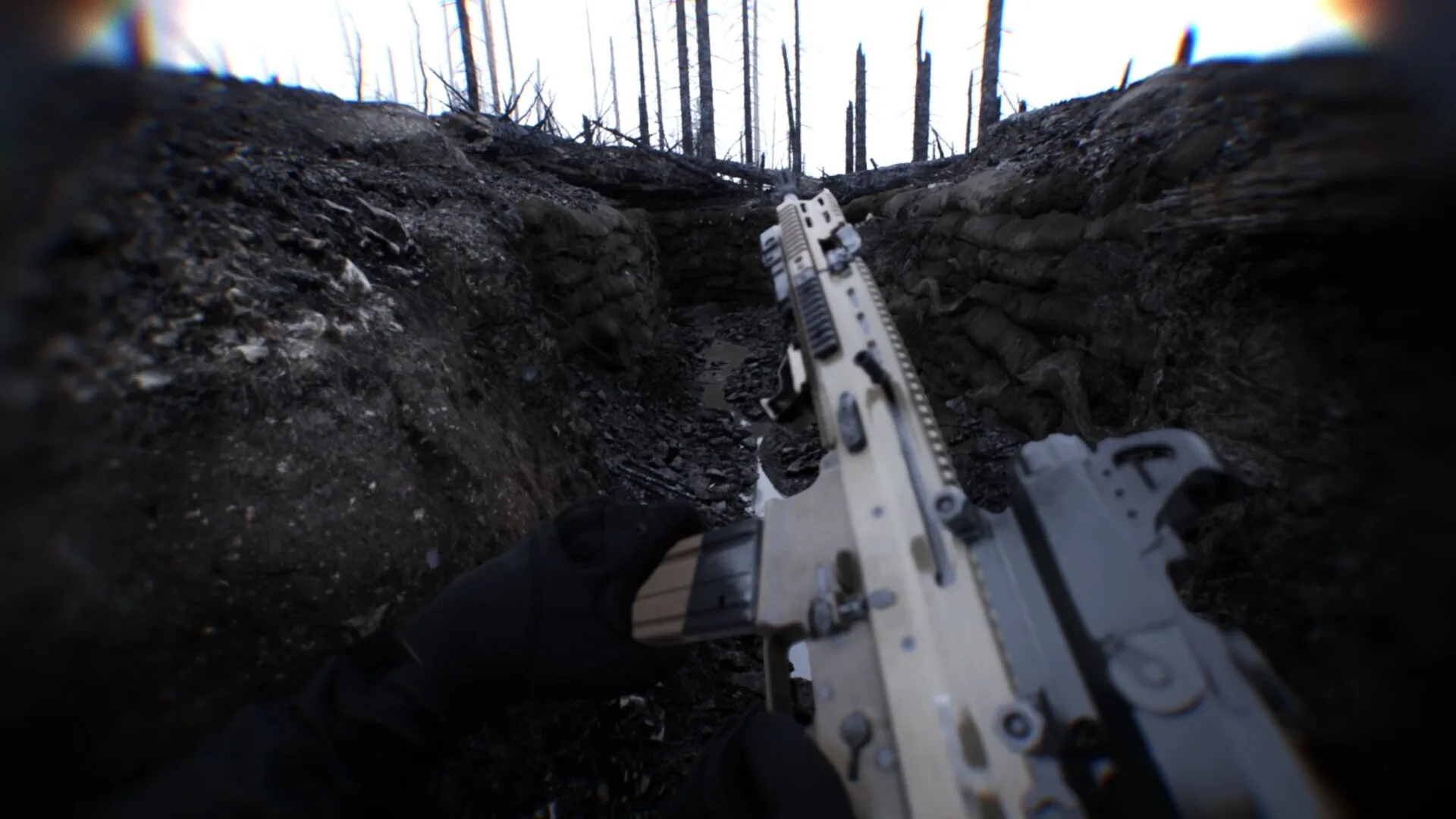
Bodycam Weapons and Loadouts: Crates, Primaries, Secondaries#
Bodycam builds its shooting on a body-cam perspective with no fixed crosshair, so hit judgment leans on hip-fire feel and ADS rhythm. Inside that frame, where guns come from and how you pair them decides how fast a match goes from spawn to first kill — and whether you keep your nerves in a close-quarters encounter.
The v0.9 update of November 13, 2026 rewrote weapon acquisition. Weapon crates now drop guns with random attachments, and a new crate type with its own look delivers the primary and secondary from your saved loadout. The same version raised saved loadout slots from five to seven, making “bring a plan into the match” a real option. This page works through the two crate types, primary/secondary division of labor, and how the crossbow and machine pistol changed the pool.
Written as of v0.9 and the November 16 v0.9.1 hotfix. Player-tested details are flagged as such; unpublished numbers stay unpublished.
Weapon Crates: Random Attachments, Flashlight Almost Always#
The weapon crate is the most direct source of guns. From v0.9, crate weapons arrive with random attachments — and because basic attachments remain in the pool, most crate guns come with a flashlight attached. That matters most in the Trenches map’s storm-and-fog night and the Asylum’s full-blackout special wave, where illumination stops being a luxury and becomes a near-guaranteed accessory.
| Element | v0.9 rule | Match impact |
|---|---|---|
| Drop content | Gun with random attachments | Usable on pickup, no separate attachment hunt |
| Attachment pool | Includes basic attachments | Plain rolls happen; keep expectations roomy |
| Common result | Most crate guns carry a flashlight | Lighting is available in dark scenes most of the time |
| Randomness | Attachment combos vary | The same gun can feel different crate to crate |
The flashlight’s near-guarantee also cuts the risk of misreading targets in the dark. Trenches storms and fog compress sightlines; the Asylum’s blackout wave turns interiors black. In both, a crate-included flashlight often decides whether you spot an incoming zombie in time. Since basic attachments are in the pool, though, plan around “usually a flashlight,” not “always.”
The practical reading: a weapon crate is a certain gun plus uncertain attachments. You can predict the gun, not the combo. Treat crates as a way to fill your primary and secondary slots rather than fishing for one ideal build — especially since hand-shake in the body-cam view means attachment feel needs live adaptation anyway.
Loadout Crates: Own Look, Your Exact Loadout#
Alongside weapon crates, v0.9 added a look-distinct loadout crate. It delivers the primary and secondary of your currently selected loadout — nothing random: whatever you preset in the loadout menu gets dropped into the match.
- Distinct look: visually separable from weapon crates, so you can prioritize it in cluttered scenes.
- Deterministic content: your preset primary and secondary, ideal for players who bring a plan.
- Zombies bonus: v0.9 added two loadout crate positions on the Asylum, making it easier for a four-man team to re-arm on plan.
- Pairs with seven slots: the richer your presets, the more a loadout crate is worth.
| Aspect | Weapon crate | Loadout crate |
|---|---|---|
| Look | Generic | Distinct |
| Content | Gun + random attachments | Current loadout’s primary and secondary |
| Certainty | Gun fixed, attachments random | Fully fixed |
| Main use | Live improvisation | Execute your preset |
The two crates complement rather than replace each other: one supplies variance, the other certainty. Knowing which to crack first matters — in the time-boxed Trenches with its announcer calling the clock, taking the deterministic loadout crate usually beats rerolling weapon crates.
Dividing Primary and Secondary#
With no crosshair and a camera that amplifies hand-shake, loadout building should answer one question: who carries the main fight, and who covers reloads and point-blank surprises.
- Primary: mid-range engagements, favoring guns that feel stable both hip-fired and aimed; avoid guns that only work at one distance band.
- Secondary: the bridge when the primary runs dry or something gets in your face — speed of draw and forgiveness first.
- By mode: Deathmatch, Team Deathmatch, and duo duels run fast and reward quick-reacting builds; four-player Zombies faces sustained hordes and rewards staying power and easy resupply.
- By map: the Trenches is a dark-conditions endurance fight; Village and Asylum each have their own special waves, so leave room in the build for those moments.
Engagement distance is the underrated factor. The body-cam field of view is already narrow, and ADS narrows it further, so the primary suits fights where you’ve confirmed the threat direction, while the secondary handles things that appear at arm’s length. Factoring this in trims the hesitation when you swap mid-fight.
To be clear: these are heuristics. No official optimal loadouts exist per mode, and community recommendations drift with patches — your own feel through the body-cam lens is the final judge.
v0.9 Pool Additions: Crossbow and Machine Pistol#
Two additions materially changed what a loadout can contain.
| Weapon | Status change | Since |
|---|---|---|
| Crossbow | Promoted from a Village hidden-content reward to a regular selectable weapon, now also placed on PvP maps | v0.9 |
| Machine pistol (model name kept in-game) | Added to the secondary pool | v0.9 |
Before v0.9 the crossbow only appeared at the end of the Village map’s hidden content — unobtainable in ordinary matches. Making it selectable and putting it on PvP maps means a loadout slot can finally hold it on purpose. The machine pistol widens the close-range backup options. Their detailed roles and trade-offs deserve their own treatment; here they simply extend the primary/secondary framework.
In loadout terms: the crossbow breaks the assumption that a primary must be a conventional firearm, and the machine pistol adds a close-quarters answer for the secondary slot. Seven slots give both weapons room to be tested without cannibalizing a finished build.
Five Slots to Seven: Why It Matters With the Crates#
Raising saved loadouts from five to seven looks like a small number change until it compounds with the crate rules.
- Per mode: enough room for one preset each for Deathmatch, Team Deathmatch, duo duels, and Zombies — no re-configuring between queues.
- Per map: the three zombie maps differ sharply in environment; a tailored preset per map is now feasible.
- With loadout crates: more presets means the “deliver my current loadout” mechanic fires closer to what the situation needs.
- New-weapon sandbox: spare slots absorb crossbow or machine pistol experiments without touching your main builds.
A pragmatic start for new players: pin two of the seven slots as “general PvP” and “general Zombies,” then specialize for Trenches, Village, and Asylum as you learn them. Even before you’ve built for a special wave, the loadout crate keeps your spawn kit solid.
Think of the seven slots and loadout crates as one design: slots give breadth of planning; crates turn a plan into a spawn kit. That’s why both landed in v0.9 — slots without a reliable delivery route would be shelf-ware, and crates with only five slots couldn’t cover the map and mode spread. Together, they make loadout prep a real phase of a Bodycam match.
Resupply Rhythm per Zombie Map#
All of this cashes out on specific maps, and the three zombie maps want different pickup tempo.
| Map | Environment | Resupply notes |
|---|---|---|
| Trenches | Storm, lightning, and fog at night; ten-minute timer | Supply crates scatter randomly per match; jumping and vaulting are available to reach them |
| Village | Nonstop church bells; new sprinter-only special wave | Lighting, materials, audio, spawns, and zombie behavior all rebuilt in v0.9 |
| Asylum | Special wave brings full blackout, alarms, red emergency lights; sprinters mix in from wave two | v0.9 added two loadout crate positions; the interface flags when power returns |
Win conditions also split: the Asylum and Village have no officially published final wave, while the Trenches is won by outlasting the ten-minute timer. The first two reward endurance-friendly resupply; the Trenches rewards tripping between taking guns and holding ground inside a clock.
In the Trenches, randomized crate placement means no fixed pickup coordinates — routes get rebuilt as the countdown moves. The announcer calls the clock at start and at five, two, and one minutes remaining, which is your resupply cadence; vaulting and jumping add some mobility on approach. On the Asylum, the two added loadout crate positions give deterministic re-arm spots, so a team that knows them stays on plan even through a blackout wave — and the power-restored notification is worth watching. The Village’s endless bells and sprinter-only wave ask you to track sound cues while you arm up. Point and tactic details above are community-tested and shift with patches; trust the live match.
Related pages
- Bodycam Guide Hub — modes table, v0.9 overview, timeline.
- Bodycam Beginner Guide — hip-fire, ADS, and sound fundamentals.
- Bodycam Zombies Mode — the three maps and v0.9 pacing rules in depth.