Pikmin 4 Oatchi Guide: Riding, Smashing Obstacles and Leading Squads Alone#
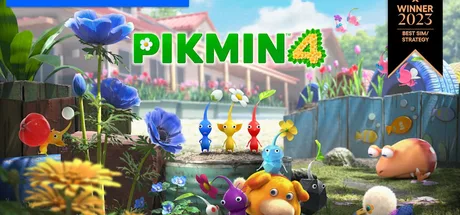
Alongside the series’ long-standing throw, whistle and pluck trio, Pikmin 4 hands the player a space dog who leads squads of his own: Oatchi. He is not a tenth Pikmin type beyond the nine — he stands beside the custom captain and the Rescue Corps as an independent unit, carrying the captain across the map, smashing what blocks the road, and taking a Pikmin squad to handle distant obstacles and resources without you. Understanding what Oatchi can and cannot do is the precondition for running the ~13-minute day smoothly.
The official store page and multiple references confirm: Oatchi smashes obstacles, hauls heavy loads, carries the captain as a mount, and grows through training upgrades; he can also leave the captain’s side and lead Pikmin on his own — a second command line advancing in parallel on the same map. Those abilities spread across riding, smashing, hauling, squad-leading and growth, and reading any single line understates his value inside the thirteen-minute day.
This page peels the layers one by one — positioning, the ability list, solo squad-leading, training growth, the carry-capacity blank, and the interlock with squads and caves. All figures stay inside the fact card’s verified range; anything appearing only in secondhand references stays qualitative, the blank stated plainly, so no unsourced number ever drives your three-type squad planning.
Oatchi’s Position: Not a Tenth Pikmin Type#
The store page names all nine types one by one — Reds fireproof, Blues amphibious, Yells conductive, Ice freezing, Glow night-fighting, Purples carrying, Rocks shattering crystals, Winged flying, Whites fast and toxic — and Oatchi is not on that list. He arrives with the Rescue Corps as a companion unit inside the main line of the custom captain, the mothership (S.S. Shepherd) repair and the S.S. Beagle castaway rescues; he is never thrown, never plucked, and never counted against the three-type squad rule.
- The nine types cap at three per sortie, the rest waiting in reserve; Oatchi stands outside that rule as a separate command unit.
- The captain throws Pikmin onto targets and whistles them back; Oatchi takes orders instead — the two operate at different command layers.
- Captain, Pikmin squad and Oatchi form three separable advance lines — this game’s command structure versus Pikmin 3’s three explorers.
- He never joins by being plucked from the ground; only Pikmin need plucking.
| Comparison | The nine Pikmin types | Oatchi the space dog |
|---|---|---|
| Counts against three-per-sortie | Yes | No — independent unit |
| How they join | Plucked from the ground | Story companion from the start |
| Can be thrown | Yes, onto targets | No |
| Recalled by whistle | Yes | Responds to commands instead |
| Can carry the captain | No | Yes — ridable mount |
| How they grow | Grown and plucked in numbers | Upgraded through training points |
Read the table and the misread disappears: Oatchi is not “a stronger Pikmin” to squeeze into a lineup. He adds a command dimension, not a type-matchup dimension — water still needs Blues, electrified gates still need Yellows, and freezing plus night fights still belong to Ice and Glow Pikmin alone.
Riding, Smashing, Hauling: the Ability List#
The clearest view of the fact card’s confirmed abilities is a single table. Smashing answers passages blocked by rubble and brittle walls; hauling answers the heavy resources no single Pikmin budges; riding moves the captain between daily landing sites without whistling the whole squad into formation each time.
| Ability | What it does in game | Fact-card sourcing |
|---|---|---|
| Riding | The captain mounts Oatchi to travel, cutting transit between landing sites | Verified — official store page |
| Smashing obstacles | Charge-tackles brittle walls and blockages, opening the way for Pikmin | Verified — multiple references |
| Hauling heavy loads | Carries the big pieces, a second lifting line beyond Purple Pikmin | Verified — multiple references |
| Solo squad-leading | Leaves the captain’s side and runs a Pikmin squad independently | Verified — multiple references |
| Remote orders | Takes action commands even with the captain elsewhere | Qualitative, drawn from solo leading |
| Charge attack | Aims a charge with the charge-aim controls | Tied to the free update’s settings |
| Training upgrades | Raises the above abilities through points | Verified — multiple references |
| Microphone voice commands | Call, charge and praise via the console’s mic | Official wording, separately covered |
The first six rows are core original-game uses; the last two arrive with the free update and the November 12, 2026 next-console edition (per Nintendo Hong Kong’s announcement) — written together so the ability line’s growth stays visible. Smashing and hauling both trade one unit for the whole squad’s time, the same advance-planning spirit Dandori formalizes.
Purple Pikmin carry ten times a normal Pikmin’s strength and weight and haul heavy loads too — but slowly. Oatchi’s value is merging lifting, smashing and riding into one independently commandable line, so pushing one big resource never drags all three squad types across the map. The tradeoff shows most on days when archive logging and resource recovery run in parallel.
Solo Squad-Leading and Remote Orders: One Command Line Becomes Two#
Leading a squad alone is Oatchi’s most underrated ability. The captain handles resource recovery, archive logging and Rescue Corps progress; Oatchi takes a Pikmin squad across the map to smash a wall or move a load — two lines advancing through the same thirteen minutes. That is the Dandori concept made operational.
- Whistle-muster works on the squad near you; Oatchi’s detached squad keeps working on orders without being pulled back.
- The charge-aim arrow speed gained a normal/precise toggle in the free update — precise mode lines up both Pikmin charges and Oatchi charges better when commanding from afar.
- A second player can join anytime on cursor control for throwing and aiming, stacking with Oatchi’s solo line without breaking a solo save.
- The next-console edition adds mic voice commands — call, charge, praise — without pausing, so remote orders skip the menu.
- Remote orders stay qualitative per the fact card: Oatchi takes commands and acts independently; no distance or range figures are filled in.
Pair solo leading with the whistle-center-point setting and the picture sharpens: the muster point can anchor on the cursor or the player character — you decide what the recall action circles — while Oatchi’s squad advances on its own orders. Two lines, each covering its segment; that is the command freedom that separates this game from the first’s 30-day structure and Pikmin 2’s cave rhythm.
Training Upgrades: How Oatchi’s Growth Line Runs#
The fact card confirms Oatchi upgrades through training points, a growth line bound to training projects — the very thing that separates him from Pikmin, who grow by being grown. Spending points into riding, charging and hauling directly changes how much round-trip time he saves on a given day.
| Growth dimension | The Pikmin way | The Oatchi way |
|---|---|---|
| Quantity | Grow from blooms and wild creatures, pluck to expand | One companion throughout |
| Strength | Type matchups — Purples carry ten-fold | Training-point upgrades |
| Trigger scenes | Throw, whistle, haul, bridge | Riding, smashing, solo leading, charging |
| Training link | No separate training line | Points bind to training projects |
The payoff shows only on real terrain: against a smashable blockade, charge upgrades beat bringing an extra Purple; against water and electrified gates, Blue and Yellow type abilities win and Oatchi replaces nothing in the nine-type matchup grid. This page keeps to the framework — per-project training usage and mic commands live on their own page.
Rewind, the Field Camera and Roll Over never conflict with training either: rewind rewrites one day’s decisions, training reshapes Oatchi’s long-run performance — different time scales, no need to reset training investment for a rewind.
The Carry-Capacity Blank: Why No Number Appears#
How many Pikmin can Oatchi carry? The fact card answers with restraint: the store page says he carries the captain and Pikmin — no number; one secondhand reference mentions a specific cap, but it sits on the unverified list. Within this section’s fact boundaries such figures either carry a source-grade label or stay out entirely; this page chooses the latter and keeps it qualitative.
- First-hand sourcing: rides and squad-hauling confirmed; no capacity count listed.
- Secondhand sourcing: one reference mentions a specific cap, uncorroborated by the store page — no number filled.
- Relation to the 13-minute day: any real cap also interacts with the three-type rule and the squad’s current size — it cannot be discussed in isolation anyway.
- The unverified list equally bans carry weights, throw damage, boss counts and names, cave-floor lists — none touched here.
- The demo cannot use dog commands per Nintendo Hong Kong; the voice-command rows assume the full version.
The blank exists so secondhand numbers never drive lineup planning. What actually moves daily efficiency: how the three types compose, whether to re-set the squad before a cave, where the whistle center anchors — not an unsourced capacity. Treasures-per-stage totals and full-collection conditions stay blank for the same reason.
The section’s source grading, restated: the Nintendo store page and Nintendo Hong Kong announcements are first-hand and support mechanics directly; media transcriptions of official patch notes are near-first-hand, labeled as transcriptions; single-secondhand figures flagged on the unverified list degrade to qualitative. Oatchi’s capacity sits in the third tier — hence no number, and no row in any ability table.
The same grading governs throw damage, boss counts and cave-floor lists: not nonexistent, just lacking a source precise enough to table. Hold the blanks, and everything remaining — each type’s ability, the 13-minute day, the three-per-sortie rule — checks against the store page line by line.
Oatchi with Three-Type Squads and the Pre-Cave Check-In#
However strong Oatchi gets, the three-types-per-sortie rule stands. So the pre-cave squad adjustment decides three things at once: which three types come, how many wait in reserve, and which segment Oatchi runs in parallel. Caves are the Pikmin 2-style multi-floor puzzle-and-combat stages; in-cave time flows without that game’s urgency — sorting squad and Oatchi roles before entry beats whistling everyone around mid-cave.
| Decision point | Daylight on the surface | Before entering a cave |
|---|---|---|
| Time pressure | ~13 real minutes per day; nocturnal creatures after dark | In-cave time flows, no urgency |
| Squad | At most three types, rest in reserve | Adjustable before entering |
| Oatchi’s role | Riding, parallel smashing and hauling | Reassigned per the cave’s puzzles and fights |
| Mustering | Whistle when close | Sort the squad pre-entry to cut cave retracing |
Night stages — the tower-defense-like maps restricted to Glow Pikmin — show the same boundary: Oatchi does not replace the Glow pack’s light-orb stunning. He is the standing command line that spans day, night and caves. With that boundary clear, rewind, the Field Camera, Decor Pikmin and the rank badges all read correctly — Oatchi is never one more swappable resource.
From a starting region like Sun-speckled Terrace, out through the multiple daily landing sites, into caves and night stages, Oatchi stays the line that consumes no three-type slot yet always needs its own orders. Understanding that beats memorizing any secondhand number.