9 Kings Guide Hub: Nine Kings, 130+ Cards and Builds That Break the Game#
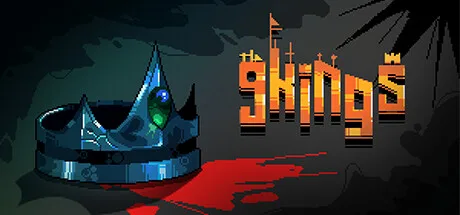
9 Kings is a card-driven grid city builder from developer Sad Socket, published jointly by Hooded Horse and Sidekick Publishing. It entered early access on May 23, 2025 and shipped its 1.0 release on November 12, 2026. You place buildings and troops on a grid, cast spells, stack cards from different kings into a single engine, expand your realm and fend off enemy kings that attack year after year — with the explicit design goal of stacking numbers until the game breaks.
The 1.0 launch brought a visible heat wave. Per SteamDB, the daily peak climbed from 976 players on November 11, 2026 to 5,540 on November 15 — roughly 4.7x growth in five days and the month’s high point. Review counts differ by source and capture date: SteamDB and SteamStat record about 21,000, PCGame about 22,500, and every source agrees on a 92% positive rating. All figures are mid-November 2026 captures; they move with patches and aggregation windows, so cite them with their timestamps.
This section splits into four boards — getting started, the nine kings, systems, and modes — twenty-four pages covering the whole road from a first run to a build that breaks the game at high difficulty. First-time players should read the beginners board in order; players who already know the loop can jump straight to a king or a combo page. The full navigation follows, and every page is reachable from this directory.
How to Use This Section#
- Check the timestamp before the number. Card, decree and perk counts are 1.0-era in-game figures; online and review data carry their own source and capture-date labels.
- Check what kind of source it is. King names, card names and unlock conditions come from the official wiki and community references, labeled where they first appear so you can weigh them yourself.
- Follow the naming rules. Each king and key card keeps one English name used consistently after first mention; community combo names are shorthand, not official terms.
- Jump by need. Getting-started pages are the foundation; systems and modes are the advanced layer. Search directly for your current pain point instead of reading everything in order.
These conventions apply to all twenty-four pages and are not repeated on later pages.
The 1.0 Snapshot#
First, the base figures that recur across the section, so the body text does not have to re-explain them. Scale numbers below are 1.0-era in-game counts; entries with source labels should be read according to their labels, not as official pronouncements.
| Item | Fact | Sourcing note |
|---|---|---|
| Content scale | 130+ cards, 140+ decrees, 110+ perks | 1.0-era, as counted in game |
| Playable kings | 9, each with a signature starting card and decrees | Per the official and community wikis |
| Game modes | Classic single-player, asynchronous multiplayer, Quest, Joker — four total | Per official and community sources, as of 1.0 |
| Challenge count | Quest mode: 9 kingdoms x 9 challenges = 81 | 1.0-era, as counted in game |
| Release and price | Early access May 23, 2025; 1.0 on November 12, 2026; 50% launch discount | Price returns from $9.99 to $19.99 |
| Platforms | Windows and macOS, Steam Deck verified | Per third-party sources; awaiting official confirmation |
One reminder before you internalize these: the all-time peak of 13,850 concurrent players happened in June 2025, during early access — not after 1.0. Sales and revenue figures circulating online come from third-party estimation models, not official disclosures. Where the aggregations disagree, the performance and FAQ page lays out the divergence in detail.
Clarifying the timeline also explains where each feature came from. The table below lists the key dates that shaped this section’s structure; everything before 1.0 was carried into the release version.
| Date | Event | Effect on the content |
|---|---|---|
| May 23, 2025 | Early access launch | Around 81 cards at the start — the baseline for all scale numbers |
| November 21, 2025 | Patch #19 | Quest mode added with its 81 challenges |
| September 16, 2026 | Official date announcement | 1.0 enters countdown |
| November 11, 2026 | Patch #18 | Rainbow content, reworks and blessings |
| November 12, 2026 | 1.0 release | Cards grow past 130; 50% launch discount |
| November 15, 2026 | Daily peak 5,540 | Per SteamDB, the month’s heat high point |
The 24 Subpages, in Four Boards#
Boards A through D follow the learning path: A builds the foundation, B maps the kings, C adds the growth systems beyond cards, and D covers the four modes plus the performance FAQ. Paths point to real pages in this section.
Board A: Getting Started — Survive the First Run#
These four pages are the foundation of the whole path. Read them in the order “play the first run — understand the loop — read the grid — learn the cards” and the early game stops being confusing.
| Page | Theme | What it solves |
|---|---|---|
| Beginners Guide: Your First Run | How to open the first run | First-year flow, why the King of Nothing fits beginners, interface and turn structure |
| Core Loop: Build, Years, Auto-Battles | Building, years and auto-battle | Placement, adjacency, enemy attacks, winning a card or paying for a loss |
| Grid Layout and Adjacency | Where tiles earn the most | The blacksmith’s four tiles, the farm’s random pick, deliberate empty spaces, move planning |
| Card System: Types, Draws and Tiers | Types, draws and three tiers | The four card types, tier-up economics, specializing the core, win-drawn cards and the base pool |
The classic early mistakes are spreading resources across a pile of tier-one cards, and failing to reserve space for cards that move or remove your own units. The pages above each carry the corresponding fix.
The reading priority of Board A is rhythm first, names second: establish the “year advances — enemy attacks — one choice after battle” cadence before memorizing specific cards. The King of Nothing’s opening kit — the Castle, Archer, Paladin and Soldier — is the most straightforward; run it through the first few years, then branch out.
Board B: The Nine Kings, One by One#
Nine playable kings ship with distinct starting decks, themes and unlock milestones. The overview page is the entry point; the table below links each king’s own page, and the unlock order below it is the cheapest route to a full roster.
| Page | King | One-line role |
|---|---|---|
| The Nine Kings Overview | All | Names, identities, castle cards and unlock milestones at a glance |
| The King of Nothing | King of Nothing | Balanced starter pick; strong Soldier and Paladin damage scaling |
| The King of Spells | King of Spells | Enchants and spells, amplified through the Library; wants other kings’ cards |
| The King of Greed | King of Greed | Gold economy; hoard and snowball — strong late, weak to early rushes |
| The King of Blood | King of Blood | Sacrifice and self-destruction; the widest summon playstyle |
| The King of Nature | King of Nature | High HP, huge armies, exponential growth, a strong base tower |
| The King of Nomads | King of Nomads | Moving tiles, mounts and dragons; the castle itself is a unit |
| The King of Stone | King of Stone | Towers and fortification, leaning on buildings; almost no troop scaling |
| The King of Progress | King of Progress | Tile upgrades and sci-fi troops; sensitive to pacing and card order |
| The King of Time | King of Time | Rewinds and cooldowns; the highest ceiling and the hardest to pilot |
Beyond the nine, two enemy-only kings exist: the Rainbow King appears once in every standard run, and beating it offers a pick of one special card; the Chaos King’s deck is an upgraded variant of the other kings’ cards. Unlock progress persists across runs, and your king choice also restyles the interface colors, background music and map look.
The unlock conditions themselves form a beginner route: the King of Nothing is available from the start, and the King of Spells, King of Greed and King of Blood open one by one through milestones like casting 9 spells, spending 999 gold, and killing 9,999 enemy units. For the least-effort order, check the milestone table on the overview page first, then decide which king each run should train.
Board C: The Systems Behind the Cards#
Once a single card and a single king make sense, what caps your ceiling is the layer beyond cards: troop-and-building synergy, the long-term growth of decrees and perks, spell and enchant triggers, the gold economy — and the game-breaking builds that assemble all of it.
| Page | System | Focus |
|---|---|---|
| Troops and Buildings | Positioning and synergy | Division of labor, buff coverage, farm and blacksmith spots, tiering the core |
| Decrees and Perks | Long-term growth | 140+ decrees, 9 per king, 110+ perks (1.0-era) |
| Spells and Enchants | Triggers and amplification | Static, combustion, sacrifice; Library amplification and spell timing |
| Economy and Gold | Operations rhythm | Rogues, mercenaries, vaults, Midas-style effects; defend early, burst late |
| Game-Breaking Builds | Combo thinking | Seven community combos, cross-king multiplication, no hardcoded multipliers |
The game-breaking page carries this section’s loudest claim: stacking numbers until the game breaks is a design goal in 9 Kings, not an exploit. The specific combos shift with balance patches, so treat them as directions rather than fixed recipes.
The combos with the widest community circulation include the Golden Death Ray (the King of Greed’s Palace, Beacon and distributor buildings multiplying each other), the Lightning Library (Spell and Time kings’ wizards, Static, the Library and the rail card), the Imp Blood Engine (the King of Blood’s Demon Altar, Imps, Graveyard and Farm) and the Time Loop (the King of Time’s Portal and rewinds). These names are community shorthand; exact multipliers live in game.
Board D: Four Modes and the Performance FAQ#
Besides classic single-player, the game ships an asynchronous multiplayer ladder, Quest challenges and Joker’s custom decks — plus one page of spec and FAQ answers covering the late-game army stutter and the data divergences.
| Page | Mode or topic | What it solves |
|---|---|---|
| Classic Mode | Classic | Structure, challenge difficulties, facing unchosen kings and your own rebels |
| Multiplayer Ladder | Asynchronous multiplayer | Attack-defense mechanics, ladder decks, common defenses |
| Quest Mode | 81 challenges | 9 kingdoms x 9 challenges; added in Patch #19, folded into 1.0 |
| Joker Mode | Custom decks | Mix starting decks across kings, custom rules, combo practice |
| Performance and FAQ | Specs and answers | System requirements, army stutter, data and sourcing divergences |
Quest mode arrived before 1.0 — added as a brand-new way to play in Patch #19 on November 21, 2025 and only integrated into the release version now; it doubles as one of the main king-unlock lines. Armies larger than four units occasionally stutter or lock up in the late game, a known pain point rather than your hardware’s fault.
The four modes have distinct jobs: classic is the mainstream year-by-year game, asynchronous multiplayer attacks other players’ kingdoms to climb the ladder, Quest mode is puzzle-like fixed scenarios, and Joker lifts deck and rule restrictions. Beginners should drill the loop in classic, validate combo ideas in Joker, then take a finished build to the ladder or high difficulty.
Quick FAQ#
The questions new readers ask most, one-line answers first; each linked page expands in full.
- Who should lead the first run? The King of Nothing — unlocked from the start, with direct Soldier and Paladin damage scaling that teaches the loop. See the beginners guide.
- Why did my buff not apply? Most likely the building sits out of range of its target, or the farm’s bonus was randomly dealt to another adjacent unit. See the grid layout page.
- Level one card high or many a little? Push a core card to tier three first — spreading resources across several tier-one cards is weaker. See the card system page.
- Is a lost year wasted? Not wasted, but a loss only draws from your own base pool; beating an enemy king steals one of its cards. See the core loop page.
- Why do review counts disagree? Outlets captured at different dates with different windows; the positive rate matches at 92% while absolute counts differ. See the performance and FAQ page.
- Which mode is best for practice? Joker mode lets you customize decks and rules — the quietest way to test combos; classic mode carries dozens of challenge difficulties for real runs. See the Joker and classic mode pages.
- How do I get other kings’ cards? Beating an enemy king steals one of its cards, so the kings you face decide what your run can collect; Joker mode mixes starting decks directly. See the core loop and Joker mode pages.
- What about the late-game stutter? Very large armies occasionally stutter or lock up — a known pain point; spec and optimization notes live on the performance and FAQ page.
- What did 1.0 actually add? Cards grew past 130, Quest mode joined the release version, and the scale now lists 140+ decrees and 110+ perks — all 1.0-era in-game counts.
These are summaries only; every linked page carries the fuller mechanics and the sourcing labels for specific names and numbers. When a card name or a figure looks off, go back to the body text and check what kind of source stands behind it.