Getting Started: The Ten Pre-Disaster Hours#
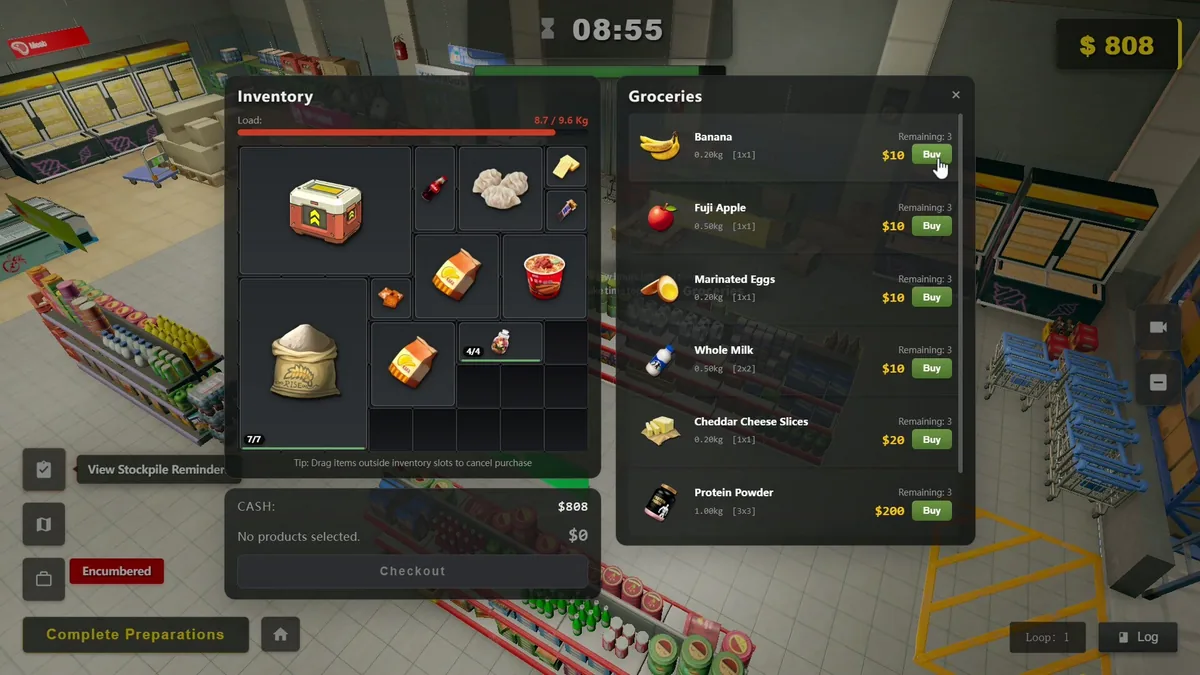
Every run of Survival Log starts from the same point: your character is reborn knowing exactly that the zombie apocalypse arrives in ten hours. Those ten hours are your only shopping and preparation window, and how you spend them decides whether the first night is survivable. This page is for first-time players: read the interface first, then learn the rhythm, then dodge the most common traps. For the game’s overall structure see the Chinese overview page.
Read the Interface First: Five Elements That Matter#
All of the pre-disaster pressure comes from a handful of HUD elements. Do not sprint to the shops yet — spend one minute learning these:
| HUD element | What it does | What beginners miss |
|---|---|---|
| Countdown | Time left until the outbreak — the single most important number | It never pauses, so even shopping trips split your attention |
| Cash | Spendable money, the only hard currency for purchases | When it runs out you are not helpless — scavenging and favors still progress |
| Carry weight | The pre-disaster backpack has a weight cap, about 9.6 kg in the sample scenario | Fill it with heavy items and the critical supplies will not fit |
| Task list | Guides what the current phase wants from you | Beginners ignore it and wander the aisles aimlessly |
| Journal | Logs events, encounters and leads, including neighbor interactions | Key setups like meeting the college girl live here — miss it and you lose the unlock line |
Treat the task list as your spine: when you do not know what to do next, checking it always beats wandering.
A Three-Phase Plan for the Ten Hours#
You do not need to run the same checklist every loop, but this skeleton keeps you from starting loose and finishing panicked:
| Phase | Main task | Minimum requirement |
|---|---|---|
| Opening (first third) | Read your home, set fortification goals, finish one basic shopping trip, greet neighbors | Know your floor plan and your remaining cash |
| Middle (half) | Hit the four store types in priority order, secure core furniture and bulk goods | Food and water secured, defense taking shape |
| Final stretch (end of countdown) | Empty the backpack to make room for the zero-yuan spree | Finish at least the first two stops of the spree route |
The split is a reference, not a law: once you know the map the middle phase can shrink a lot. On your first life, though, three phases beat freeform improvisation. The full spree route is in Pre-Disaster Shopping.
What to Do in the First Hour#
The first hour is not about buying everything — it is about three things done right:
- Read your home and its routes. What kind of housing do you have, where are the doors, how does the stairwell run, is the rooftop reachable? This decides the fortification plan and the post-disaster escape route. Floor plans are covered in Safehouse Building and Layout.
- Do one nearby shopping trip. Walk to the closest store and solve two problems: something edible and something that blocks a door. Basic food and water plus one defensive or utility item. Do not try to buy it all — your carry weight will not allow it.
- Greet your neighbors. Pre-disaster neighborliness is cheap and pays for a long time: goodwill converts into post-disaster aid and trading. Some character unlocks also depend on this line, see the Chinese characters page.
By the end of hour one, the ideal state is: one trip of basic supplies hauled home, a fortification plan in your head, and at least one neighbor who knows your face.
A Realistic First-Life Goal: Survive Day One#
Many beginners burn their first life chasing a “perfect loadout” and are still stuck between shelves when the countdown hits zero. Lower the bar:
- The passing grade for life one is surviving the first post-outbreak day — not a full storeroom, not a farming corner.
- Death is not a failure state: you bank experience by days survived and inherit starting supplies and skills. That is the entire point of the Roguelite loop.
- In life one, observe more and decide less: watch how the horde moves, how neighbors help each other, how trades trigger. All of it survives death with you.
Players who treat the first life as reconnaissance consistently shop faster in the second; players obsessed with a perfect haul tend to fumble the end of the countdown.
Beginner Mistakes to Avoid#
| Mistake | Consequence | Fix |
|---|---|---|
| Shopping with no plan | Cash burns out, key supplies missing | Set priorities before entering any store — see Pre-Disaster Shopping |
| Ignoring carry weight | Heavy items hog the pack, food and medicine get left behind | Leave heavy hauls for later trips; check the weight bar before every departure |
| Missing the zero-yuan window | The best loot opportunity of the run evaporates | Memorize the route order: supermarket, renovation supplier, farmers’ market |
| Never talking to neighbors | No post-disaster aid, unlock lines broken | Bank goodwill early — the rope pulley and return gifts both depend on it |
| Fixating on one perfect weapon | Neglecting the food and water basics that keep you alive | Solve eating and shelter first; a serviceable weapon is enough in life one |
| Treating the journal as decoration | Missed encounters and leads, broken unlocks and trades | Flip through the journal every time you get home — it costs seconds |
“Missing the spree” hurts the most: it is the developer’s compensation window for every player, and it is worth cutting your shopping short to keep the final minutes free for it.
Keyboard and Mouse Habits#
Survival Log is Windows-only, so keyboard and mouse are the default inputs. The pre-disaster pace is tight and shop interactions are dense, so build these habits:
- Confirm your keybinds in settings before starting. Movement, backpack, interact and journal — finding a keybind mid-crisis is lethal.
- Keep the backpack panel one muscle-memory press away. The shopping loop is “check weight — triage — continue”.
- Aim before you confirm interactions. Highlight the target before pressing on shelves, doors and neighbors to avoid wasted purchases.
- Use the task list to navigate. It usually points at the target location and beats memorizing store layouts.
After Your First Life#
Once you survive day one, this order of study pays best:
- Review the mistake table above, focusing on the spree and carry weight.
- Study purchase priorities and the four store types in Pre-Disaster Shopping.
- Try the second character to feel the crafting-vs-farming split — see the Chinese characters page.
- Start zoning your safehouse with Safehouse Building and Layout.
- To compare the genre, see our best survival crafting games ranking.