Pre-Disaster Shopping: Priority and the Zero-Yuan Spree#
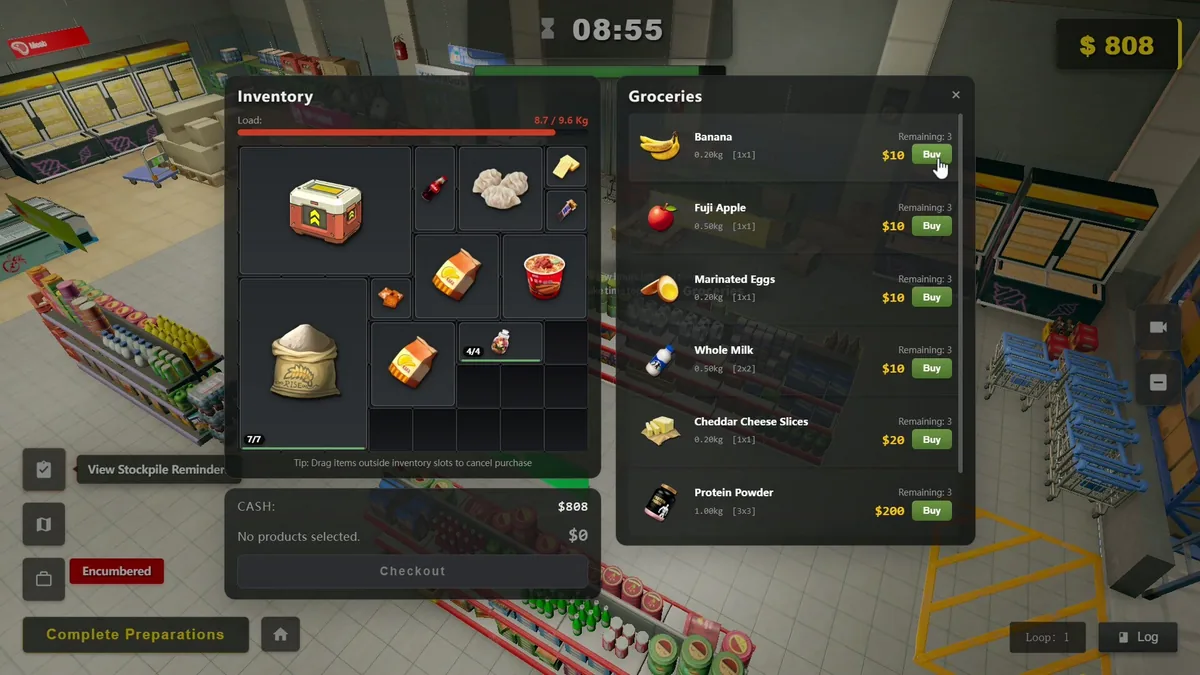
The ten pre-disaster hours are the highest decision-density phase of Survival Log: limited cash, a limited backpack and a merciless countdown, all while you run a route between the supermarket, hardware store, renovation supplier and farmers’ market. This page covers the complete shopping strategy from raising money to the final spree. For interface basics and the first hour see Getting Started.
Raising the Startup Fund#
Using the office worker’s opening as the example: you need ¥1,680 of startup cash. Three sources cover it:
| Source | Notes | Advice |
|---|---|---|
| Starting funds | Cash the character begins with | This is your reserve — save it for the big-ticket targets |
| Your wallet | Money the character carries personally | Easy to forget; count it before you plan loans |
| Neighbor loans | Borrow from neighbors pre-disaster in a pinch | Borrowing also builds goodwill — two birds with one stone |
Do not treat fund-raising as pure errand-running: every loan thickens the neighbor line, and the rooftop pulley rescues, return gifts and exclusive supplies after the outbreak all grow out of these small pre-disaster favors. Character and money differences are detailed on the Chinese characters page.
Purchase Priority#
The community consensus on ordering is clear — mobility first, survival second, production last:
- Buy the used car first. Mobility is the most valuable currency in a ten-hour countdown: with a car, multi-trip hauling, cross-district shopping and post-disaster relocation all become possible. This is the universally agreed first purchase.
- Then core survival furniture: the bed, the air conditioner, the titanium security door. Bed manages recovery, AC manages the environment, the titanium door manages defense — these three are the foundation of the safehouse, analyzed in Safehouse Building and Layout.
- Finally, farming prep. At the farmers’ market, pick up the full-spectrum hydroponic station and seeds to lay the groundwork for post-disaster food self-sufficiency. The farming line continues in the Chinese farming guide.
One line sums it up: the car buys efficiency, furniture buys the baseline, farming buys the future. Beginners who reverse the order spend the post-disaster phase worrying about movement, defense and dinner simultaneously.
Shopping Lists for the Four Store Types#
Each store type has a job. Know the goal of the trip before you walk in, and do not let the shelves steer you:
| Store | Core target | Also watch for |
|---|---|---|
| Supermarket | Food and water — the basis of every post-disaster meal | The college girl’s pre-disaster encounter can trigger here |
| Hardware store | Weapons and tools — defense and handiwork in one trip | Crowbars as door-breaking, exploration-side tools are underrated |
| Renovation supplier | Fortification and building materials, the main channel for doors and windows | Core survival furniture can also be solved here |
| Farmers’ market | Full-spectrum hydroponic station and seeds | The core source for farming prep — lowest priority, but do not skip it |
The zero-yuan spree route follows the same order (supermarket, renovation supplier, farmers’ market), which suggests this is the developer’s intended value gradient — use it as the master ordering for all shopping.
Carry Weight and Multi-Trip Hauling#
The pre-disaster backpack caps at roughly 9.6 kg in the sample scenario — it sounds like plenty until a few building materials and a few bottles of water max it out. Management principles:
- Split trips by weight: building materials get a dedicated run; light consumables ride together. Do not let a few bottles of water eat a materials trip’s capacity.
- Buy the car before planning multi-trips: without it, the time cost of walking eats the countdown — that is why the used car is priority one.
- Check the weight bar before departing: build the “sort, then leave” habit so you never discover at the store that it will not fit.
- Leave headroom for the spree: the emptier the backpack at the end, the better — do not max out early.
Shopping Mistakes to Avoid#
Beyond weight, a few failures show up again and again:
| Mistake | Typical scene | Prevention |
|---|---|---|
| Big items eat a whole trip | One furniture errand, and you return to find the supermarket’s cheap window closed | Schedule bulk purchases after the car |
| Ignoring burn rate | Stocking food for “right now” without counting post-disaster mouths | Check by category; err toward extra food |
| Tools all wrong | Weapons but no tools, and post-disaster demolition and repairs stall | Keep a multipurpose crowbar-class tool on hand |
| Farmers’ market left for last | Time runs out and the entire farming line is gone | Put farming prep in the mid-phase plan, never the final minutes |
Use this table together with the beginner mistake table in Getting Started and you have most of the pre-disaster failure modes covered.
The End of the Countdown: the Zero-Yuan Spree#
In the final minutes a “zero-yuan” looting window opens — the last moment before order collapses, when store goods are free for the taking. It is the developer’s compensation mechanic for every player, and the community route runs in this order:
- Supermarket: food and water first — you will need them the moment the outbreak hits.
- Renovation supplier: building and fortification materials to carry defense and expansion.
- Farmers’ market: hydroponic station and seeds last, laying track for long-term survival.
Execution notes: end your regular shopping early, empty the backpack, and rehearse the route mentally. The window is short, and the classic beginner failure is lingering in the first store and losing the last two stops.
The Five-Category Stockpile Checklist#
Whatever your budget, build your list around five categories so nothing gets neglected:
| Category | Contents | Notes |
|---|---|---|
| Food and water | Shelf-stable staples and water | The survival line for the first post-disaster week |
| Medicine | First-aid supplies | Drone trading can also resupply bandages, med kits and vitamins |
| Weapons and tools | Defensive weapons and work tools | Hardware store mainly; the crowbar doubles for exploration |
| Building materials | Door/window reinforcement and fortifications | Renovation supplier mainly, paired with the titanium security door |
| Seeds | Hydroponic seeds and growing equipment | Farmers’ market purchases; the start of the long-term food line |
You will not buy it all in one pass — weight and time guarantee multiple trips. Tracking gaps by category beats memorizing by store. Where everything goes once you get home is the business of Safehouse Building and Layout; planning food consumption is in the Chinese cooking guide.