Silent Hill 2 Remake Story Analysis#

Silent Hill 2 Remake does not tell its story as a quest line — it tells it as a trial that closes in step by step. From the moment James sets foot in the town, the player is walking with him through denial, avoidance, and finally the cruel fact behind the letter. This page follows the main storyline’s arc first, then unpacks each character’s inner projection and each location’s symbolism.
The Main Story: From a Letter to a Trial#
The Beginning: A Letter From a Dead Wife#
James Sunderland receives a letter signed by Mary, inviting him back to Silent Hill — the place they once promised to visit together. The problem: Mary died of illness three years ago. The letter makes no logical sense, yet it is the journey’s starting point. The opening hands the player one thread to hold onto — James insists “she wrote, so she must be alive,” while everything around him hints that Mary is long gone. That contradiction is the story’s engine.
| Story stage | Key scenes | The tension to watch |
|---|---|---|
| Beginning | Entering by Toluca Lake; the cemetery and park | The letter’s signature versus the fact of Mary’s death — James is avoiding |
| Searching | Blue Creek and Wood Side Apartments | Laura met Mary before James did — proof Mary was here |
| The hospital | Brookhaven Hospital | Nurse crowds and the Otherworld shift — where guilt concentrates |
| Entanglements | Rosewater Park, the Labyrinth | Angela’s, Eddie’s and Laura’s stories converge with his |
| The truth | The videotape in the Lakeview Hotel | The full truth of how Mary died is played out |
| The choice | The hotel’s lakeside finale | The player closes the story with James facing or fleeing the truth |
The Turning Point: The Videotape#
The story peaks at the Lakeview Hotel. James finds a tape Mary left behind, and what it plays is the truth: James, in a hospital room, ending the life of the gravely ill Mary himself. The scene needs no dialogue to land — it shatters every “she wrote to me” illusion that came before. Mary has been dead all along, and the letter was something James wrote to himself because he could not carry the memory. Understood this way, every ending answers the same question: can James forgive himself?
The Characters’ Inner Maps#
James: A Protagonist Driven by Guilt#
James is no conventional hero — he moves slowly, speaks little, and is threaded through by the full chain of denial → anger → bargaining → depression → acceptance. The player can use this model to read the story in real time: the opening is denial, the hospital sparks anger and self-blame, the collecting and choosing is bargaining, the Labyrinth and hotel sink into depression, and the ending depends on whether he reaches acceptance.
| Stage | James’s behavior | Story node |
|---|---|---|
| Denial | Insisting “Mary wrote to me — she’s alive” | The opening search for a living Mary |
| Anger | Rage at the hospital, the illness, his own fate | His hard reactions in the hospital scenes |
| Bargaining | Trading items and clues for a chance to undo it | Collecting letters, pursuing different endings |
| Depression | Crushed by memory and guilt | Self-doubt in the Labyrinth and the hotel |
| Acceptance | Admitting “I killed you” | The choice after the videotape |
Mary and Maria: One Face, Two Fates#
Mary and Maria share an identical appearance but project two lives. Mary is the real wife — gentle, chronically ill, long suffering. Maria is the fantasy’s “Mary who never got sick”: lively, forward, seductive. This contrast is the key to the ending branches: choosing Maria is choosing to hide inside the fantasy.
| Dimension | Mary | Maria |
|---|---|---|
| Personality | Gentle, considerate, touched by sorrow | Lively, proactive, flirtatious |
| Toward James | Deep love mixed with pain | Approaches him, plays the temptress |
| Dressing | Plain home clothes | Revealing outfits |
| Fate | Died of illness in the hospital | Repeatedly killed by Pyramid Head |
| Symbolism | Reality and responsibility | Fantasy and desire |
Angela and Eddie: James’s Two Mirrors#
Angela and Eddie are James’s reference points: both entered the town carrying their own guilt, and both ended differently. Angela carries her father’s violence and her mother’s weakness; her inner world manifests as the Abstract Daddy, and she walks into the flames. Eddie, humiliated for years, discovers the pleasure of violence once he kills, and finally faces James in the Labyrinth. Their trajectories force James to confront what his own choices mean.
Laura: The Only Innocent#
Laura is the one character the town cannot touch. She met Mary during her hospitalization and came to find her; because she carries no guilt, the town’s monsters barely register to her. Her existence is the story’s cleanest proof of its own rule — the town’s horror switches on guilt, and the clean-hearted can pass through untouched.
Scenes and Symbols#
Monsters as Metaphors#
Every monster is deliberate, carrying a specific psychological burden:
| Monster | Symbolism | Where it appears |
|---|---|---|
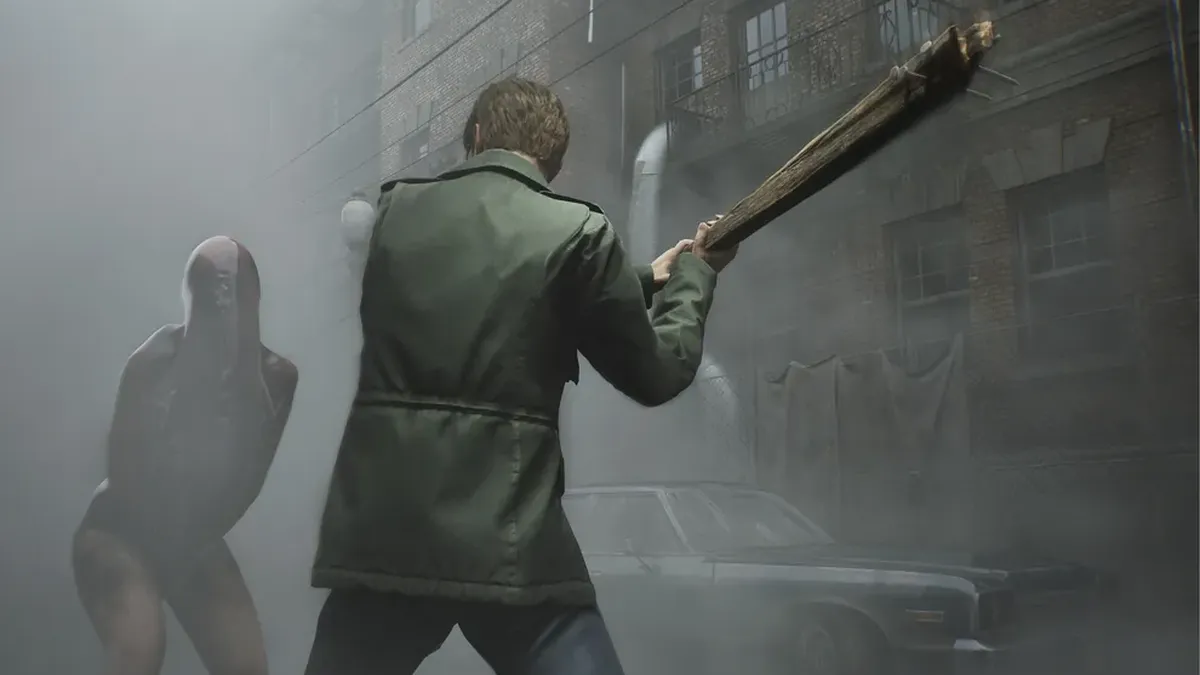
| Pyramid Head | James’s punitive urge and self-judgment | First seen in the apartments; hospital chases; the Labyrinth and finale — as twins |
| Mannequin | James’s repressed desire | Common in the apartments and hospital; slow-moving |
| Nurse | The distortion of Mary’s hospitalization | Dense in the hospital areas |
| Abstract Daddy | The embodiment of Angela’s father’s abuse | Within Angela’s storyline |
Whose Memory Each Place Mirrors#
- Brookhaven Hospital: where Mary was hospitalized for years and died — the densest point of James’s guilt, crowded with Nurses and Otherworld shifts.
- The Lakeview Hotel: Mary’s last stop in life; the videotape and final truth surface here, deciding the ending.
- Blue Creek Apartments: the first half’s main exploration area, dense with letters and diaries — where James’s avoidance begins.
- Toluca Prison and the Labyrinth: the densest zone of encounters and the climax of self-punishment — where multiple endings diverge.
What the Endings Mean#
The endings are not a good/bad binary — each is a different way of handling “I killed Mary”:
| Ending | James’s attitude | Meaning |
|---|---|---|
| Leave | Faces the truth and forgives himself | Released from guilt — he leaves with Laura |
| In Water | Still cannot forgive himself | Follows Mary; the car sinks into the lake |
| Maria | Drowns in fantasy rather than truth | Escapes reality with Maria |
| Rebirth | Refuses reality, seeking ritual resurrection | Rows to the lake’s center to perform the rite |
| Dog | Official gag ending | The final joke against the weight |
| UFO | Official gag ending | Another humorous hidden ending |
Full unlock conditions and the collection routes are in the endings guide; each character’s detailed profile is in the characters page.
The Story’s Timeline in Brief#
| Beat | Where | What the player learns |
|---|---|---|
| The letter | Opening | A dead wife invites James back — the premise is impossible |
| The meeting | Rosewater Park | Maria exists, and she looks exactly like Mary |
| The companions | Apartments and beyond | Angela, Eddie and Laura each carry their own story |
| The descent | Historical Society, prison, Labyrinth | The town’s spaces turn inward; the truth is below |
| The tape | Lakeview Hotel, room 312 | How Mary actually died |
| The verdict | The lakeside finale | Which truth James can live with — the ending’s job to decide |
How the Story Is Told#
Beyond what happens, the way it is told is part of the meaning:
- The letter is the story’s engine. Every scene plays as evidence in an argument James is having with himself: “she wrote, therefore she lives.” The game never argues back directly — it lets the town’s evidence accumulate until the letter’s authorship becomes the question.
- Silence does the heavy lifting. James speaks little, and the game’s biggest reveals come without dialogue: the videotape needs no narration, and the corridors need no explanation. The restraint is why the truth lands as hard as it does.
- The town is the narrator. The Otherworld’s architecture — the prison’s execution imagery, the hospital’s examination rooms — states what James cannot say aloud. Reading the scenery is reading the confession.
- The player is complicit. Because endings track accumulated behavior, the story’s final judgment is partly yours: how you treated Maria, whether you kept James healthy, whether he lingered over Mary’s things. The game makes you a participant in the denial it depicts.
- Foreshadowing is environmental. Almost nothing in the opening is a lie — the falsehood is in the framing. Replayed after the truth, the earliest scenes read entirely differently, which is exactly what a New Game+ run is for.
These techniques are why the remake’s expanded presentation matters: more searchable rooms and more voiced scenes give the same devices more surface to work with, but the method — evidence over exposition — is the 2001 original’s, preserved.
A Comprehension Checklist#
After reading this page, test yourself on these five points:
- Can you name the scene where James’s turn from “finding a living Mary” to admitting “I killed you” completes?
- Can you explain why Mary and Maria share a face, and which inner tendency each represents?
- Can you say which psychology Pyramid Head, the Nurses and the Abstract Daddy each mirror?
- Can you state how Leave, In Water and Maria each process James’s guilt?
- Can you use the guilt-and-innocence rule to explain why Laura is untouched?
Answer all five and you have moved from “being scared” to “understanding” — the core value that separates this story from ordinary horror.
For the town’s world rules behind these symbols, see the lore and world guide; for how the narrative stages map onto playable areas, see the area guide.
And one caution for players mid-story: this page is a map of the whole territory, drawn for readers who want the geography. If you are playing the game for the first time and have not yet reached the hotel, the sections above will still hold — the story’s power does not depend on the videotape’s shock alone. Knowing the truth reframes every earlier scene without ruining any of them, because the game was never hiding what it shows; it was only withholding the reading. That is why Silent Hill 2 survives being spoiled in a way lesser mysteries do not, and why a second run through the town feels like rereading a book you thought you knew.