GTA 6 Gameplay Explained: Duo Combat, Stats, Heists#

As the series’ first mainline entry built for current-generation consoles, Grand Theft Auto 6’s mechanics were always going to be picked apart by players and media alike. From trailers and official material, the game inherits the series’ classic DNA — open world, crime sandbox, vehicle chases — while upgrading the dual-protagonist narrative, character growth, dynamic world and engine technology. This page starts with the Jason-Lucia switching and partner play, then walks through every gameplay system so you build a complete picture of “how it plays” before you boot up.
Note: the console version launched on November 19, 2026. The material below is compiled from official public information, the two trailers and media demos; mechanics marked as inference should be checked against the shipped game.
1. Dual Protagonists and Partner Play#
From “Three Characters” to “Two Outlaws”#
The three-way switching system pioneered by Grand Theft Auto V — free swapping between Michael, Franklin and Trevor — once turned the whole open-world industry’s head. GTA 6 keeps the design but trims the cast from three to two: Jason and Lucia. On the surface that looks like a downgrade, but what Rockstar stresses is the duo’s fighting side by side partner play, not simply “whoever you switch to, you control.”
Real-Time Switching and Tactical Roles#
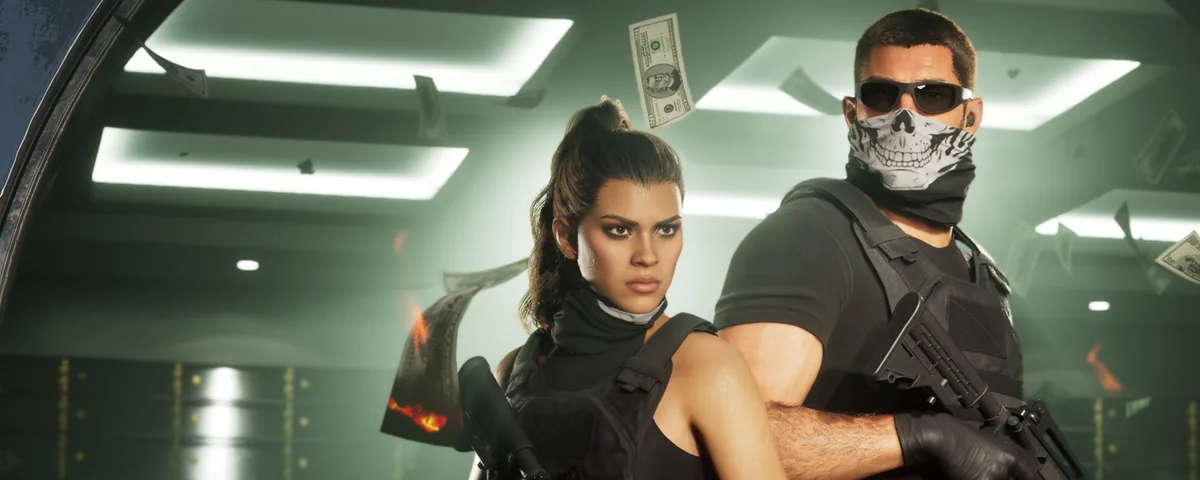
As in GTA 5, the game is expected to support real-time switching between Jason and Lucia. What Rockstar emphasizes, though, is their cooperative positioning inside missions: during heists, infiltrations and shootouts you switch between the two according to the situation, using different roles to push the objective — one suppresses the front while the other flanks; one picks the lock while the other keeps watch. This “one commander, two operators” style should give mission strategy far more depth than GTA 5’s “everyone for themselves” switching.
| Switching mechanic | Manifestation | Versus the previous game |
|---|---|---|
| Real-time swap | Change control target mid-fight | Continues the base design |
| Partner co-op | Two roles coordinating through missions | Strengthens the “side by side” concept |
| Emotional linkage | Their relationship shapes interaction beats | New emotional dimension |
| Freedom | You decide who attacks and who supports | More emphasis on tactical choice |
The Relationship and Emotion System#
The most unusual thing versus three separate protagonists: this pair is a couple. The official story premise — Jason and Lucia are dragged into a criminal conspiracy spanning all of Leonida, and the only way out alive is to rely on each other more than ever — means their bond is not a tool-only partnership but the emotional core of the story. Beach walks, nightclub dancing and cuddling in a car all signal that the game spends real page space on this Bonnie-and-Clyde romance.
What It Means for Mission Design#
The dual-protagonist setup reshapes mission design deeply. It lets one scene play from two perspectives, and lets designers build “requires two-person coordination” mechanics. When one goes down, the other may have to reach them; when one is chased by police, the other may run interference. That “fates bound together” design gives GTA 6’s campaign a “two people facing everything together” tension the series has never had.
2. Character Growth and Stat Training#
The Gym and Stat Progression#
In the second trailer, Jason training on beach gym equipment was an instant nostalgia hit — training to raise character stats is exactly the classic San Andreas mechanic. In that game, muscle, stamina, driving and shooting grew with your habits; GTA 6 looks set to bring the design back, so how you spend your time directly shapes how strong your character actually is.
Multi-Dimension Growth#
Combined with the detailed official character profiles, growth is expected to cover several dimensions. A “likely trainable dimensions” table compiled from series tradition and official clues:
| Dimension | Training method (inferred) | Gameplay effect |
|---|---|---|
| Physique | Gym training, running, swimming | Stamina and melee strength |
| Driving | Drive often, complete driving challenges | Handling and stunt ability |
| Shooting | Use guns, complete shooting drills | Accuracy and reload speed |
| Stealth | Sneak often, avoid detection | Concealment efficiency |
| Social | Interact, complete relationship missions | Partner coordination and negotiation |
“Play Is Progress” Design Philosophy#
This “train what you play” approach is one of the most addictive designs in open-world games. It binds growth to freedom — you are not funneled through a fixed leveling path; your own choices shape a unique character. If Rockstar truly brought San Andreas’ system back, it is a powerful nostalgia strike for veterans.
Differentiated Growth for Two Protagonists#
With two leads, growth is likely not shared but independent, each with a focus — Lucia perhaps leaning combat and stealth, Jason leaning driving and athletics. That differentiation makes switching feel like “playing a different game,” and underpins the tactical division of labor between them.
3. Vehicles: Full Land, Sea and Air Expansion#
Roster Variety#
The trailers showcased sports cars, pickups, motorcycles, off-roaders, hovercraft, jet skis, speedboats and helicopters — clear evidence the GTA 6 roster continues the series’ richness while expanding across all three dimensions. The vehicle system, the series’ soul, is expected to step up again in count, variety and customization depth.
| Vehicle class | Examples (seen in trailers) | Best use |
|---|---|---|
| Land | Sports cars, pickups, motorcycles, off-roaders | City roads, rural off-road |
| Water | Speedboats, jet skis, hovercraft, fishing boats | Keys, wetlands, coastline |
| Air | Helicopters, fixed-wing planes | Cross-region travel, aerial chases |
| Special | Semi-trucks, armored vehicles | Hauling and mission vehicles |
Compound Vehicle Play#
The most memorable trailer moment: Jason rides a motorcycle up onto a moving semi-trailer and lifts a sports car straight off it. That “chase plus load plus hijack” three-in-one beat signals mission design with more imagination than before — vehicles are no longer just “drive to point A” tools but a system you can play with. Expect “perform actions on vehicles” design threaded through many missions.
Customization and Collecting#
As a series staple, deep vehicle customization and collecting are expected to return with more modern options — liveries, wheels, performance mods, garage showcases, rare-vehicle hunts. This “nurturing” layer is a major source of long-term appeal, and a carefully built custom car will again be a player’s badge of identity and taste.
Vehicles Bound to the Map#
Vehicle fun depends on the map behind it. Leonida spans city, islands, wetlands and mountains, and each terrain demands different machines — a sports car drowns in the marsh, an off-roader is useless on the Keys. That deep binding makes vehicle choice itself a strategy, and gives every class an irreplaceable role.
4. Policing and the Wanted System#
Finer-Grained Wanted Levels#
The trailers repeatedly stage cop-versus-criminal set pieces: helicopters circling, police convoys ramming in, protagonists smashing through windows to escape. Following series tradition, the wanted-level system (the classic one-to-five stars) is expected to get finer. Police escalation grows with stars — from patrol pursuit to roadblocks, helicopters and SWAT in layered steps.
| Wanted level | Response (inferred) | Countermeasure |
|---|---|---|
| Low | Patrol car pursuit | Break away, leave sight |
| Mid | More cruisers and roadblocks | Choose concealed routes |
| High | Helicopter and SWAT join | Use complex terrain |
| Extreme | Citywide lockdown | Swap cars, hide, or run it |
Pursuit Routes in Special Terrain#
Leonida’s wetlands and Keys may produce pursuit routes unlike anything in a city. In the city a chase means weaving blocks; in the marsh and islands both police options and escape routes go three-dimensional — jump on a speedboat and leave by water, duck into the swamp to break line of sight, or use an oversea bridge to block pursuers. “Terrain decides the chase” is one of this entry’s biggest wanted-system upgrades.
NPC Reactions and the Bystander Effect#
Trailers repeatedly show bystanders pulling out phones to film violence. NPC reactions to crime will be closer to reality — some watch, some call it in, some run. As wanted levels rise, the bystander-report chain may accelerate police reinforcement, forcing you to manage “witnesses” more carefully. This social realism is a key part of the policing system’s evolution.
5. Heists and Crime Gameplay#
Crime at the Center of the Story#
“A job that should have been an easy score goes wrong” — the official line states outright how central heists and crime missions are. Not a side activity bolted onto the open world, but the spine driving Jason and Lucia’s outlaw journey. The signature heist missions will very likely return as the heart of the mission system.
Heist Mission Chains#
Heists are expected to weave more complex chains with Leonida’s gangs, corrupt cops and smuggling networks. Traditional heists follow “recon — prep — execute — payoff,” and this entry likely stretches that chain longer and deeper: not just grabbing money but managing relationships with every faction, preparing tools, planning routes and improvising when things break. Veteran robber Raul Bautista, seen in the trailers, looks set to be a key figure when you assemble a crew.
Diversified Crime#
Beyond big heists, Leonida’s vast map and varied terrain host many crime types:
| Crime type | Rough content | Signature areas |
|---|---|---|
| Street gang wars | Get pulled into turf conflicts | Vice City blocks, Little Cuba |
| Smuggling | Move and intercept contraband | The Keys, ports |
| Cargo hijacking | Intercept freight on the highway | Interstates, Port Gellhorn |
| Stealth theft | Infiltrate facilities and take the goods | Sugar mill, warehouses, docks |
| Underground competition | Illegal races and events | Tracks and hideouts statewide |
The Social Ecology of Crime#
GTA 6’s crime gameplay is not just shooting — it builds a complete underground society. Gangs, drug dealers, corrupt cops, smuggling networks and the entertainment industry interweave across Leonida, and you freely choose sides, betrayals, alliances or wars. That “one state’s underworld” construction is the series’ most charming quality and the most promising direction for this entry.
6. The RAGE Engine: Rebuilding the Technical Base#
Engine Status and Rebuild#
The game runs on Rockstar’s in-house RAGE engine (Rockstar Advanced Game Engine), deeply rebuilt for current-generation consoles. RAGE has been Rockstar’s technical base since GTA 5; in GTA 6 it was re-engineered to match current hardware. Rockstar calls it “the biggest, most immersive evolution in Grand Theft Auto history.”
Visuals and Animation, Fully Upgraded#
The second trailer was captured entirely on PlayStation 5. Facial expressions, cloth and skin detail are markedly better than before, with more natural muscle movement and running animation. The realism jump is not just resolution and texture precision — it is combined progress across animation, physics and lighting. Players get a more real, more alive Leonida.
| Engine dimension | Upgrade seen in trailers |
|---|---|
| Visuals | Finer face, cloth and skin detail |
| Animation | More natural muscle motion and gaits |
| Physics | More realistic destruction and interaction |
| Lighting | Dynamic weather and truer light |
| Scenes | Higher-density cities and NPCs |
The Dynamic World and Simulation Systems#
The core of the RAGE rebuild is supporting a “more real” dynamic world. Dynamic weather (hurricanes, storms, floods) is not a visual trick — it changes play; NPC behavioral logic (gawking, reporting, filming) needs serious compute. These simulation gains are the technical basis for a map that “looks big and feels fuller when you walk it.”
The Double-Edged Sword#
Big technical gains also mean demanding hardware. From the trailers, lighting, scene density and effects hit new heights — behind them, enormous compute. For console players this is about holding a smooth framerate; for future PC players, about heavier requirements. Balancing “visuals” against “smoothness” is the technical focus players and media watch together.
7. Open World and Dynamic Events#
Bigger, Denser, More Alive#
From published trailers and official information, GTA 6’s open world scales up on both size and density. Leonida spans city, islands, wetlands, mountains and ports; day-night and weather shift the scene’s atmosphere in real time. NPC behavior clearly evolved, pedestrian density far exceeds GTA 5, and street interaction, wanted response and bystander mechanics should all feel closer to reality.
Dynamic Weather Events#
The trailers showed hurricanes rolling through and streets underwater, signaling gameplay consequences from dynamic weather. These events are not background animation but systems that change the rules: storms cut visibility and change handling, floods reroute travel, and a hurricane may even serve as a mission’s stage. Dynamic weather means every session in the open world can look different.
Hidden Content and Exploration Rewards#
The vast map gives exploration enormous room. By series tradition, every corner of Leonida should hide side missions, collectibles, secret compounds and easter eggs — from the mystic settlements on Mount Kalaga to smuggler caches deep in the marsh to hidden coves in the Keys, nearly every terrain class prepares something you cannot find elsewhere. Exploration reward is a pillar of long-term open-world appeal.
8. Summary: A Living Gameplay System#
GTA 6’s mechanics come down to one word: alive. A living duo partner system, living character growth, a living vehicle system, living policing and wanted levels, a living crime world, and a living engine. This is no longer “reskinning the old framework” — on top of the series’ genes it evolves toward more simulation, more dimension, and a stronger “two people facing the world together” core.
For players, the system’s greatest charm is freedom married to depth — you can roam Vice City’s neon boulevards on a whim, or find tactical and growth satisfaction in duo coordination and stat training. How fully the system lands: boot the game, drive a lap, and the answer arrives.
This page was last updated on November 18, 2026, based on officially published information and reasonable inference; specifics follow in-game reality.
9. Getting-Started Advice#
Before You Boot Up#
A few things first: rewatch both official trailers and the website material to learn Leonida’s outline and the main cast; confirm console storage, since this game’s appetite is considerable; and if you plan to try the online mode, study the series’ past online cadence and follow up once Rockstar opens it.
Mindset for Newcomers#
GTA 6 is a freedom-first game — newcomers need not obey a “main story first” rule. The series has always encouraged free exploration: drive Vice City’s streets until they feel like home, then work outward to the Keys, wetlands and mountains for each terrain’s different pleasure. The dual-protagonist system also means no rush on the campaign — playing with the two leads’ interactions in different settings is how you come to understand this outlaw couple.
Watch Official Follow-Ups#
After launch, the new information to track shifts to the online-mode reveal and version updates; the August 28, 2026 Netflix premiere “extended gameplay preview” remains the single most rewatchable showcase of mechanics. If you care about mechanism details, test them against this page in-game.
Back to the Series’ Roots#
However the systems evolve, the series’ founding promise never changes: live and crime your own way in a free, living, possibility-filled world. The dual protagonists, the growth system and the dynamic world all serve that promise. When you drive a custom car through Leonida’s sunshine toward the horizon with Jason and Lucia, that singular series magic is the final answer to everything this gameplay system is built for.
This article is compiled from officially published information; mechanism details follow in-game reality.