Palworld Resource Guide: Distribution, Processing and Stockpiling#

Palworld is developed and published by Pocketpair. It launched in early access on January 19, 2024, and received its 1.0 release on July 10, 2026. For resource planning, 1.0 is a “map reshuffle” of an update: the Sunreach floating islands and the World Tree endgame region stretch the world into three vertical layers, the new ore Soralite can only be mined with special equipment, and the No-Go Zones were rebuilt wholesale as ancient-civilization preserves. Copying your early-access gathering routes is no longer just inefficient — the new resources are physically unreachable on the old map.
This page answers three questions on 1.0 terms: where each resource comes from, how processing chains run from raw gatherables to endgame gear, and what to stockpile at each stage. For mechanism-level criteria — which vein or which Pal a resource hangs on, Pal Soul tiers, the Mimog lockpick change — see the items and resources guide. For how to explore and reach each region, see the map and regions guide. Food, cakes, and ranch production lines are covered in the farming guide.
First, Clear Out Three Outdated Claims#
Most resource guides still circulating online date from the early-access era. Against the actual 1.0 content, these three claims must be corrected first:
| Old claim (early-access era) | The 1.0 reality |
|---|---|
| Level cap is 65, and gathering planning ends at the 50s bracket | The level cap is now 80, with high-level wild Pals and high-tier materials extending into the endgame regions |
| Clear the main island plus Sakura Island and you’ve finished the map | Sunreach and the World Tree are official 1.0 regions — Soralite, Paloxite, and Radiant Gems don’t exist on the old map |
| The No-Go Zones are three offshore islets: sprint through and leave | The No-Go Zones were rebuilt as ancient-civilization preserves — rare materials now come with a guard cost of regional bosses and defense drones |
One more warning about the old guides themselves: the “resource respawn timetables” and “drop-rate tables” circulating in the early-access era were never published by the officials. Do not treat any of them as planning data. Every conclusion on this page rests only on verifiable mechanics — regional associations and processing-chain relationships — and unpublished figures are stated as such.
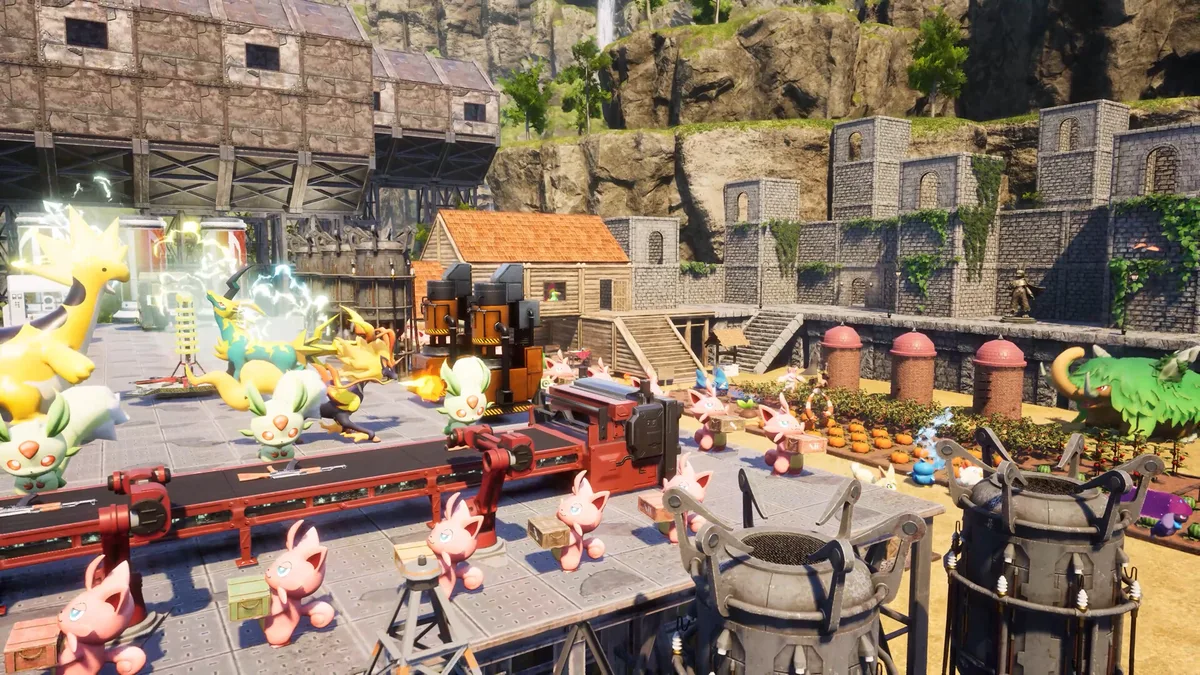
Master Resource Distribution Table (1.0)#
| Region | Representative Resources | Gathering Notes |
|---|---|---|
| Main island forests | Wood, Fiber, Stone, Pal Crystals | The opening foundation and the main source of base self-sufficiency |
| Main island, everywhere | Ore | Distributed across the whole map; node density varies — place bases near metal |
| Volcanic and lava zones | Coal, Sulfur | The raw-material depot of the ammo line; region-bound, cross-region trips mandatory |
| Snow zone | Pure Quartz | The region-bound mineral of high-tier crafting lines; cold protection first |
| Desert zone | Ore (dense nodes) | The main producing region for metal; heat protection and supply management matter most |
| Sakura Island | High-level gathering points and boss drops | The high-difficulty offshore island added June 27, 2024; 1.0 built a new settlement there |
| Seven Islets | Field resources by type | New in 1.0: volcanic, desert, and ruin types, each with signature Pals |
| Three No-Go Zones | Rare gathering materials | Rebuilt in 1.0 as ancient preserves, guarded by regional bosses and defense drones |
| Sunreach | Soralite | The new 1.0 ore; minable only with special equipment |
| World Tree | Paloxite, Radiant Gems, Ancient Civilization Relics | The story endgame region and the source of endgame crafting and awakening materials |
| Sea enemy bases | Enemy drops and chest loot | Existed in early access; 1.0 added more positions at sea |
Read this table in two buckets. Region-bound resources (Coal, Sulfur, Pure Quartz, Soralite, the World Tree trio) mean cross-region trips are unavoidable — no base placement replaces leaving home. Base-self-sufficient resources (Wood, Stone, Fiber, Pal Crystals, Ore) can be produced on a rolling loop by Pals around a resource-rich base. The first bucket’s cost is a route-planning problem; the second bucket’s output ceiling is a base-building problem. Optimize the two separately.
Volcanic and Lava Zones: The Gunpowder Line’s Raw Materials#
Two minerals are bound to the volcanic and lava zones: Coal and Sulfur. They are the shared upstream of the ammo line — Wood is burned into Charcoal, Charcoal and Sulfur combine into gunpowder, and gunpowder is processed into advanced gunpowder, sustaining the continuous drain of firearm ammo and explosives. 1.0 added 13 new weapons, which amplifies ammo consumption further — Coal and Sulfur carry an even higher gathering priority than they did in early access.
Sulfur has a second destination: carbon fiber production, and carbon fiber is a key material of the endgame gear line. So the volcano feeds both “ammo” and “endgame gear” at once, and this region’s gathering priority only rises through the mid and late game.
Three points on organizing the trips:
- Heat protection is mandatory. Constant high temperatures and lava terrain — get the environment prep wrong and the gathering experience falls off a cliff.
- Bring ground- and transporting-type Pals in your party. Clear division between mining and hauling is what makes each round trip profitable.
- Treat cross-region trips as scheduled business travel, not daily routine. Coal and Sulfur hang on specific veins and can’t be self-supplied at the base. Activating the volcano region’s fast-travel points and watchtowers in advance, then filling a boatload per trip, beats frequent short hops.
Snow and Desert: One Cold Line, One Hot Line#
The snow and desert zones are the other two region-bound resource sources — one cold, one hot, with completely different preparation:
| Region | Bound Resource | Environment & Party Preparation |
|---|---|---|
| Snow zone | Pure Quartz | Bitter cold and blizzards — cold protection mandatory; night travel is riskier |
| Desert zone | Ore (dense nodes) | Scorching days, open terrain — heat protection and hydration first; open ground favors ranged weapons |
Pure Quartz serves the high-tier crafting line: the type where you don’t need huge stockpiles, but missing it stalls progress — plan dedicated trips on demand. The desert, on the other hand, deserves treatment as your main metal producing region: Ore exists across the whole map, but dense nodes concentrate in the desert, and once ingot and refined ingot consumption ramps up mid-game, desert nodes decide your metal output ceiling.
The downstream of the metal line unfolds in the processing-chain section below; here’s just the siting conclusion: of the second and third bases you establish mid-game, at least one should sit next to dense ore nodes so metal enters the base self-sufficiency loop — desert trips then only top up the gap.
Main Island Forests: The Self-Sufficiency Foundation#
Every resource activity in the opening game revolves around the main island forests. This stretch produces four foundation resources: Wood, Fiber, and Stone, plus Pal Crystals that come as a byproduct of mining stone — the crystals are the core ingredient of the Palball recipe family and burn faster than you expect. Smash stones as you pass to bank fragments; it beats a dedicated restock trip back home.
Base-siting criteria for the first base match the early-access era: flat ground near Ore, Stone, Wood, and water. What 1.0 changes is the ceiling of self-sufficiency efficiency — with work suitability raised to Lv10, base Pals produce substantially more in gathering and transporting roles, so foundation resources “grow on their own” far more readily than before.
There’s exactly one planning rule for foundation resources: never let business trips replace base self-sufficiency. Wood, Stone, and Fiber are continuous-consumption items, and rolling production by base Pals is the only sustainable way to supply them. Your time out of the base belongs to region-bound minerals — not to coming home to chop trees.
Sakura Island and the Seven Islets: Two Difficulty Tiers of Offshore Resources#
Offshore resources come in two tiers. Sakura Island arrived with early access’s first major update (June 27, 2024): a Japanese-styled offshore island whose overall difficulty exceeds the main island regions of its era, with gathering materials and Pal drops to match its higher level band. 1.0 built a new settlement there — “old regions gain new content” is a broad 1.0 pattern, and Sakura Island is its clearest example.
The Seven Islets are 1.0’s lateral expansion, in three types — volcanic, desert, and ruin — each with its own resident Pals. The official per-island output lists have not been published, and this page won’t invent them. Preparing by type is the reliable approach: gear for heat on volcanic islets and gather like you would in the main island’s volcanic zone; balance heat protection and supplies on desert islets; prioritize exploration and combat loadouts on ruin islets. Thorough type-based preparation beats memorizing an unreliable per-island list.
Sunreach: Soralite and the Mining Gate#
Soralite is 1.0’s new ore, produced on the Sunreach floating islands. It carries one hard gate no old mineral had: it can only be mined with special equipment — ordinary pickaxes don’t scratch it. So when planning an endgame base, step one isn’t finding veins; it’s crafting the mining gear. Landing on the island without it means staring at ore empty-handed.
Four points on gathering in Sunreach:
| Point | Detail |
|---|---|
| Level gate | We recommend level 65 or above and at least one fully built main fighter in the party before landing — Sunreach’s gathering and combat tiers are laid out for the endgame bracket |
| Mining gear | Soralite is minable only with special equipment — fix the gear first, then look at veins |
| Movement | Hopping between floating islands depends on flight — the Wing Pack lets you fly without riding a Pal, and pairing it with flying mounts changes efficiency completely |
| Pacing | Sunreach’s gear and materials are prerequisites for the World Tree segment — run this place thoroughly before pushing on |
Soralite’s role is upstream material of the endgame crafting line. Whether it has any source beyond Sunreach is unpublished — plan around it as a Sunreach regional resource.
The World Tree: The Endgame Resource Trio#
The World Tree is 1.0’s story endgame region, towering over the archipelago — visible but out of reach before 1.0. The region produces three endgame resources:
| Product | Positioning | Where It Goes |
|---|---|---|
| Radiant Gems | Core material of the awakening system | Awakening Pals for major stat gains — consumption rules in the awakening guide |
| Paloxite | New resource exclusive to the World Tree region | Endgame crafting line material |
| Ancient Civilization Relics | The ancient tech line’s long-running rare material | Ancient tech crafting and reinforcement |
The trio shares one source, so one deep run into the World Tree advances crafting, awakening, and ancient tech simultaneously. Two points of organization are worth arranging in advance:
- Stockpile Radiant Gems as a long-horizon consumable. Awakening is per-Pal: as long as there are main fighters to build, there are Gems to spend — every World Tree haul should flow straight back into the awakening line.
- The World Tree is expensive to traverse — activate watchtowers first. Activate every watchtower’s travel point the moment you meet one, and every subsequent gathering round trip gets measurably cheaper. That is exactly the design intent of watchtower facilities, expanded in the next section.
The story’s endpoint is here too: the endgame boss Astralym holds the World Tree. Scheduling the fight is covered in the boss guide and the endgame guide.
The Three No-Go Zones: Preserve Rare Materials#
The No-Go Zones were three offshore islets even in early access; 1.0 rebuilt them wholesale as preserves left behind by an ancient civilization: each has a unique environment, resident Pals, and rare gathering materials, guarded by regional bosses and defense drones. Entering is still a crime — being spotted draws a wanted level, a rule carried over intact from early access.
For resource planning, the rebuilt zones changed their job: no longer a “sprint through for the dex entry” stop, they are now a stable source of endgame materials, worth clearing repeatedly. Defense drones raise the cost of brute-forcing significantly, so plan gathering routes like operations: stealth route planning and clearing the perimeter before the core both pay better than charging in. Regional boss strategies are in the boss guide; how preserve materials feed the endgame progression lines is in the endgame guide.
Watchtowers and Ancient Ruins: Two New Acquisition Routes in 1.0#
1.0 added two new fulcrums to resource acquisition, both at the exploration-facility layer:
| Facility | Function | Value for Gathering |
|---|---|---|
| Watchtower | Reveals the surrounding map, doubles as a fast-travel point | Turns “opening the map” into an active node; round-trip route efficiency jumps |
| Ancient Ruins | Exploration sites with minigame play | Produce schematics pointing at the ancient civilization crafting line |
The watchtower’s value shows most in repeated-gathering scenarios: for regions like Sunreach and the World Tree that demand many trips, every activated watchtower saves a stretch of travel on all future routes. Combined with 1.0’s new auto-run feature, watchtower fast travel cuts the stamina and time cost of long gathering routes substantially.
Ancient Ruins take the other path: exploration and minigames produce schematics, and schematics correspond to the ancient-civilization crafting line — together with boss-drop blueprints they form the two channels supporting ancient civilization parts and downstream crafting. Clearing a ruin between map sweeps is the endgame bracket’s main source of “on-the-way income.”
Sea Enemy Bases: Loot-Oriented Sailing Targets#
Sea enemy bases existed during early access, and 1.0 added more positions at sea. Their resource identity is loot-oriented: chests inside hostile facilities and enemy drops are the core payoff of sailing out — a parallel acquisition channel next to vein mining and Pal drops, not a replacement for either.
Confirm three things before sailing: transport (boat or flight), supplies, and your ability to handle locked chests — from 1.0 on, a Mimog opens locked chests of every tier without condensation, an expense that’s simply gone now; the mechanic is explained in the items and resources guide. Enemy bases are risk-and-reward targets by design; don’t brute-force them with an underleveled party.
Processing Chains: From Gatherables to Endgame Gear#
Most gatherables can’t be used directly — several layers of processing sit in between. Breaking the lines open shows you which tier to stockpile each resource to, and which stations deserve jobs in your base:
| Line | Upstream Gatherables | Processing Path | Final Destination |
|---|---|---|---|
| Gunpowder line | Wood, Sulfur | Wood burns into Charcoal; Charcoal + Sulfur makes gunpowder, processed into advanced gunpowder | Firearm ammo and explosives |
| Metal line | Ore | Furnaces smelt Ingots, processed into refined ingots | Mid-to-late weapons, armor, and construction |
| Polymer line | Pal Oil, Sulfur | Pal Oil (drops from certain Pals) processes into Polymer; polymer and carbon fiber also consume Sulfur | Endgame weapons and gear parts |
| Stone line | Stone | The basis of stone materials and the cement line; stone mining yields Pal Crystals | Base construction and the Palball family |
| Endgame line | Soralite, Paloxite, Radiant Gems, Ancient Civilization Relics | Straight into endgame crafting and awakening consumption | Endgame gear, awakening, and ancient tech lines |
Two rules for reading this table:
- Farther downstream, higher facility demands. Furnaces handle one-step products like Ingots and Charcoal; synthetics like Polymer and carbon fiber go to more advanced facilities; the endgame material line sits at the very end. “I have the materials but can’t craft it” is almost always a facility-tier problem — go back and unlock the tech tree, don’t re-gather.
- Pals own the upstream, facilities hold the middle, players steer. Gathering and hauling run on automatic loops by Pals with the right work suitability; the mid-line bottleneck on every production chain is facility tier and tech unlocks. Official per-recipe consumption numbers aren’t published item by item — this page gives upstream/downstream relations only, no invented yields; the in-game crafting panel is authoritative.
For the full criteria of processing mechanics — which mechanism each resource hangs on, how Pal Souls tier — see the items and resources guide. For how production lines sit inside a base and how to arrange jobs, see the base production section of the farming guide.
Use-Based Criteria: Which Line Each Resource Serves#
The last step of stockpiling is knowing the destination. Split by use into four lines:
| Use Line | Resource Group | Criterion |
|---|---|---|
| Basic construction | Wood, Stone, Fiber, cement-line materials | Direct consumption by the build menu and base facilities — steady demand, small batches, base self-sufficiency |
| Base automation | Ingots, circuit boards, and other electronic parts | Gate materials for facility upgrades and operation — automation stops wherever facility tier stops |
| Combat consumption | Pal Crystals, gunpowder and advanced gunpowder, food | Stock before departure by burn rate — Palballs and ammo are the two consumables you never have enough of |
| Endgame gear & progression | Soralite, Paloxite, Radiant Gems, Ancient Civilization Relics, carbon fiber | Scarce inputs of the crafting and awakening lines — bank them on arrival, don’t repurpose |
The resource properties of these lines differ fundamentally: the first three run on consumable thinking — replenish when short, use as produced. The endgame line runs on scarcity thinking — sources are bound to endgame regions and boss fights, and how much you bank decides how fast awakening and endgame crafting can move. Hoarding consumables like scarcities strangles base expansion; spending scarcities like consumables stalls the endgame. Keep the criteria straight and resources won’t sit in the wrong place.
Stockpiling Priority by Stage#
| Stage | Prioritize | Notes |
|---|---|---|
| Early (levels 1-15) | Wood, Stone, Fiber, Pal Crystals | Sustain the first base and Palball consumption; don’t rush cross-region lines |
| Mid (levels 15-30) | Ore, Sulfur, Coal | Firearm and ammo consumption ramps up; the metal and gunpowder lines both accelerate |
| Late (levels 30-50) | Refined ingots, Polymer, carbon fiber, Ancient Civilization Parts | Facility tiers and the ancient tech line advance together, paving the road to the endgame bracket |
| Endgame (levels 50-80) | Soralite, Paloxite, Radiant Gems, Ancient Civilization Relics | Sunreach and World Tree brackets; feed endgame crafting and awakening |
Let stage progression follow the main story: build the foundation on the main island, drill discipline on Sakura Island and the No-Go Zones, train for the endgame in Sunreach and the World Tree. The 80 cap makes the late-to-endgame stretch longer than early access ever had, so stockpile weight should tilt toward cross-region lines from mid-game on — don’t wait until you can’t scratch a tower boss to start backfilling Coal and Sulfur.
Palworld FAQ#
| Question | Answer |
|---|---|
| Can’t mine Soralite? | It’s minable only with special equipment; ordinary pickaxes do nothing — craft the mining gear before landing on Sunreach |
| Any Radiant Gem source besides the World Tree? | None published — plan around it as an endgame-region exclusive and stop wasting trips to low-level zones |
| Short on gunpowder? | Its upstream is Charcoal and Sulfur — Charcoal comes from burning Wood (base self-sufficiency), Sulfur requires a cross-region trip to the volcano; restock the two lines separately |
| How often do veins respawn? | No official unified respawn time — precise tables in old guides are unreliable; planning round trips around watchtower travel beats camping nodes |
| Where should the first base go? | Flat ground near Ore, Stone, Wood, and water — cross-region materials (Coal, Sulfur, Pure Quartz) come in via fast-travel business trips |
| Where do I check breeding cake materials? | Farming lines and cake ingredients are in the farming guide; breeding consumption planning is in the breeding guide |
| Should I hoard Pal Souls? | Stock by enhancement target — large souls go to main fighters you’ll max out; tiers and sources are in the items and resources guide |
Connecting to Other Pages#
- How to explore and reach each region, and watchtower placement: the map and regions guide
- Which vein or Pal each resource hangs on: the items and resources guide
- The awakening line’s Radiant Gem consumption rules: the awakening guide
- The overall arrangement of endgame materials and crafting: the endgame guide
- Boss fights and tower boss scheduling: the boss guide
- Food, ranches, and the cake production line: the farming guide
After 1.0, the center of gravity of “resource guides” shifted from memorizing spawn points to reading structure: which resource binds to which region, which production line chokes on which facility tier, which materials should only flow to the endgame. This page has laid out the regional structure on 1.0 terms — combined with the exploration loop in the map and regions guide and the mechanism criteria in the items and resources guide, the three questions — what’s missing, where to restock, and how far to stockpile — all have their answers.