Palworld Story & World Lore#
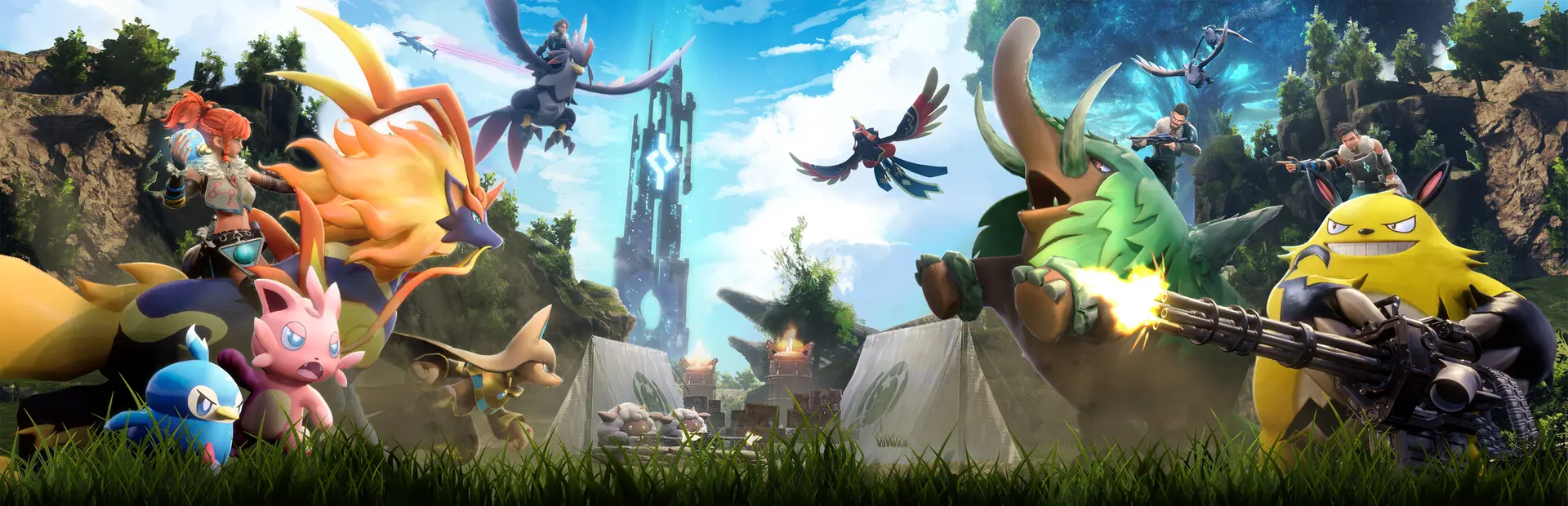
Palworld is developed and published by Pocketpair, launched in early access on January 19, 2024, with the 1.0 release on July 10, 2026. Its story unfolds across an open sea called the Palpagos Islands: you play a survivor who wakes on a strange shore with no destined-savior backstory, starting from gathering, building, and taming Pals to find your footing among the islands. The game does not tell its story through long dialogue and cutscenes — the narrative hides in three threads: tower conquest, faction conflict, and how humans and Pals treat each other. Your own behavior is part of the story.
1.0 filled in the most glaring gaps of the world puzzle: the World Tree looming over the islands is finally enterable, and the central mystery around the towers is revealed in that story arc; the floating island of Sunreach brings a civilization rooted there for ages; and the new Journal system gathers the scattered world-building texts into one collectible line for the first time. This page rewrites the whole setting framework to 1.0 standards.
The boundary first: this page organizes only officially published lore and does not finish history on the officials’ behalf. Unpublished chronology, naming systems, faction origins, and the Ancient Civilization’s full story are all left unwritten; confirmed settings are itemized, and anything unpublished is labeled unpublished.
I. First, Recalibrate: Old Claims From the Early-Access Era#
The previous version of this page was written during early access, and several of its claims have expired wholesale. Returning players should swap mental models via this table before reading on:
| Old claim (early access) | 1.0 reality |
|---|---|
| The game has five towers; clearing them ends the main story | There are 7 tower bosses — Sakurajima’s tower arrived with the mega-update, Sunreach’s with 1.0, and the story’s endpoint extends to the World Tree |
| No-Go Zones were just “islands where hunting is banned”, origin unknown | The No-Go Zones are preserves left by the Ancient Civilization — three of them, each guarded by a regional boss and defense drones |
| World-building texts were scattered in Paldeck entries and scenery, with no proper system | 1.0 adds the Journal system, making lore text an official collectible content line |
| The floating island and the World Tree were only rumored regions | Sunreach and the World Tree are both real regions in 1.0, carrying a unique civilization and the story’s endgame |

II. The Palpagos Islands: the Stage and Its Ecology#
The Palpagos Islands are the stage of the whole story. Not one uniform continent but an archipelago world assembled from many biomes, outer islands, a floating island in the sky, and the endgame region — each layer with its own narrative job:
| Region layer | Gameplay role | Lore it carries |
|---|---|---|
| Surface biomes (grassland, desert, snowfields, volcano, etc.) | The main stage of survival, gathering, and capture | Biomes determine Pal habitats and resource spread — the base layer of the archipelago’s ecology |
| 7 islets | 1.0’s new exploration zones, in volcano, desert, and ruins types | Each with resident Pals, pushing the ecological map out to sea |
| No-Go Zones (three) | High-risk gathering grounds | Ancient Civilization preserves — see section six |
| Sunreach | 1.0’s pre-endgame arc, home of the seventh tower | A floating island powered by Pal-energy, cradle of a unique civilization |
| World Tree | The story’s endgame region | The story’s crux, where the tower mystery resolves |
| New settlements (Bamboo Groves, snowfields, Sakurajima, Skyfall grounds) | Side quests and NPC interaction | Humanity’s footholds on the islands, with enemy outposts at sea |
The ecology’s sheer scale tells a story by itself. After 1.0 the Pal total reaches 287 (72 new, including 47 all-new species and 25 variants) — a species list of that size, spread across biomes, is the most tangible depth of this world: you “read” it through habitats, Paldeck entries, and wild Pal behavior, not through walls of text. The gameplay face of habitats and regions is on the map and regions page.
III. The Seven Towers: the Fight for Control#
The towers are the Palpagos Islands’ most visible landmarks and the focal points of faction conflict — the factions fight endlessly for control of the towers. Each tower boss and their partner Pal holds one tower, which makes tower fights the de facto nodes of the main story. The early-access claim of “five towers” is void: Sakurajima’s tower came with the mega-update, Sunreach’s with 1.0 — 7 tower bosses in total.
| Tower | Boss duo | Debuted |
|---|---|---|
| Windswept Hills tower | Zoe & Grizzbolt | Early access launch |
| Bamboo Groves tower | Lily & Lyleen | Early access launch |
| Dry Desert tower | Marcus & Faleris | Early access launch |
| Volcanic Island tower | Axel & Orserk | Early access launch |
| Astral Mountains tower | Victor & Shadowbeak | Early access launch |
| Sakurajima tower | Saya & Selyne | Early access, with the Sakurajima update |
| Sunreach tower | Auri & Shaolong | New in 1.0 |
The bosses’ allegiances differ. Two are explicitly documented: behind Zoe of the Windswept Hills stands the Rayne Syndicate, poachers and smugglers; behind Lily of the Bamboo Groves stands the Free Pal Alliance, advocating Pal liberation. The rest of the bosses’ affiliations are presented through the in-tower presentations — this page does not fill beyond them; watch the show when you climb.
1.0 reworked the tower fights as a whole: unique tower designs and new mechanics per tower, fight length compressed to 5 minutes (from 10). The narrative effect is direct — each tower fight is now a compressed, tense collision of positions rather than a pure strength check. Per-tower strategies, mechanics, and recommended levels on the boss guides page.
IV. The World Tree: Where the Tower Mystery Resolves#
The World Tree looming over the Palpagos Islands is the story’s crux and 1.0’s new endgame region. In early access, the game never answered where the towers came from, why they were built, or what the bosses were guarding; 1.0 extends the story’s endpoint into the World Tree, and the central mystery around the towers is revealed in that arc. The specifics unfold with the main quest — this page spoils nothing; walk to the endgame and see for yourself.
The endgame region’s play and output are built around the setting too:
| Element | Content |
|---|---|
| Endgame boss | Astralym, deep in the World Tree — the story’s final fight |
| Exclusive output | Paloxite, Radiant Gems, Ancient Civilization artifacts |
| Linked system | Radiant Gems feed the awakening system, massively boosting awakened Pals |
| Achievements | “To the World Tree” and “Savior of Palpagos” (defeat Astralym), both new in 1.0 |
The Radiant Gems line ties the world’s lore to its progression: materials from the World Tree feed directly into awakening, giving endgame resource routes a footing in the setting. The full awakening system is on the awakening system page; endgame routes and collection planning on the endgame content page.
V. Sunreach: the Floating Island and Its Rooted Civilization#
Sunreach is 1.0’s new floating-island region, hovering in the sky on Pal-energy. Its environment is nothing like the surface, and the officials describe it as “a unique civilization that took root here through long ages” — for the first time, the Palpagos stage shows a civilization standing alongside the islands’ human societies, of unknown origin.
| Element | Content |
|---|---|
| Floating setting | Pal-energy keeps the entire island aloft |
| Environment | Ecosystems utterly unlike the surface |
| Civilization | Officially described as “a unique civilization rooted here through long ages” |
| Bosses | Auri & Shaolong, holding the Sunreach tower |
| Exclusive ore | Soralite, mineable only with special equipment |
About that “unique civilization”, the officials have published only the positioning above: it floats on Pal-energy and took its own shape over long ages. Its origin, composition, and fate are all unpublished, and this page will not extrapolate — which is exactly the restraint of 1.0’s world expansion: the island’s existence is revealed, but the civilization itself is left to player imagination and future updates.
VI. The No-Go Zones: From Banned-Hunting Islands to Ancient Preserves#
The No-Go Zones got a frontal reveal in 1.0. In early access they were merely “islands where hunting is banned” — you knew trespassing was risky, not why they existed. 1.0 gave the origin: they are preserves left behind by the Ancient Civilization, and all three were redesigned around that identity.
| Element | Setting and mechanics |
|---|---|
| Origin | Preserves left by the Ancient Civilization |
| Count | Three, all redesigned as preserves |
| Guard | One regional boss each, with defense drone patrols |
| Gameplay role | High-risk gathering grounds producing rare materials |
From “banned-hunting islands” to “Ancient Civilization preserves”, more than the wording changed: the preserves gained an explicit guard system (regional boss plus drones), and the reason for the ban came into focus — this is protected land left by an ancient civilization. Why that civilization set the preserves aside, and what exactly it protects, are unpublished; this page does not answer for them. Locations and gathering routes on the map and regions page.
VII. The Ancient Civilization: Ruins, Parts, and Lost Technology#
The Ancient Civilization is the oldest layer of the islands’ setting. You cannot touch its historical texts, but you keep touching its legacy: Ancient Ruins scattered across the map, collectible Ancient Civilization parts and building materials, the ancient tech tree behind high-tier crafting, and the three No-Go Zones it built.
1.0 made this line concrete: the new Ancient Ruins are explorable ruin sites with minigame play inside, producing schematics — a major source of equipment blueprints.
| Legacy | Form in play | Notes |
|---|---|---|
| Ancient Ruins | Exploration sites and minigames | Produce schematics — a key source of equipment blueprints |
| Ancient parts and materials | Crafting resources | Materials for building and crafting lines |
| Ancient tech tree | Tech unlock system | Ancient tech points unlock high-tier items; tower fights are one source |
| No-Go Zones | Three preserves | Built by the Ancient Civilization — see the previous section |
The civilization’s origin, scale, and disappearance are unpublished, and this page writes none of it. What is certain: from the No-Go Zones and the Ruins to the artifacts of the World Tree, this lost civilization’s legacy is spread across the islands as the backdrop that high-tier content keeps citing.
VIII. The Journal: the Formal Gateway to World Text#
1.0 added the Journal system, and the officials’ positioning is blunt: it expands Palworld’s mythology and worldview. Journals collected during exploration gather the setting fragments once scattered through Paldeck entries and scenery into an official, collectible, re-readable text line.
For this page’s topic, that is an upgrade in how the world is presented: where you once pieced clues from Paldeck entries, Pal behavior, and scenery, there is now a formal gateway of official text. The journals’ specific contents follow the in-game text — this page neither retells them nor summarizes them into a “chronicle”; the texts are themselves part of the setting, left for you to collect and read. Collection mechanics and advice in the Journal section of the challenges guide page.
IX. Humans and Pals: Coexistence, Labor, and the Poachers#
The officials’ own summary of this world: you can live in harmony with your Pals, or risk your life fighting poaching syndicates. The line names the most fundamental divide of the Palpagos Islands — how you treat Pals. In game terms, that choice is not an abstract slogan; specific mechanics carry it:
- The daily trade-off between labor and kindness: Pals haul, plant, generate power, and smelt at your base; overworked ones slack off. Hot springs, beds, and on-time feeding are what kindness looks like in practice. Balancing efficiency against kindness is every player’s daily decision.
- The poachers are concrete enemies: organizations like the Rayne Syndicate treat Pals as prey and merchandise; their bases — and 1.0’s new sea-based outposts — are frontal assault targets.
- Tower fights put the disagreement on stage: the bosses hold different positions on how Pals should be treated, and climbing the towers means colliding with each of them in turn.
- A dark-humor footnote: using a Pal Sphere on a human NPC and completing a “capture” is itself an achievement (Inhuman Act) — the game never hides its self-mockery about the boundaries of “labor”.
One narrative fact worth surfacing: you, the player, also capture and employ Pals, sharing the same behavioral logic as every faction. What makes you different is not a higher moral position — it is that the choice always stays in your hands: how to treat the Pals at your base, whether to release them, whether to fight the syndicates to the end. The combination of those choices is Palworld’s real “branching story”.
X. In What Order to Experience the Setting#
| Order | What to do | Setting layer it touches |
|---|---|---|
| 1 | Climb the towers in story order, watching each boss’s stance and presentation | Towers and faction landscape |
| 2 | Set foot on Sunreach; take in the floating island’s environment and civilization traces | The unique civilization |
| 3 | Go deep into the World Tree and finish the endgame story | The tower mystery’s resolution |
| 4 | Collect journals and reread the islands’ myths and fragments | The Journal system |
| 5 | Run the No-Go Zones and Ancient Ruins, inventorying the Ancient Civilization’s legacy | The preserves and the lost civilization |
The Palpagos Islands’ lore is not read — it is walked. 1.0’s biggest contribution is making the walking finally lead to answers: the World Tree resolves the tower mystery, the No-Go Zones have an origin, and the Journal binds the scattered clues into a volume. As for where the Ancient Civilization came from and where it went — where the officials are silent, this page will not invent a single word. That is the honest part of this setting framework: the mystery is still standing there, and the answers are yours to find on the islands.