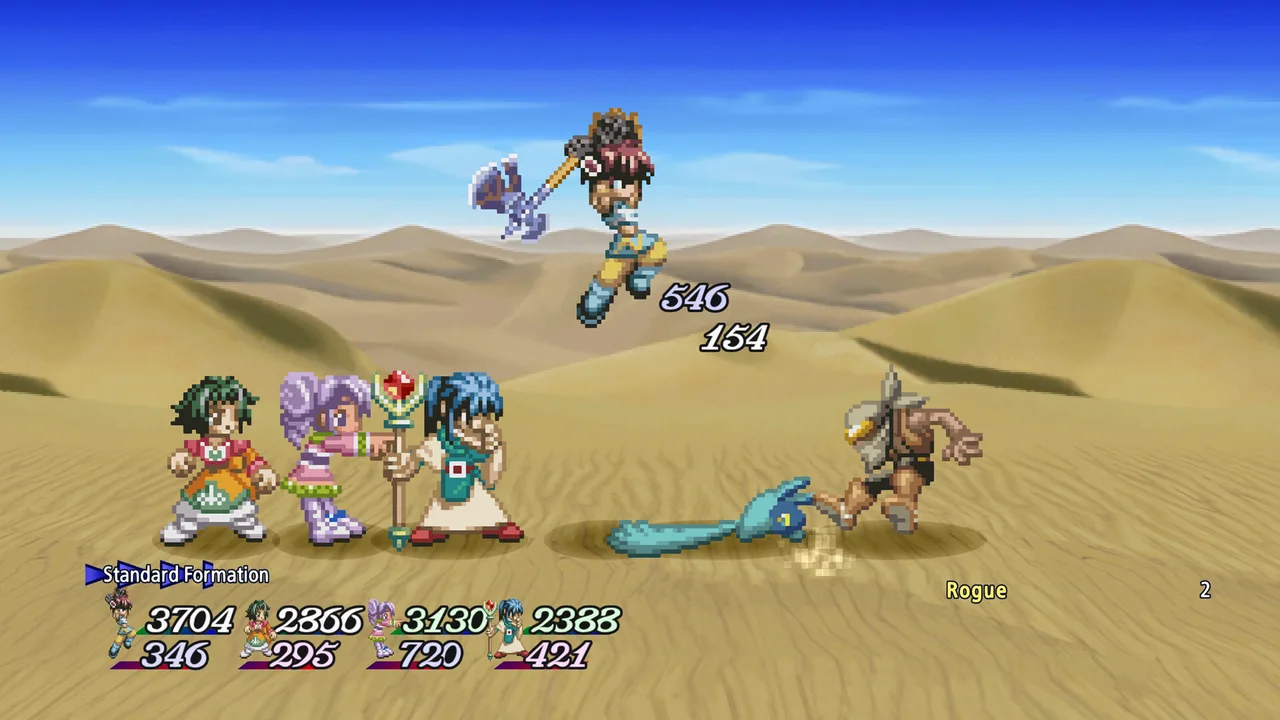
Tales of Eternia Remastered: The Artes System and Combos#
Artes are the ammunition of A-LMBS combat, and Tales of Eternia Remastered carries over the original’s three-tier structure: base artes → higher artes → arcane artes, with “unlock by use count” wiring combat directly into growth. This page covers what is verifiable — and says so where it isn’t.
Data note: arte names and unlock numbers below trace to fan-wiki documentation of the original game (2000 PlayStation / 2005 PSP), romanized here from the Japanese names. Whether the remake reuses the same display names and values is unconfirmed until checked in game — the shipping version’s in-game text is authoritative.
The Three-Tier Structure#
| Tier | Role | How it unlocks | In battle |
|---|---|---|---|
| Base artes | The tree’s foundation | Known from the start or learned early | Combo openers and cheap filler |
| Higher artes | Powered-up extensions of bases | Base arte use count reaches a gate | The mid-chain workhorses |
| Arcane artes | The tree’s ceiling | Higher-tier conditions met | Combo finishers and bursts |
The elegance: every tier serves the next. More base-artre uses unlock higher artes faster; slotting higher artes into chains advances arcane progress in parallel. “Leveling” stops being XP farming and becomes practice — every arte you fire is visible growth.
The Use-Count Unlock Mechanism#
The most useful numbers in original-game documentation are three gates on Reid:
| Base arte (romanized) | Uses needed | Unlocks |
|---|---|---|
| Majinken | 48 | Majinken Souga (twin thrust) |
| Kogahazan | 150 | Kogarenzan (chain slash) |
| Senkureppa | 250 | Senkushoureppa (aerial charge) |
Three design lessons in the numbers:
- The spread is wide — 48 to 250: arte growth is a whole-game process, not a menu you clear in one sitting;
- Cheap artes mature first — Majinken’s low gate builds the habit of opening with base artes;
- 250 means deliberate practice — Senkureppa’s gate will not fill on incidental encounters; you schedule it.
Remake caveat: whether these exact values carried over is unconfirmed, but the framework — higher and arcane artes unlock on base-artre use counts — is confirmed remake design. The practice logic holds under either reading.
Reid’s Arte Tree (Original-Game Data)#
Reid Hershel, the melee sword core, owns the party’s most complete tree — the best sample for reading the three tiers.
Base Tier#
| Arte (romanized) | Type |
|---|---|
| Majinken | Thrust-line sword arte, cheap opener |
| Raijinken | Lightning-line sword arte |
| Sansau | Combo-line sword flurry |
| Kogahazan | Sweep-line sword arte |
| Rekkuuzan | Aerial-line sword arte |
| Senkureppa | Thrust-line higher candidate |
Higher Tier#
| Arte (romanized) | Type |
|---|---|
| Majinken Souga | Twin-cast upgrade of Majinken |
| Fuuraijinken | Wind-lightning compound of Raijinken |
| Kogarenzan | Chain-slash upgrade of Kogahazan |
| Shuusau | Multi-hit combo upgrade |
| Senkushoureppa | Aerial-charge upgrade of the Senkuu line |
| Shinkuuretsuzan | High-power finisher slash |
Arcane Tier#
| Arte (romanized) | Type |
|---|---|
| Raijinsouhazan | Thunder-line arcane |
| Majinsenrezan | Demon-line multi-hit arcane |
| Majinrengazan | Demon-line chain arcane |
Reading the tree, three lineages emerge: the Demon line (thrust), the Thunder line (lightning), the Tiger-Fang/Senkuu lines (combos and aerials). Each climbs to its own arcane — and chains built along one lineage flow best.
Chaining: How Artes Connect#
Solo Chain Rules#
- Same-lineage links: Majinken into Majinken Souga is a same-line upgrade; the rhythm is smoothest;
- Cheap opens, expensive closes: base fill, higher transition, arcane finish — TP cost tracks the chain’s arc;
- Alternate movement and damage: 2D artes carry displacement (thrust, sweep, aerial); the chain is your footwork, so don’t chain yourself into the mob.
Chaining With AI Teammates#
A-LMBS promises “companions who act with distinct tactics,” so chains aren’t a solo act:
- Split angles: thrust from the front while AI teammates cut from the flank — pincers open longer combo windows;
- Cover attributes: the spell-support line (Keel) and craymel line (Meredy) hit weaknesses your sword doesn’t;
- Yield the beat: when an AI fires something heavy, leave a finisher window instead of overlapping.
Party-level framing lives on the party guide.
Mystic Artes: The Chain’s Final Form#
The top of the chain is the Mystic Arte. The remake confirms it can be accelerated through the Boost options’ attack proficiency setting; full activation conditions and the per-character list were not verified this round — the Chinese Mystic Arte page carries what’s known.
A Three-Phase Practice Plan#
For planners: treat arte acquisition as a scheduled project.
Phase One (early game): The 48-Use Sprint#
Majinken’s gate is the lowest — the first deliberate target. Open every random fight with it for a few hours of combat and your first higher arte lands.
Phase Two (mid game): Accumulating Kogahazan to 150#
Fold Kogahazan into the mid-slot of every chain — never grind for it, never waste an appearance.
Phase Three (late game): The 250-Use Push#
Senkureppa’s gate wants scheduled practice. Boost the encounter rate, let auto-battle high-speed clear low-risk mobs, and pilot manually in boss-adjacent fights — the remake turns a 2000-era hand-grind into a settings problem.
Artes FAQ#
| Question | Answer |
|---|---|
| Do remake arte names match the original fan data? | Unconfirmed — in-game text governs |
| Is there a use-count tracker? | Its menu location follows the in-game UI |
| Do base artes matter after unlocks? | Yes — openers and cheap filler still run on them |
| What does each arte cost in TP? | Original-game fan figures; remake values unconfirmed |
| Where are other characters’ arte lists? | No verified complete source this round; character pages carry confirmed entries only |
One-Line Summary#
The artes system is how “combat is growth” becomes literal: three tiers give depth, use-counts give drive, chaining gives expression. Master it and the 40-hour campaign stops being a sequence of fights and becomes one continuously thickening combo curve. Next stop: the Chinese Mystic Arte page.