Mario Kart World Open-World Track Design: How Four Scenes Become One Map#
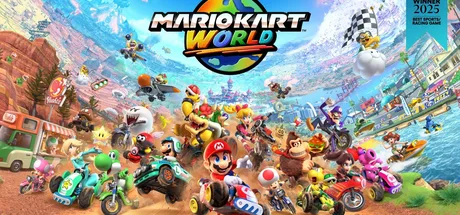
The most fundamental change in Mario Kart World is structural: the series’ previously standalone courses become one seamlessly connected open world. Grassland, city, ocean and volcano are no longer four unrelated menu entries but regions of one continuous space — racers can drive between them without waiting for a course to load.
The map also adds weather changes and a day-night cycle, so the same stretch of road looks different at different times. For kart players used to fixed laps and fixed environments, this track structure needs re-learning: you now memorize not just a course’s corners but how regions connect, where connector roads lead, and which terrain is closed for racing yet open for exploring.
Starting from the seamless design, this page works through the four scene types, weather and day-night, the racing nature of connector roads, and the green-marked off-route terrain — building a complete mental coordinate system for the world map.
Seamless Connection: From a Set of Courses to One World#
This is the first entry with seamlessly connected open-world course design, and it is the premise for every other mechanic here. The table below lists the design’s key points.
| Item | Note |
|---|---|
| Design | First seamless open-world course layout in the series |
| Scene relations | Grassland, city, ocean, volcano joined into one world |
| Spatial continuity | All scenes sit on one continuous map |
| Effect on races | Courses no longer isolate from each other |
| Shared space | Racing routes and exploring routes use the same world |
In older games a course was a closed unit; finishing meant returning to the menu. Here courses share one world and traffic flows between scenes, with two direct consequences: races can run continuously across scenes, and the map itself becomes an object to memorize.
That continuity also explains why the Grand Prix became a no-reset cup structure — with courses physically joined, having racers drive connector roads to the next venue is the natural design, no menu reload required.
How Four Scenes Assemble One Map#
Grassland, city, ocean and volcano are the open world’s four constituent scenes — not four separate maps but different characters within one space. The table below lists confirmed information and observation tips per scene.
| Scene | Confirmed information | Observation tip |
|---|---|---|
| Grassland | One of the four scenes, seamlessly joined to the others | In Free Roam, watch where grassland meets its neighbors |
| City | One of the four scenes, seamlessly joined to the others | Track how connector roads branch through city stretches |
| Ocean | One of the four scenes, seamlessly joined to the others | Follow connectors to find the entries into ocean areas |
| Volcano | One of the four scenes, seamlessly joined to the others | Watch how the volcanic area links to high routes |
A caveat: specific course names and fine terrain inside each scene lack first-hand confirmation, so this page lists no course rosters and invents no scene-specific rules. What is certain: the four scenes compose the seamless world, and racers can drive through them continuously.
The useful move is treating the four scenes as four compass points: first drive their connecting roads in Free Roam, then bring that geographic memory back into races to judge forks. This section provides no unverified course lists.
Weather Changes and the Day-Night Cycle#
The open world adds weather changes and a day-night cycle — a series first. The table below separates the two elements.
| Element | Note |
|---|---|
| Weather changes | Weather in the open world shifts over time |
| Day-night cycle | The world moves through day and night |
| Coverage | Applies across the single seamless map |
| Relation to exploring | The same spot looks different at different hours |
Weather and day-night add a dimension to “learning the map”. A connector’s legibility may differ day versus night, and distant landmarks fade or emerge with conditions — so seasoned players track not just routes but the current time of day.
Both elements are parts of the open-world design, completing the world experience alongside the scenes. Available material gives no weather types or cycle lengths, so this page confirms their existence only, without quantifying durations or triggers. To feel the design directly, run the same route in Free Roam a few times and watch the environment change.
Connector Roads: Travel Becomes a Race Stage#
Connector roads are the part of the open-world structure that changes racing most. The table below lists the relevant rules under the Grand Prix structure.
| Item | Note |
|---|---|
| Cup structure | Cups of four tracks retained |
| Between tracks | The race no longer resets between courses |
| Travel | After finishing, the field drives connector roads to the next course |
| What carries | Positions, items and speed momentum carry over |
| Connector status | A race stage in their own right |
| Stage contents | Filled with shortcuts and item boxes |
In older games the between-tracks moment was a menu jump; here that travel becomes genuine race content. After a finish the field does not stop — it flows along the connector to the next venue, positions, items and momentum riding along. Connector roads are therefore not transition scenes but real stages: position lost here carries straight into the next course.
Their value doubles from contents: shortcuts reward map knowledge with shorter distances, item boxes let trailing racers restock, and wrong forks burn accumulated momentum. The game has effectively elevated “knowing the way” into a racing skill on par with drifting.
Engine classes and Mirror Mode follow series tradition — three selectable levels plus an unlockable mirror — but the no-reset carry rules apply identically at every level.
The Green-Marked Off-Route Terrain#
One class of terrain in the open world stays closed during races and opens only in Free Roam. The table below lists the rules.
| Item | Note |
|---|---|
| Mode | Free Roam |
| Mode character | Goal-free exploration |
| Race elements | No races, no timers, no rivals |
| What opens | Off-route terrain closed in Race mode |
| Map marking | Shown green |
| What you find | Hidden shortcuts, scenic routes |
In Race mode, green-marked off-route terrain is closed to traffic; switch to Free Roam and those areas open up. Green functions as a marker of explorable range — a green patch means a route exists there that racing never uses, waiting to be found.
The area’s main value is hidden shortcuts and scenic routes. Hidden shortcuts pay off later in races — knowing a shorter fork hides beside a connector lets you grab positions in cups; scenic routes serve pure exploration, free of position pressure, for relaxed driving.
Free Roam has no races, timers or rivals, making it the lowest-pressure place to learn the map. Once the green areas are familiar, back in Grand Prix or knockout races you will judge forks and shortcuts noticeably faster.
Turning Map Structure into Race Advantage#
Pulling the sections together, the track structure forms one world map shared by racing and exploring. The table below collects the key understandings a player should build.
| Understanding | Use |
|---|---|
| Scenes are continuous | Races can run across scenes |
| Connector roads | Stages, not intermissions; positions carry here |
| Shortcuts and item boxes | Concentrated on connectors; the familiar win |
| Green terrain | Off-route areas open only in Free Roam |
| Weather and day-night | Change landmark legibility and look |
Together these point at one conclusion: in this game, map knowledge is itself competitiveness. Older entries tested course memorization and drifting; this one adds “knowing where the road goes”. Every fork on a connector can shift positions and item flow, and that judgment only accumulates through repeated Free Roam runs.
For players pushing further: use Free Roam as a formal training ground — first drive the connectors between the four scenes, then specifically memorize shortcut entrances inside green areas, finally carry those routes into Grand Prix and knockout races. The open world then stops being pretty scenery and becomes a resource that converts directly into positions.