England National Team Guide#
Basic Information#
| Item | Details |
|---|---|
| Federation | The FA (Football Association) |
| Confederation | UEFA (Europe) |
| World ranking | 4th |
| 2026 title probability | 12-18% |
| Best finish | Champions once (1966) |
| 2022 result | Quarter-finals |
| Tactical tradition | Fast attacking + wide penetration |
Coaching England in Football Manager 2026, the challenge is not squad quality — this is a golden generation — but how to fuse stars from many elite clubs into a tournament-hardened unit inside very short camps. This page runs four lines: England’s selection dilemma, the dual-formation switch, set pieces and penalties.
The Dual-Formation Fit#
England’s biggest asset is the mutual compatibility of its attackers. Kane, Bellingham, Saka and Foden come from different systems at different clubs, yet nationally they power two completely different attacking logics.
4-2-3-1 Attack (Plan A)#
The highest-margin-of-error first choice: Kane dropping in and Bellingham surging past him exploit both midfield numbers and a focal point at once.
| Position | First choice | Role | Key attributes |
|---|---|---|---|
| GK | Jordan Pickford | Goalkeeper-defend | Reflexes 16, one-on-ones 15, command 16 |
| RB | Reece James | Attacking full-back-attack | Crossing 17, pace 16, stamina 16 |
| CB | John Stones | Ball-playing defender-defend | Passing 17, composure 16, defending 16 |
| CB | Harry Maguire | Central defender-defend | Defending 16, heading 17, strength 16 |
| LB | Luke Shaw | Full-back-automatic | Crossing 16, technique 15, defending 14 |
| CDM | Declan Rice | Anchor-defend | Tackling 17, defending 16, stamina 17 |
| CDM | Kalvin Phillips | Deep-lying playmaker-support | Passing 16, vision 15, defending 14 |
| RW | Bukayo Saka | Inside forward-support | Dribbling 17, passing 16, technique 17 |
| CAM | Jude Bellingham | Attacking midfielder-attack | Finishing 17, movement 17, technique 17 |
| LW | Phil Foden | Inside forward-attack | Dribbling 18, passing 17, technique 18 |
| ST | Harry Kane | Deep-lying forward-attack | Finishing 19, passing 17, vision 17 |
The key linkage: set Kane as a “deep-lying forward-attack” rather than an advanced forward, so his drop-ins let Bellingham burst from the midfield line into the striker’s zone. This false-nine-plus-late-runner pattern is especially effective in FM26 against high lines.
4-4-2 Flat (Plan B)#
When opponents show a back three or five and the middle is choked, the CAM position gets smothered — switch to a flat 4-4-2 and hit the box with two strikers.
| Position | Player | Role |
|---|---|---|
| ST | Kane | Deep-lying forward |
| ST | Rashford | Advanced forward |
| LM | Foden | Winger |
| CM | Bellingham | Box-to-box midfielder |
| CM | Rice | Midfielder-defend |
| RM | Saka | Winger |
Switching criteria — rules you can apply directly:
- Opponent plays three at the back / back five: abandon the CAM, go 4-4-2 with two strikers, and let Rashford’s pace attack the space behind.
- Opponent has a double pivot that pushes up: stay 4-2-3-1 and send Bellingham into the space behind their two holders.
- One goal up past 70 minutes: turn one of the double pivot into a pure anchor, slow the tempo, and protect the lead.
Instructions Compared#
| Instruction | Plan A (4-2-3-1) | Plan B (4-4-2) |
|---|---|---|
| Mentality | Attack | Balanced |
| Passing style | Mixed | Mixed |
| Tempo | Higher | Standard |
| Defensive line | Standard | Lower |
| Pressing | Standard | Standard |
| Crossing | Medium | High |
| Counter-attack | On | On |
Plan B raises crossing and drops the line so the two strikers can attack deliveries while nobody runs in behind them unchecked — and against clearly weaker European opposition in qualifying, it pins teams in their own half even more effectively than Plan A.
Positional Depth and the Selection Dilemma#
England’s real problem is that almost every position except left-back and goalkeeper has duplicate quality. This ladder helps you settle the XI quickly once camp opens:
| Position | Starter | Backup | Youth reserve | Trade-off note |
|---|---|---|---|---|
| GK | Pickford | Ramsdale | Butland | Pickford’s command matters; changing tournament starters is risky |
| RB | Reece James | Trippier | Livramento | Trippier steadier; James stronger going forward |
| CB | Stones | Guehi | Colwill | Stones’s build-up is the spine of progression |
| CB | Maguire | Dunk | Tomori | Maguire’s heading is essential on set plays |
| LB | Luke Shaw | Chilwell | Mitchell | Shaw is injury-prone — keep a ready deputy |
| CDM | Rice | Henderson | Gallagher | Rice is irreplaceable |
| CDM | Phillips | Ward-Prowse | Gallagher | Ward-Prowse’s set-piece delivery has real value |
| RW | Saka | Bowen | Palmer | Saka starts; Palmer can deputise at CAM |
| CAM | Bellingham | Maddison | Eze | Maddison’s dead balls and through balls are elite |
| LW | Foden | Rashford | Anthony Gordon | Foden cuts in; Rashford suits vertical carries |
| ST | Kane | Toney | Watkins | Behind Kane there is no pure focal point |
The operating rule for selection: never rotate Kane, Bellingham, Rice or Saka — they are the spine; adjust everything else by opponent and fitness.
Set Pieces and Penalties#
England’s set pieces have always looked strong on the blackboard — cashing in takes the right takers.
Penalty Order#
FM26 reads a player’s Penalty Taking and Composure, not raw finishing. These five are the usable top of the order, prioritised by high Pressure handling:
| Order | Taker | Style note |
|---|---|---|
| 1 | Kane | Highest penalties and composure in the squad; down the middle or either side |
| 2 | Bellingham | High-velocity strike; forces the keeper to move first |
| 3 | Saka | Placement type; sends the keeper the wrong way |
| 4 | Foden | Technical; sells the dive with disguise |
| 5 | Rice | Power type; straight down the middle to remove the guess |
Once chosen, set penalty practice to a medium-high frequency in training and lock these five two weeks before knockouts — late changes unsettle the dressing room.
Corners and Free Kicks#
- Corner attack: post Kane and Maguire — the two best headers — at the far and near post respectively, with delivery mixed-toward-deep so their height and timing win the first contact.
- Free-kick delivery: Ward-Prowse and Maddison are the squad’s best dead-ball crossers; give them every wide free kick in the final third rather than defaulting to Saka or Foden.
Responses by Opponent Style#
England’s approach varies sharply by opponent; these are directly applicable setups:
| Opponent type | Formation | Key instructions | Mentality |
|---|---|---|---|
| European mid-tier possession sides | 4-2-3-1 | High press, short-passing control | Attack |
| Traditional elites who push up | 4-2-3-1 | Kane drops, Bellingham runs for the counter | Balanced |
| South American technicians | 4-4-2 | More duels, wide delivery | Attack |
| Knockout opponents | 4-2-3-1 | Fewer risky passes, efficiency first | Balanced |
Against South American sides, do not trade short-passing possession — that is their home turf. Using the 4-4-2’s wide crosses and physical duels to drag the game into England’s rhythm is the sounder plan.
Tournament Psychology and Dressing-Room Management#
England’s recurring criticism is nerves at the decisive moment — tournament exits on penalties or fine margins. In FM26 this is partly manageable through the psychology dimension:
| Method | Operation | Effect |
|---|---|---|
| Experience-led selection | Prioritise players with high Important Matches attribute | Better displays in decisive games |
| Penalty practice | Lock five takers early and drill repeatedly | Fewer shootout misses |
| Captain choice | Kane as captain to steady the room | Stable dressing-room climate |
| Camp talks | Team meeting before knockouts stressing collective over individual | Eases pressure on young players |
Training Priority Order#
National camps are short — training priorities must be explicit, not spread like a club’s:
| Module | Focus | Reason |
|---|---|---|
| Tactics | Fast transition + width | Unlocks Saka and Foden on the flanks |
| Set pieces | Corners + penalties | England’s traditional edge and tournament x-factor |
| Defence | The Rice + Stones core | Defence sets the tournament floor |
| Psychology | Penalty practice + big-game management | Points straight at England’s long-standing weakness |
With limited national-team time, putting set pieces and psychology ahead of tactics and defence often pays the most direct dividends — there simply is not enough camp time to drill a complex possession system.
Knockout Operating Points#
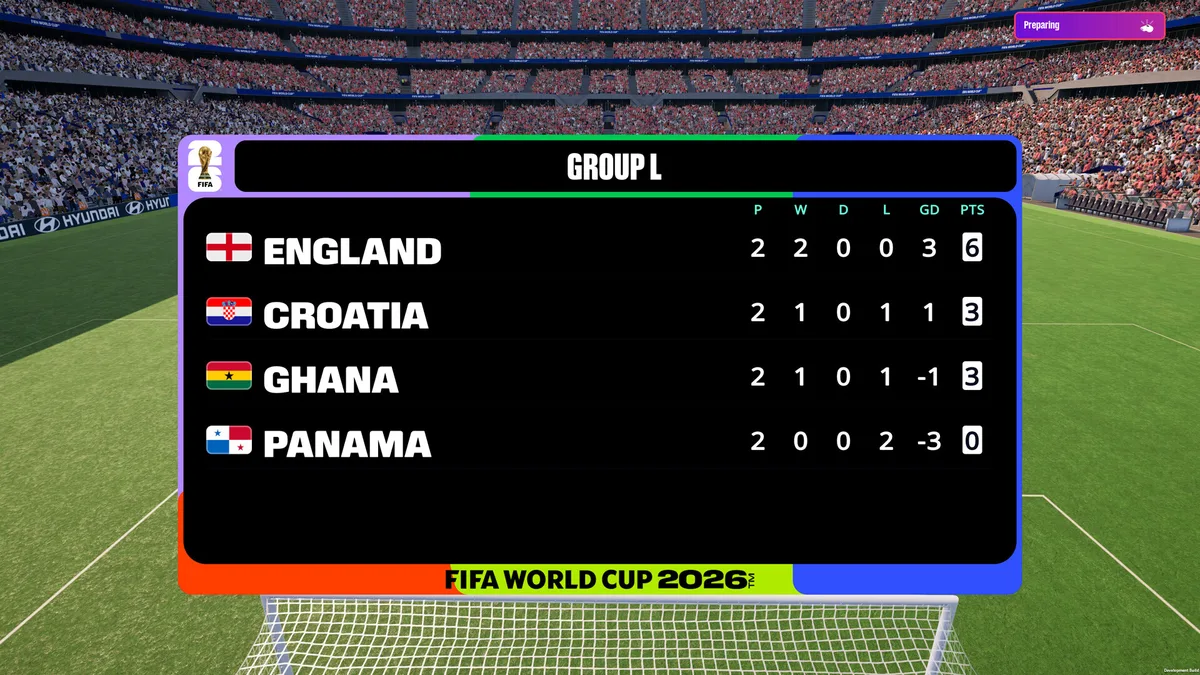
- Group stage: bank maximum points from the first two games; decide rotation in game three by the table — do not gamble the goal difference.
- From the round of 16: default back to the 4-2-3-1; hold your freshest wide players until after 70 minutes and accelerate into the opponents’ fatigue window.
- Protecting a lead late: drop the tempo, retract the line, swap a striker for a holding midfielder.
- Before a shootout: confirm all five takers are on the pitch; if one is off or injured, drill the replacement in advance.
England own the most mature star collection at the 2026 World Cup. Kane’s finishing, Bellingham’s all-round game, Saka’s wide bursts, Foden’s technique — these weapons can beat anyone. The only opponent you truly need to conquer is the England penalty curse.