Escape Academy 2 Puzzle Design Guide: The Answer Is Always in the Room#
To judge these puzzles, start with who builds them: Coin Crew Games’ day job is designing real-world escape rooms. That background explains most of the design language — this is not a logic-puzzle gauntlet, it’s the real-room toolkit of environmental storytelling and information distribution.
This page contains no solutions, only structure. Understand the structure and you’ll solve rooms twice as fast on your own.
The Skeleton: Micro-Puzzles Chain Into One Exit#
Every room runs the same pattern:
- The room holds several micro-puzzles (a keypad, a switch bank, a mechanism that wants a specific item);
- Each solved micro-puzzle pays out a fragment (a digit, a letter, a shape, an item);
- All fragments combine to open one master exit.
Polygon’s review uses the clock tower as the example: shape, rope and celestial clues — three threads, climbed floor by floor, converging into one way up.
The structure’s virtue is that you are rarely hard-stuck: some micro-puzzle is always currently solvable. The cost: miss one fragment and the final step turns into circular misery — which is exactly why the Journal auto-records.
Three Rooms, Three Design Lessons#
The Spike Classroom: Look Up#
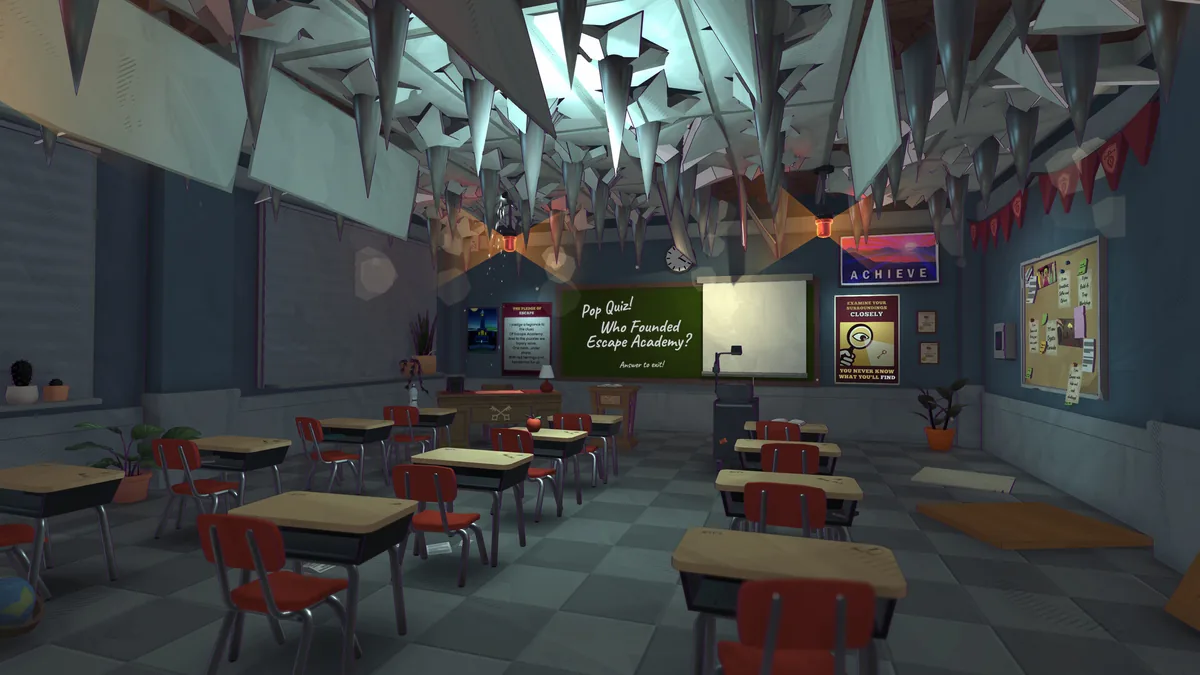
The opening room is the design language’s instruction manual. Ceiling full of spikes, desks below, blackboard reading:
Pop Quiz! Who Founded Escape Academy? Answer to exit!
Three lessons in one room:
| Design intent | Where it shows |
|---|---|
| Environment as threat | The spikes are a visual promise that failure has teeth |
| Answer in the scene | The exit condition is written on a blackboard, not in a menu |
| The question is a clue | Asked “who founded the school”? Then something printed in this room carries the name |
That last line generalizes: the wording of the question itself directs you. “Who founded the academy” means “find a printed name,” not “start guessing.”
The Clock Tower: Three Threads, One Direction#
The room reviewers keep citing, because it is the micro-puzzle chain at full strength: shapes, ropes and celestial signs seem unrelated, but all resolve into the same action — climbing. The design difficulty isn’t any single puzzle; it’s making three clue-lines converge in space.
The Gym Room: Physical Intuition as Rules#
From retail screenshots: a football field’s yard lines painted on the floor, gears and planks on the wall, a caged object, tubes ferrying colored balls, a target at the end.
This room runs on real-world physical intuition: balls roll, tubes carry, targets break, gears mesh. No rulebook to memorize — your existing intuition is the rulebook. It’s the classic real-room move: minimize rule-learning, put the difficulty in observation.
The Three Clue Carriers#
Cross-referencing the examples above, nearly every clue arrives through one of three channels:
| Carrier | Examples | Character |
|---|---|---|
| Blackboards, posters, bulletin boards, shelf tags, newspaper clippings, yearbooks | Highest information density; easiest to dismiss as background | |
| Movable objects | Gears, dials, switches, liftable lamps, passable items | Interaction is the clue — touch it once and its function reveals |
| Spatial relations | Spike positions, field yard-lines, staircase orientation, stained-glass patterns | Information that requires no reading at all |
Practical corollary: stuck three minutes with zero progress, re-sweep in this order — read every print, touch every interactive, then stand center-room and turn a full circle. Most deadlocks die in those three passes.
The Hint System Is Design, Not a Patch#
Hints come in three layers: direction, location, answer. That’s not newcomer coddling — it’s the real escape room’s Game Master protocol, where staff nudge before they ever tell.
It should change how you feel about pressing: taking the first layer is not cheating; it is part of the design. The real waste is twenty minutes of circular staring.
The Three Criticisms#
Honestly: 4.5/5 doesn’t mean flawless. Reviewer criticism clusters on three points:
One: Word Ciphers Skew Predictable#
Aggregate commentary flags “predictable word ciphers.” It’s the genre-wide cost of porting real rooms to software: in a physical room you must physically assemble the word; here the system has already eliminated most possibilities, so guessing works.
Two: Occasional Obscure Steps#
“Occasional obscure steps” — some micro-puzzles connect through a stretch of association that feels unnatural. Real rooms cover this with a Game Master; the game covers it with the hint button.
Three: A Soft Final Room#
Multiple reviews found the finale underwhelming. The complaint targets closing ambition: after a world built on “the secret of the school’s founding,” the last room’s puzzle strength doesn’t match the narrative scale it answers to.
An Efficient Solve Loop#
The analysis, compressed into a routine:
- Enter and sweep, in silence. Both of you (if co-op) read your half of the room before anyone speaks; premature narrating poisons observation.
- Read all print. Blackboards, posters, tags, clippings — the densest layer first.
- Touch everything interactive once. Not to solve — to map what each thing does.
- Sort your fragments. Digits with digits, letters with letters, shapes with shapes. Most endgame frustration is cross-type forcing.
- Stuck five minutes: take one hint layer, then back to searching.
- Before leaving any room, open the Journal and confirm the clues recorded.
One-Line Verdict#
The puzzles are strong where it counts — clean structure, fair clue placement, nothing to memorize — and weak where reviews said: guessable ciphers, a few contrived hops, a soft finale. For an evening of thinking with a friend, it’s more than enough.
For the timer’s settings and one switching trap, see the Chinese difficulty page; for what survives the credits, see the Chinese post-game page.