Save Shrines and Respawn Rules: Discipline Without Checkpoints#

On saving, Queen’s Domain is among the least forgiving games we cover: no checkpoints, no autosave. GameSpot’s review specifically warns that “it’s easy to lose progress — dying sends you back to your last manual save”. At the same time the island’s shrines and save crystals are both your save mechanism and a world reset switch: resting revives enemies. This page covers both rule sets together, because together they decide how far you dare go.
The Save Rules in Full#
The hard rules, all from official settings and review coverage:
| Rule | Content | Source |
|---|---|---|
| No checkpoints | The game never saves for you | GameSpot review |
| No autosave | No background timed saves exist | GameSpot review |
| Death rewinds | You return to your last manual save, position and state | GameSpot review |
| Shrines / save crystals | Interact to save — soulslike save points | AltChar review |
| Rest resets | Resting at a save point resets the world and revives enemies | AltChar review |
| Milestone respawns | At progress nodes enemies repopulate on their own, with changed compositions | RPS review |
“Milestone respawns” is the key difference from soulslikes: in a soulslike the world resets only when you rest; here enemies also reappear by themselves as you push story and exploration nodes, and their compositions change. RPS reads this as engineered ambush potential — the corridor you cleared yesterday may hold a new garrison today.
Using Shrines Right: Save as Anchoring, Not Insurance#
With no autosave, your shrine rhythm directly prices every death. Treat it like dropping anchor at sea, not like a free heal you happen to pass:
- Save before any new path. Every unopened fork and every unopened door gets priced as “possibly fatal”.
- Return to anchor after any important pickup. New weapons, new accessories, key items — those are the most painful things to lose on a rewind.
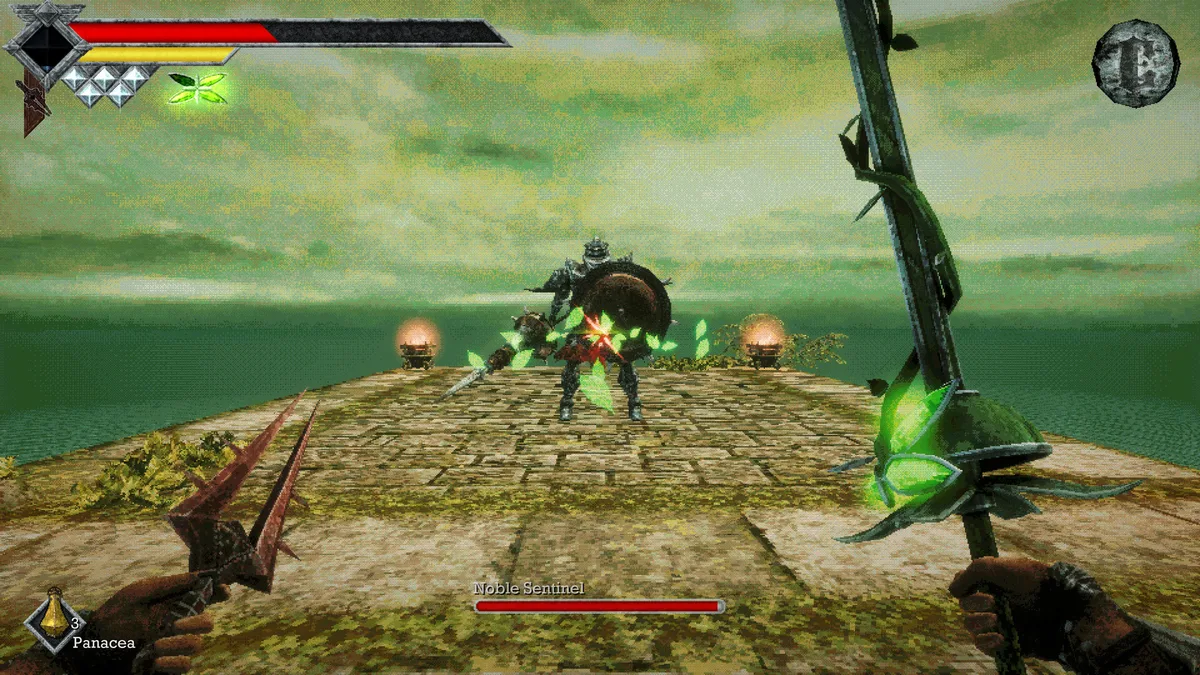
- Always save before a boss room. Given the gear-gate design (AltChar documented the opening boss crushing the starting kit repeatedly), a pre-boss save is an admission that you expect to die a few times.
- Do not lean on shrines to survive. Resting revives enemies and refills the road home — resting at low HP then setting out means facing a full-strength garrison on the way back.
Patrol Economics Under Two Respawn Systems#
The two respawn systems together change what “clearing” means:
- Rest resets are a tool: use them deliberately — in a low-risk, high-yield corridor near a save point, rest-farm XP and materials on repeat. This is the legal low-risk grind (mechanics per AltChar/RPS).
- Milestone resets punish “clear and forget”: RPS’s pull tactic (throwing daggers to drag one enemy out of a group) gains value in high-frequency respawn zones, because you never face the refreshed garrison all at once.
Practical takeaway: treat high-respawn corridors as training grounds, and treat milestone nodes as watersheds — before pushing a story node, confirm your gear and saves are in order.
What Death Actually Costs, and How to Stop the Bleeding#
Death in a checkpoint-free world has four cost lines, worst first:
- Progress: everything explored, opened and looted since the last save is gone.
- Position: the walk from the save point back to your front line — with anchor discipline this stays contained.
- Knowledge: not lost. Enemy patterns, hidden walls, shortcut routes all survive in your head — the only free asset in a checkpoint-free design.
- Morale: the most underrated line. Reviews agree the opening is brutal (AltChar’s 7/10), but equally agree the game opens up once you push through. Reading death as a reload, not a failure, is the price of admission.
The damage-control principle in one line: rather skip ten minutes of exploration than walk five minutes without an anchor. The moment you think “one more stretch should be fine” is the moment to go back to the shrine.
How the Systems Interlock#
Save rules do not stand alone — three other systems define them:
- The gear gate: boss stat checks mean death is often a “signal” rather than a punishment — after a rewind, go get stronger (see the Chinese boss guide).
- Throwing daggers on cooldown: the infinite-supply sidearm is the cheapest-output answer when things go wrong (RPS); stall with it first.
- Flight upgrades and revisits: gems extend your dash and old areas must be re-walked — drop an anchor at the region entrance and revisit one line per trip.
Route Planning: Advance by Anchor Zones#
In a checkpoint-free world the unit of route planning is not the “region” — it is the shrine radius. The method:
- Plan every outing from a shrine: keep your anchor radius within what one full party-wipe rewind can absorb. Weak gear and unfamiliar enemies mean a small radius; gear up, then widen it.
- Loops beat out-and-back: the maze is interconnected (official setting) — leaving one shrine and returning to a different one beats retracing your steps, and sweeps the respawned enemies on the way.
- Two anchors before high-risk actions: boss rooms, unknown depths, jump-down platforms — before any of these, confirm both shrines in that direction are lit. Two anchors means a failure restarts from the nearer backup save.
- Separate anchors for revisits: when flight upgrades send you back to old regions, light an anchor at the region entrance first and revisit one line per trip (the revisit method is in the exploration page).
The essence of the method: compress the blast radius of “no checkpoints” with save-point density until it only ever burns a small, planned area.
Death Is a Stat Signal#
Read the save rules together with the gear gate (AltChar’s finding: the opening boss crushes starting equipment), and you get a counterintuitive conclusion: death is not a mistake — it is a stat notice.
| Death scene | The signal | Correct response |
|---|---|---|
| Two or three hits take most of your HP | Gear/level gate not reached | Go collect weapons and eat for stats (AltChar: food raises stats) |
| You can hurt it but cannot close | Positioning rhythm issue | Drill the stamina loop; stop overcommitting |
| Dying repeatedly at a boss room | Stat gate (AltChar verified) | Change damage type and stronger gear, then return |
| Killed by an ambush | Respawn composition changed (RPS) | Re-scout the return route with fresh eyes |
Answer each death with the table and every wipe converts into a clear direction to get stronger — that is the “harsh but fair” half of the design.
Quick FAQ#
Q: Do I drop items on death? Official and review coverage only confirm “return to your last manual save”; no item-loss penalty is documented. Do not assume the worst, but do not gamble either — plan as if progress alone is at stake.
Q: Doesn’t frequent saving ruin the experience? Resting revives enemies (AltChar), so saving has a price. Follow the anchor rhythm on this page rather than touching every shrine you pass.
Q: Can I return to old areas after story progress? The interconnected-maze design plus the revisit mechanics (flight upgrades unlock old areas) both say yes (official setting/RPS). But milestone resets refresh the garrison — scout again on arrival.
Section Navigation#
- Getting Started: The First Hour — where the first anchors go
- The Holy Sword Endu: Flight and Gems — the discipline flight depends on
- Boss guides (Chinese) — gear gates and the pre-boss save
- Advanced survival tips (Chinese) — these rules compressed into daily habits