Armored Core VI: Fires of Rubicon Guide#
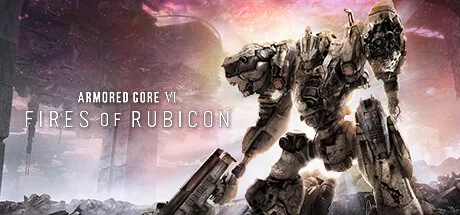
Armored Core VI: Fires of Rubicon is FromSoftware’s return to asymmetric mech action, released August 24, 2023 on Steam and consoles. You are an augmented human — a Raven — mercenary-piloting a mech you assemble yourself across Rubicon. The core pleasure is exactly what it sounds like: the machine you built, flown your way. Every part choice changes attack, movement and defense at once; one mission can be cleared orbiting behind the boss in a light frame or walked through head-on in an assault cannon tank.
Platforms: PC (Steam, Steam Deck “Playable”), PS, Xbox — this guide uses the Steam PC version as its reference baseline | Genre: third-person mech action with campaign, Arena and PvP
Because the freedom is total, new pilots stall in the same three places: Assembly, locking, and the ending branches. This hub maps the whole section around those three choke points.
Game Overview#
| Item | Detail |
|---|---|
| Developer | FromSoftware |
| Publisher | Bandai Namco Entertainment |
| Release date | August 24, 2023 |
| Modes | Single-player campaign, Arena, PvP |
| Player base snapshot | ~156K all-time peak on Steam; recent daily peaks in the high hundreds — third-party snapshots, different sampling windows |
| Review snapshot | ~91–92% positive across 67K–86K reviews (snapshot variance); praise centers on build depth and replay value, complaints on crashes and “more Souls than mech” |
| Expansion | Vault 5 DLC — new parts, ACs and missions; content per in-game data |
A 2023 game with a 2026 guide? Because the systems are dense and the branches hidden: dual Assembly constraints, FCS-chip matching, decision missions that lock your ending. None of that is discoverable by feel alone, and the build space rewards planning in a way the hot-take reviews never captured. Snapshot numbers above come from third-party trackers and move with sampling — treat them as trend, not fact.
The Dual Assembly Constraint#
Every build lives or dies on two load bars, and both must be green before you can deploy:
| Constraint | What it measures | Overload result | Typical fix |
|---|---|---|---|
| Load limit (weight) | Cumulative mass of all parts | Cannot deploy | Lighter frame or parts, fewer weapons |
| EN load | Energy demand of weapons and internals | Cannot deploy | Lower-EN weapons/internals, swap FCS chip |
The two bars are joined by AND — one red light voids the build. Which is why the first move in Assembly is never “pick the biggest gun”: it is checking how much headroom is left. Weapons are the usual overload culprit. Light parts buy movement; tank-build parts buy firepower and armor at the cost of boost quality — that trade runs through every mission and every duel in the game.
The Three Endings Framework#
Three endings are three separate mission routes, each with its own decision missions, endgame chain and final boss — and each playthrough locks exactly one ending. Collecting all three means three full campaigns.
| Ending | Playthrough | Route | Final opponent |
|---|---|---|---|
| The Fires of Raven | Reachable in NG | “Top” choices: Ch.3 M21, Ch.4 M31, Ch.5 M37 | Ayre’s AC — Rubicon 3 ignites |
| Liberator of Rubicon | NG or NG+ | Opposite choices: Ch.1 M06 “refuse the deal”, M22, M32, M38 | Handler Walter |
| Alea iacta Est | NG+ only (third run) | New missions: M26-B, M33-B | ALLMIND, two phases |
Decision missions carry a special icon and a pick-one-forget-one rule: choosing one option makes the other unavailable for the rest of that cycle. Finishing NG auto-rolls you into NG+, so the efficient order is Fires or Liberator in NG, the other in NG+, Alea iacta Est in the third run. Mission anchors are in the three endings guide.
Section Navigation#
| Group | Pages | Solves |
|---|---|---|
| Get started | Parts and Assembly · Frame and Legs | The dual constraint; choosing a chassis personality |
| Combat | Combat mechanics (ZH) · Stagger and melee (ZH) · FCS and targeting (ZH) · Assault boost and air combat (ZH) | Omni-directional movement, stagger, lock-on chips |
| Campaign | Three Endings guide · Boss guides (ZH, part 1 part 2) · Decision missions (ZH) | Routes, branch points, final fights |
| Advanced | Lightweight builds (ZH) · Heavyweight builds (ZH) · PvP basics (ZH) · Arena guide (ZH) · Achievements (ZH) | Build philosophies and endgame |
Pages marked (ZH) currently ship in Chinese; English versions are in progress.
Reading Paths#
- New pilot, can’t figure out Assembly → Parts and Assembly → Frame and Legs → back here for the endings map.
- Stuck on a boss → combat mechanics and stagger pages (ZH now, EN later) → the boss guides, which carry build suggestions per fight.
- Chasing all three endings → Three endings guide with mission numbers per cycle; the Arena’s last three opponents vanish after the third cycle, so clear Arena before you burn NG+.
The Three Mistakes This Section Exists to Prevent#
- Shopping guns before legs. The garage’s #1 new-pilot loop: buying a cool cannon, discovering the chassis cannot carry or aim it, rebuilding from zero. The legs guide inverts the order permanently.
- Treating the load bars as suggestions. They are not. Both gates are absolute, and the fun builds live on the correct side of both — see the assembly page.
- Grinding one machine against a boss exam. Every hard fight in this game is a question with a build-shaped answer. Swapping parts is cheaper than swapping skills, and usually faster.
Quick Answers#
Do I need to play Armored Core before? No. Fires of Rubicon is a soft-reboot entry point: the tutorial garage sequence teaches assembly from zero, and the story is self-contained.
How long is one playthrough? Roughly 20–25 hours for the first cycle at a normal pace, shorter in New Game+ once parts carry over — the game is built to be cycled, not stretched.
Is the assembly screen intimidating? The first hour, yes. After that it collapses into one loop: pick legs, balance the two load bars, slot weapons that match your mobility. This section’s parts guide exists to speed up exactly that hour.
PvP or PvE first? PvE campaign first. The bosses are the game’s real teaching tool, and every fight doubles as an assembly exam — players who skip to multiplayer fight the meta instead of understanding it.
Do difficulty settings change the builds I need? They change how forgiving bad builds feel, not which builds work — the mission’s weight and energy constraints are identical on every setting. Set the difficulty you can learn at, then raise it when the garage habits hold.
Related#
- Elden Ring Guide — the other FromSoftware structure worth mapping before you commit.
- Best Soulslikes — where AC6 sits among the genre’s bosses-by-design.