The Holy Sword Endu: Flight Mechanics and Gem Sockets#

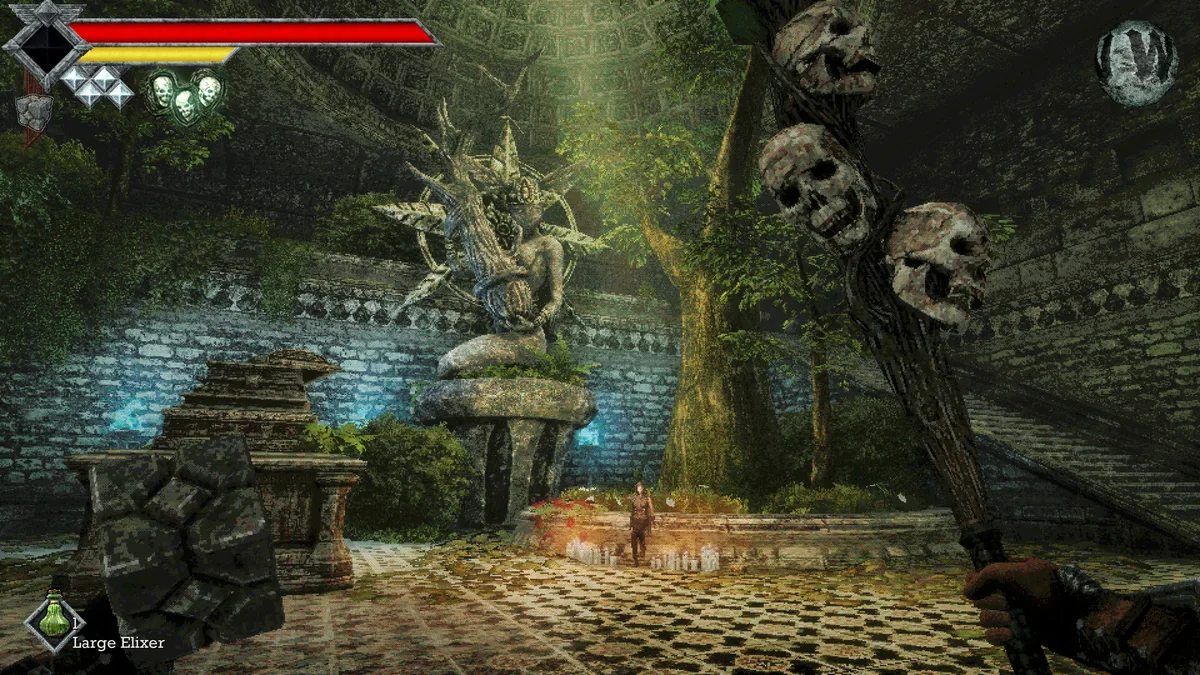
If you remember one thing about Queen’s Domain, remember the sword. The holy sword Endu (Notebookcheck/RPS) is the design that separates the game from every other King’s Field follower: it is a melee weapon and an exploration key at once — air dashes cross chasm platforms, and socketable gems extend the flight distance further (RPS/Notebookcheck). Rock Paper Shotgun described its design philosophy as “force you to walk so you can learn to fly”: first you measure the island on foot, then it lets you fly. This page takes apart its acquisition, mechanics and upgrade line.
How You Get It: the Giant Skeleton Sentinel#
Endu is not found — it is won:
- The boss: the giant skeleton sentinel, the early game’s signature fight (RPS’s playthrough).
- The reward: victory grants the holy sword Endu and unlocks the air-dash/flight ability.
- The catch: skeletons resist sword damage (RPS) — and this opponent is a skeleton. Bring non-sword damage types into the room (the full prep checklist is in the Chinese boss guide).
The reward is structural: unlocking flight rewrites the exploration rules of the entire island. RPS framed it as the game’s core progression loop — get stronger for the sword, open the road for the sword, then let the sword open the map.
What Flight Actually Changes#
Per the official setting and RPS’s review, Endu’s flight is an air-dash/glide — not free flight. Mechanically:
| Dimension | Before the sword | After |
|---|---|---|
| Terrain | Chasms and broken ledges are dead ends | Air dashes cross platforms and gaps (RPS: fly from platform to platform and across gaps) |
| Regions | Unreachable high ground is scenery | Far islands and collapsed ramparts enter the reachable list (RPS) |
| Routes | Detour-first planning | Lines become shortcuts; old areas gain new answers |
| Risk | Wrong turns cost a walk back | A failed air line can drop you — stamina and landing spots still count |
That last row is the warning: flight is not a death waiver. Air dashes spend resources and landing choice is still positioning discipline (stamina rules in the Chinese combat page). Do not misread “I can fly” as “I cannot fall”.
One overlooked change: enemy respawns change dimension too (RPS confirms enemies repopulate as milestones pass) — ground ambushes become “bad landing zones”. Checking what waits beneath your flight path should become a new habit.
Gem Sockets: the Flight Distance Growth Line#
RPS documented Endu’s upgrade mechanic: the sword takes socketable gems that extend the dash (“socketable gems that extend the dash”); Notebookcheck’s account matches — “upgrades let the sword carry you farther”. The design intent is explicit:
- Distance is a ticket: longer dashes put farther platforms and cliffs in range — every gem is a new region.
- Loop progression: RPS’s described loop is “heading down one leg of the world, retrieving a gem, and returning along another path” — down one leg for the gem, back another way, clearing old mysteries now inside your range.
- Top priority: reviews uniformly treat gem-hunting as priority one after the sword (RPS’s four-hour mark was spent entirely on it, happily).
Exact gem counts, locations and distance tiers are not officially published; this page will not speculate. Just run “see a gem, take the gem”.
New Exploration Rules in the Flight Era#
The island-sweeping process from exploration page needs three upgrades once you have the sword:
| Exploration action | Before the sword | After |
|---|---|---|
| “Just out of reach” platforms | Park them on a revisit list | Test each against your dash range |
| Far side of a chasm | Dead end, detour | Now an optional route |
| Tall structures | Look up only | Your vertical playground |
| Revisit list | Wait for gems | One revisit loop per gem banked |
Update the save discipline too: flight-era failures shift from “killed by enemies” to “fell on a bad air line / fell into a pack” — confirm shrine anchors before departing (checkpoint-free rules unchanged, GameSpot).
Endu Is Still a Weapon#
Remember that Endu is a weapon first (official setting: both weapon and exploration key). Two combat facts:
- Skeletons resist sword damage (RPS) — Endu is fundamentally a sword, so against skeleton targets (including its former owner, the sentinel) it has a matchup disadvantage. Swap to a spear or other type for those fights; do not treat the holy sword as universally supreme.
- The weapon special skill and level-with-use rules apply to the whole weapon pool (RPS) — Endu grows through the same system as your other mains.
Sensible division of labor: Endu is your exploration primary and a main weapon for most targets; skeleton-type and bad-matchup targets get the right weapon instead (matchup logic in the Chinese melee weapons page).
Quick FAQ#
Q: Missed the sentinel fight — is it gone? The island is an interconnected maze (official setting) and boss rooms are revisitable. Gear up per the boss guide and go back. AltChar verified that stronger equipment fair-izes these fights.
Q: Is there a flight distance cap? No official number. Mechanically gems keep extending the dash (RPS), so read it as “a cap exists, but gems push it”.
Q: Can flight replace walking? No. RPS’s verdict is precisely “walk first, fly later” — terrain knowledge from walking is the raw material of flight routing, and the stamina economy is unchanged. Flying is an expense, not an exemption.
Q: Will I miss gems? The game gives no collection hints (review consensus), so yes. The counter is the revisit list from the exploration page: note the direction of every “almost reached” gem spot, and run a revisit loop after each flight upgrade.
Q: Will a better weapon retire Endu? No — its core value is the flight mechanic, not the stat panel (official setting: both weapon and exploration key). Whether its numbers scale with the upgrade line is not officially detailed, but nothing else replaces the “exploration key” role.
Flight changes more than travel speed — it redistributes the cost of death: the farther you fly, the farther you are from your last anchor, the bigger the rewind. That is why this section keeps repeating “two anchors before any new route” — the stronger the ability, the stricter the discipline needs to be.
Section Navigation#
- Flight upgrades and region unlocks (Chinese) — the full gem-loop progression mindset
- Boss guides (Chinese) — the sentinel fight prep checklist
- Exploration secrets (Chinese) — the flight-era sweeping process
- Melee weapons (Chinese) — where Endu sits in the weapon pool
- Save Shrines and Respawn Rules — the anchor discipline flight depends on