Dark Souls 3 Stats, Skills and Spells Guide#
The growth system of Dark Souls III is built from nine attributes and three casting systems — sorceries, miracles, and pyromancies — while every weapon also carries a weapon art that costs Focus Points (FP). This page only covers verifiable mechanics and values: role and soft cap for each attribute, attunement slot thresholds, the weapon-art-versus-FP tradeoff, how Dexterity drives cast speed, and how Luck scales bleed and poison. Data from the previous version of this page — “Intelligence thresholds that unlock spells”, spell-by-spell FP tables — could not be verified and has been removed entirely. Each spell’s requirements and FP cost are shown in your attunement menu in-game; trust that display.
The Nine Attributes and What Each Is For#
There is exactly one hard rule for attributes: the hard cap of every stat is 99. Soft caps differ — most attributes lose sharp returns after 40, while a few scale further (cast speed tops at 50, and the power curves of Intelligence and Faith stretch longer). Per-stat guidance:
| Attribute | Effect | Guidance |
|---|---|---|
| Vigor | Sets your HP pool | Soft cap 40 — HP gains per level shrink sharply after 40; extra points do more in offensive stats |
| Attunement | Sets FP pool and attunement slots | Tier by slot thresholds and spell FP costs — most builds land between 30 and 40 |
| Endurance | Sets stamina (green bar) | Hard-stops at 40 — stamina stops growing entirely; the cleanest soft cap in the game |
| Vitality | Sets equip load ceiling | Soft cap 40 — but the number matters less than the load tier: total weight under 70% keeps your normal roll |
| Strength | Damage and scaling for strength weapons | Counts 1.5x when two-handing — if you only need to “wield” a weapon, two-handing saves points |
| Dexterity | Damage and scaling for dexterity weapons, plus cast speed | Damage soft cap 40; cast speed is separate and tops at 50 (see the cast speed section) |
| Intelligence | Sorcery power and staff scaling | Returns slow after 40 — but top staves still gain visibly between 50 and 60; dedicated mages can push higher |
| Faith | Miracle power and chime scaling | Same logic as Intelligence — offensive miracle builds still gain between 40 and 60 |
| Luck | Bleed/poison buildup, Luck-scaling weapons, discovery | Soft cap 40 — the engine of bleed builds, and it also nudges item discovery |
Two universal rules: first, prioritize Vigor early — every build needs an HP bar that survives two or three hits before damage matters. Second, attributes serve infusion and weapons — where your points go depends on what your main weapon scales with; the mechanics are on the Infusions Guide.
Attunement and Memory Slots#
Attunement governs both your FP pool and your number of attunement slots. The slot thresholds are fixed and worth memorizing:
| Attunement | Slots |
|---|---|
| 10 | 1 |
| 14 | 2 |
| 18 | 3 |
| 24 | 4 |
| 30 | 5 |
The rule is direct: if you only attune one spell, never go past 10. Two-spell builds stop at 14, three-spell builds at 18, and mixed sorcery/miracle/pyromancy loadouts need 18 to 24. FP pool growth itself slows between 30 and 40 — rather than over-investing, split more blue Estus; the red-blue ratio can be re-split for free at the Fire Keeper in Firelink Shrine anytime.
Weapon Arts and FP#
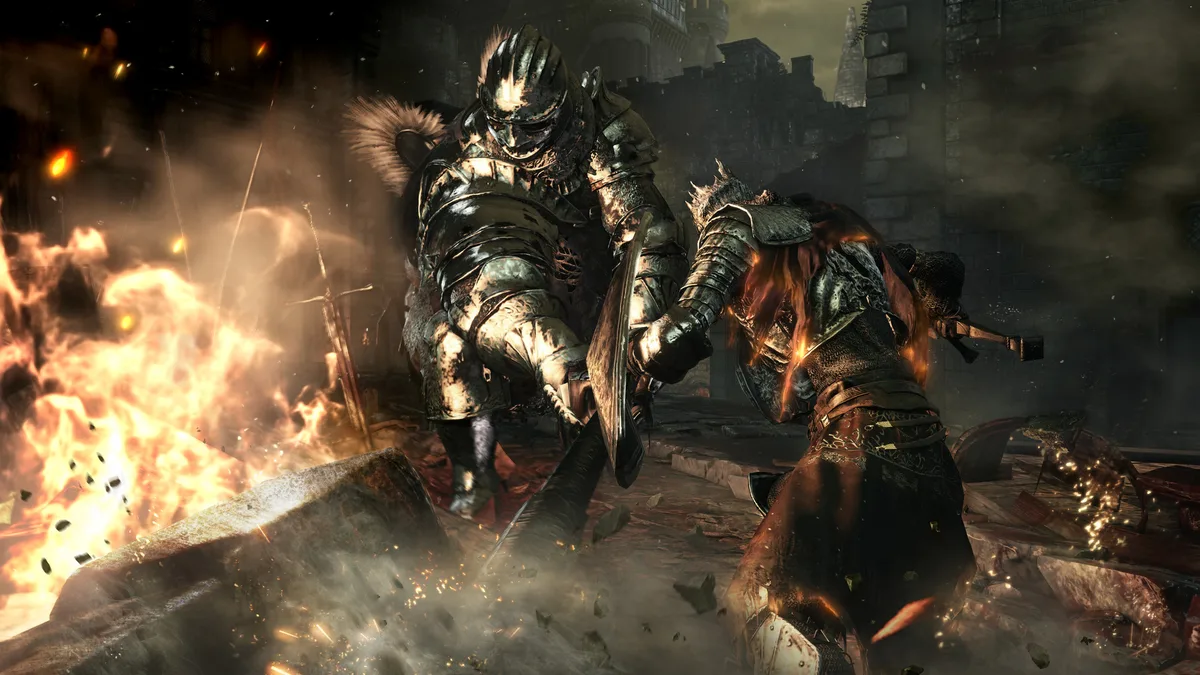
Weapon arts are this entry’s most visible new mechanic over its predecessors: every weapon comes with its own art, triggered with the art button (L2) at an FP cost. Shields and some other equipment carry arts too. Arts generally deal more poise damage than regular attacks and carry heavier animations — the key tools for guard-breaking, interrupting, and finishing boss fights — but their startup animations and recovery make them easy to punish if thrown out mid-enemy-combo.
A few representative arts, all real in-game examples:
| Weapon Art | Common Source | Use |
|---|---|---|
| Spin Slash | Sellsword twinblades | Multi-hit spinning dual-wield attack — relentless close-range pressure |
| Perseverance | Various great hammers | Brief poise and absorption boost — for trading blows head-on |
| Warcry | Various axes | Buffs the next heavy attack — the opener of heavy-hitting styles |
| Stance | Straight swords | Chains into a thrust or sweep — the rhythm tool of straight-sword play |
| Storm Drill | Storm Ruler | The mechanical answer to the Yhorm fight — charged releases deal massive damage to him |
The full FP tradeoff logic lives in the weapon-arts section of the Tips Guide; the core is one line: save FP for guard breaks and big punish windows — trash mobs are not worth it.
Farron Ring and Art Costs#
The Farron Ring reduces weapon art FP cost by 20% — the only ring in the game that directly lowers art costs. Builds that output through arts (Perseverance trades, Spin Slash brawling, Stance-driven straight-sword play) should keep it permanently; pure caster builds are better served by the Sage’s Ring below. Ring selection is covered in the Rings Guide.
One clarification: art FP costs differ per weapon — trust the cost shown when you press L2 in-game. This page deliberately does not reproduce a cross-weapon art table; that data belongs to the game’s own display, not to memory-transcribed lists.
Cast Speed and Dexterity#
Cast speed is driven by Dexterity, and its cap point differs from the damage cap:
- Dexterity 50 is the soft cap of cast speed — past 50 it stops improving, so hybrid dex-melee casters usually push Dexterity straight to 50;
- The Sage’s Ring raises cast speed as an equivalent Dexterity amount: the base ring equals +30 Dexterity of cast speed, +1 equals +35, and +2 equals +40;
- The Sage’s Ring +1 and +2 versions are obtained in the two DLCs.
Resulting build rules:
| Build | Advice |
|---|---|
| Dexterity melee plus casting | Push Dexterity itself to 50 — one curve covers both damage and cast speed, no ring slot needed |
| Pure Intelligence or Faith mage | Leave points in your main stat — cover the cast-speed gap with the Sage’s Ring instead of grinding Dexterity |
| Maximum cast speed | Sage’s Ring +2 pulls a low-Dex character to near-cap casting rhythm — the standard of PvP speedcast builds |
Luck, Bleed and Poison#
Luck is the game’s most unusual attribute: it barely touches weapon attack ratings, yet it controls three separate lines:
- Status buildup: bleed and poison buildup efficiency grows with Luck — weapons carrying bleed or poison gain real status output from Luck points;
- Luck-scaling weapons: Anri’s Straight Sword, from Anri’s questline, is the game’s only straight sword that scales with Luck — the starting point of Luck melee builds;
- Discovery: Luck slightly raises item discovery — the site FAQ’s farming benchmark is “around 40 Luck plus the Gold Serpent Ring”.
The full bleed pipeline runs through infusion: Blood infusion adds bleed buildup that scales with Luck, and Hollow infusion lets the physical rating scale with Luck while requiring your character to stay hollowed — represented by multi-hit dual-wield curved swords like the Grave Warden Twinblades and Carthus Curved Sword. Full build details live in the bleed section of the Builds Guide; infusion mechanics in the Infusions Guide.
The Three Casting Systems at a Glance#
| System | Casting Tool | Main Stat | Character |
|---|---|---|---|
| Sorcery | Staff (catalyst) | Intelligence | Ranged output from the Soul Arrow family and wide slashes like Soul Greatsword |
| Miracle | Chime or talisman | Faith | Lightning and healing — talismans grant poise while casting, safer mid-fight |
| Pyromancy | Pyromancy flame | Intelligence and Faith dual-scaling | Fire and dark — both stats feed it, the glue of hybrid builds |
Entry points and thresholds for each:
- Sorcery: a staff plus Intelligence. Soul Arrow requires only Intelligence 10 — the lowest entry barrier of any offensive spell; the Sorcerer class starts with it and establishes a ranged loop immediately.
- Miracle: a chime or talisman plus Faith. Healing and lightning run in parallel — bring heals into boss fights to save Estus, and output through the Lightning Spear family.
- Pyromancy: the pyromancy flame scales equally with Intelligence and Faith, so balanced investment works. The Pyromancer class starts with the flame and Fire Orb, giving usable fire output from minute one; hybrid Int/Faith builds make pyromancy their mainstay.
On spell requirements and FP costs: every spell lists both in the attunement menu, and spell power values are periodically rebalanced through Regulation patches — this page no longer reproduces per-spell tables. How Regulation updates reshape spell power is covered on the Updates page.
Attribute Quick Answers#
| Question | Rule |
|---|---|
| How much Attunement? | Tier by slot thresholds — 14 for two slots, 18 for three, 30 for all five; stop at 10 with a single spell |
| Not enough FP for weapon arts? | Farron Ring cuts art costs, then split more blue Estus; melee-first builds save FP for key boss-fight arts |
| Dexterity at 40 or 50? | 40 is enough for pure dex melee; hybrid casters take the cast-speed cap at 50 |
| Intelligence or Faith? | Take one past 40; only dual-stat for pyromancy — splitting evenly at 30 leaves both sides weak |
| How to start a Luck build? | Get Anri’s Straight Sword from her questline, or Blood-infuse your current weapon into a Luck-scaling bleeder — details in the Builds Guide |
| How to manage equip load? | Stay under 70% total weight for your normal roll — overloaded rolls lose distance and i-frames |
Summary#
- Nine attributes, hard cap 99; soft caps mostly 40, cast speed 50, and Int/Faith power curves stretching to 50-60;
- Attunement slots unlock at 10, 14, 18, 24, and 30;
- One weapon art per weapon, costing FP — the Farron Ring’s 20% cost cut makes it the permanent ring of art-driven builds;
- The Sage’s Ring converts to +30/+35/+40 Dexterity of cast speed — for pure mages, a ring beats grinding Dexterity;
- Luck governs bleed and poison buildup, Anri’s Straight Sword scaling, and discovery — every benefit of bleed builds flows from this line.
These rules combine with the other topic pages: parrying and combat feel in the Combat Guide, starting classes in the Beginner’s Guide, ring choices in the Rings Guide, and full build plans in the Builds Guide.