Enemies & Hazards Compendium#
The Enemy System at a Glance#
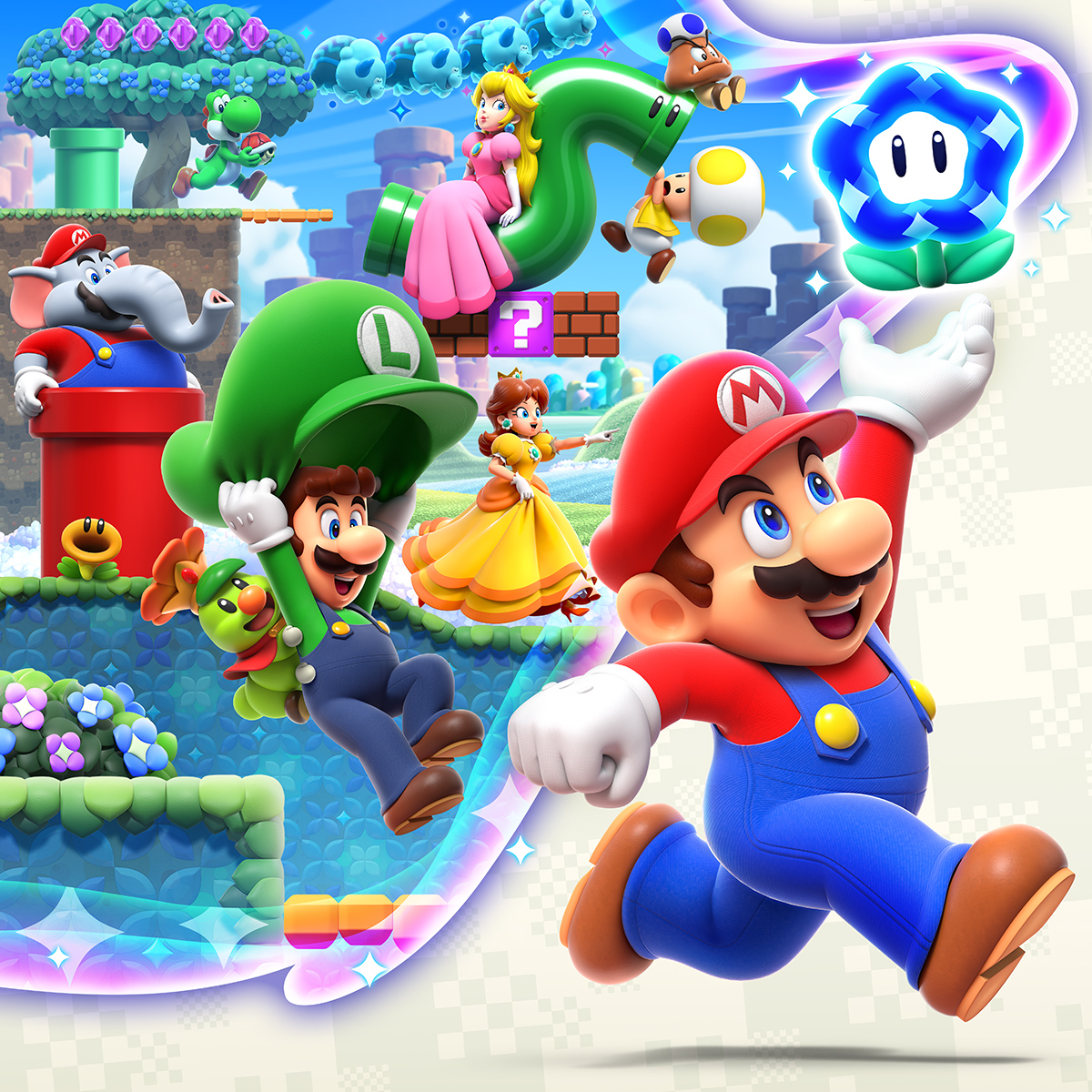
Super Mario Bros. Wonder layers three enemy groups on top of each other: the returning classics every Mario player knows, a set of brand-new enemies built for this game, and special forms that only appear while a Wonder effect is running. On top of them all sits the boss line — Bowser Jr. at every world palace and Castle Bowser at the very end.
Returning Classic Enemies#
Goomba#
The series’ most basic ground enemy walks a fixed route and goes down to a single stomp. In this game Goombas have remarkably expressive animation, and even the flattening animation lands with extra comedy. Several variants appear:
| Variant | Traits |
|---|---|
| Power variant | Stronger and more aggressive behavior |
| Giant variant | Towering over normal individuals, blocking most of the path |
| Bone variant | A skeletal form with different behavior |
Normal Goombas can be stomped, shell-comboed, or cleared with transformation abilities. Against the giant variant, a head-on clash loses to going around it or using the course’s mechanisms.
Koopa Troopa#
The classic turtle enemy retreats into its shell when stomped. The shell is one of this game’s most practical “weapons”: kick it and it slides in a straight line, bowling over an entire row of enemies — downhill terrain turns that into a beautiful chain reaction. Some courses design shells into puzzle tools, used to hit distant blocks or trigger mechanisms.
Piranha Plant#
The carnivorous plant pokes out of pipes and the ground, extending and retracting on a cycle. Never approach an open mouth — wait for the retract window, or clear it from range with fireballs or bubbles. Piranha Plants can’t be stomped, series tradition that holds here.
Bullet Bill#
High-speed munitions fired from batteries, flying in straight lines. They can’t be destroyed conventionally, but you can stomp them for a boost jump — a core technique of many speedrun routes. In some courses their flight paths are fixed; watch the firing rhythm to find the safe window.
Spiny#
The spiked turtle cannot be stomped from above — landing on it only hurts you. Deal with Spinies using ranged attacks, side shell hits, or simply going around. Spinies often mixed in with Koopa Troopas punish mindless stomping habits.
Muncher#
The purple, spike-covered chewing plant tolerates stomps completely — landing on one hurts. What Munchers do respect is transformation power: Elephant Mario can vacuum them up whole, and fire or bubble attacks clear them from range. They typically carpet chokepoints, so plan a route that either removes them or threads between them.
Buzzy Beetle#
The hard-shelled beetle bounces your stomp right back without taking damage — like the Spiny, it needs a different approach. Buzzy Beetles show up in caves and mechanism-dense courses as the “stomp-proof” interceptor.
Brand-New Enemies in This Game#
Trottin’ Piranha Plant#
The game’s signature new enemy: a Piranha Plant with legs that walks around. In normal conditions they strut about in small steps — and once a course triggers its Wonder effect, they break into song and dance en masse, turning the whole course into a musical number. That is this game’s “Wonder” spirit in a single image. Handle them like ordinary Piranha Plants, but note they move: watch their footing before committing yours.
Melon Piranha#
A new Piranha Plant variant that spits melon-shaped projectiles. The melons can be dodged or reflected off the terrain. They usually guard narrow passages and seal off jump lines — suppress them with ranged abilities before passing.
Hoppos#
A new jumping enemy that leaps toward you repeatedly. Their rhythm is fixed, so once you learn the jump interval you can predict their landing points. A stomp is the most direct solution, or you can plan your route around their bounce cadence.
Maw-Maws#
A big-mouthed enemy that snaps at anyone who gets close. The bite has a clear wind-up animation — slip through in the gap after it chomps. Some Maw-Maws are fixed to walls; others track your position.
Condarts#
Bird enemies perched in place that hurl javelins at you. The javelins arc through the air with a short flight time — enough to read and dodge. Clearing the throwers first noticeably eases the road behind them.
Bulrush#
An enemy that looks like a big clump of grass and charges at you. The charge has an obvious tell — when it crouches low, prepare to jump. During Wonder effects the Bulrush charge escalates into a far more frenzied group form (next section).
Enemy Forms That Only Appear During Wonder Effects#
- Wonder Bulrush stampede: huge packs of Bulrushes tear across the course in a sweeping charge — spectacular and oppressive, and you must find footing between the surging grass.
- Wonder Piranha Plant chorus: Piranha Plants move as a group, their song-and-dance performance rewriting the course’s rhythm and route.
- King Boo cameo: the series’ famous ghost king appears during the Wonder effect of specific courses, bringing encounters that don’t exist otherwise.
These forms exist only while the Wonder effect lasts and vanish when it ends. Courses that feature them often bind the Wonder’s “chaos performance” directly to the route through the level — some of the best course design in the game.
The Boss Lineup#
Bowser Jr. / Wonder Bowser Jr.#
The resident boss at each world’s palace is Bowser Jr. The fight itself isn’t complicated — the real show is that every time you hit him, the Wonder energy roosting in Bowser’s castle transforms him into Wonder Bowser Jr., with the form changing by world. Each palace fight uses a different Wonder effect, for example:
- Size change: his body balloons and the arena reshapes around it
- Ice and honey terrain: the floor becomes slippery or sticky special ground
- Floating water blobs: wandering water masses interfere with your positioning
- Duplicates in darkness: multiple hard-to-tell figures appear in blackout zones
In other words, each world’s palace fight isn’t “Bowser Jr. again” — it’s a bespoke boss battle built around that world’s Wonder effect.
The Flying Battleships#
Between the palaces and the castle run the airship courses: Bowser’s flying battleships mixing cannon fire, moving platforms, and progress-under-pressure routes toward the final act. They compress the war atmosphere of the endgame into short, sharp gauntlets.
Final Boss: Castle Bowser#
The game’s final battle unfolds at Castle Bowser — a floating fortress fused from Bowser’s castle and Prince Florian’s. This multi-phase showdown blends platforming with music-rhythm Wonder staging: the fight advances with the music, and you must keep pace with the Wonder performance while answering Bowser’s offense. It’s the emotional and theatrical peak of the story, and a total exam of every skill the adventure has taught you.
Wonder Bowser and the Map-Level Challenges#
Beyond in-course bosses, the endgame layers challenges across the world map itself: Bowser’s siege events, dedicated Badge Challenge courses, bite-sized Break Time trials, and the Special World’s exam gauntlet. Treat them as the campaign’s boss-tier homework — each one sharpens a skill the final battle expects you to have.
Universal Tactics for Every Enemy#
Core Principles#
- Stomp first: most enemies in this game die to one stomp, and stomping costs nothing — but stomp-immune types (Spiny, Muncher, Buzzy Beetle) demand extra care.
- Use the shell: a Koopa shell left behind can sweep a row of enemies. In dense stretches, kick the shell before you advance — it often clears a safe corridor.
- Suppress from range: Fire Flower, Bubble Flower, and other transformations kill stomp-immune enemies at a safe distance — vital against Melon Piranhas sealing a passage.
- Watch, then act: Bulrush charges, Condart throws, and Hoppo jumps all telegraph clearly. Waiting for the opening beats racing through.
Combine Transformations and Badges#
Transformations answer specific enemy types: Elephant form eats Munchers and sprays water, Drill form tunnels beneath hazards, and the ranged forms deal with anything stomp-immune. Badges patch the rest — the Sensor reveals hidden threats, Safety Bounce softens spike-heavy stretches, and Parachute Cap turns descent mistakes into non-events.
Surviving the Wonder Effects#
A Wonder effect is double-edged: it sends stampedes of Bulrushes and rewrites the course structure, but it also opens new routes through the level. The universal rule for Wonder-era enemy swarms: keep moving, don’t linger, and watch for the new paths the chaos just opened.
Summary#
Learn the stomp-immune list cold, keep a shell handy, and read the wind-ups — the enemy roster in Wonder is less about difficulty than about rhythm. Master the three layers (classics, newcomers, Wonder forms) and the palace bosses become celebrations rather than walls, with only Castle Bowser left to demand everything you’ve learned.