Multiplayer Guide#
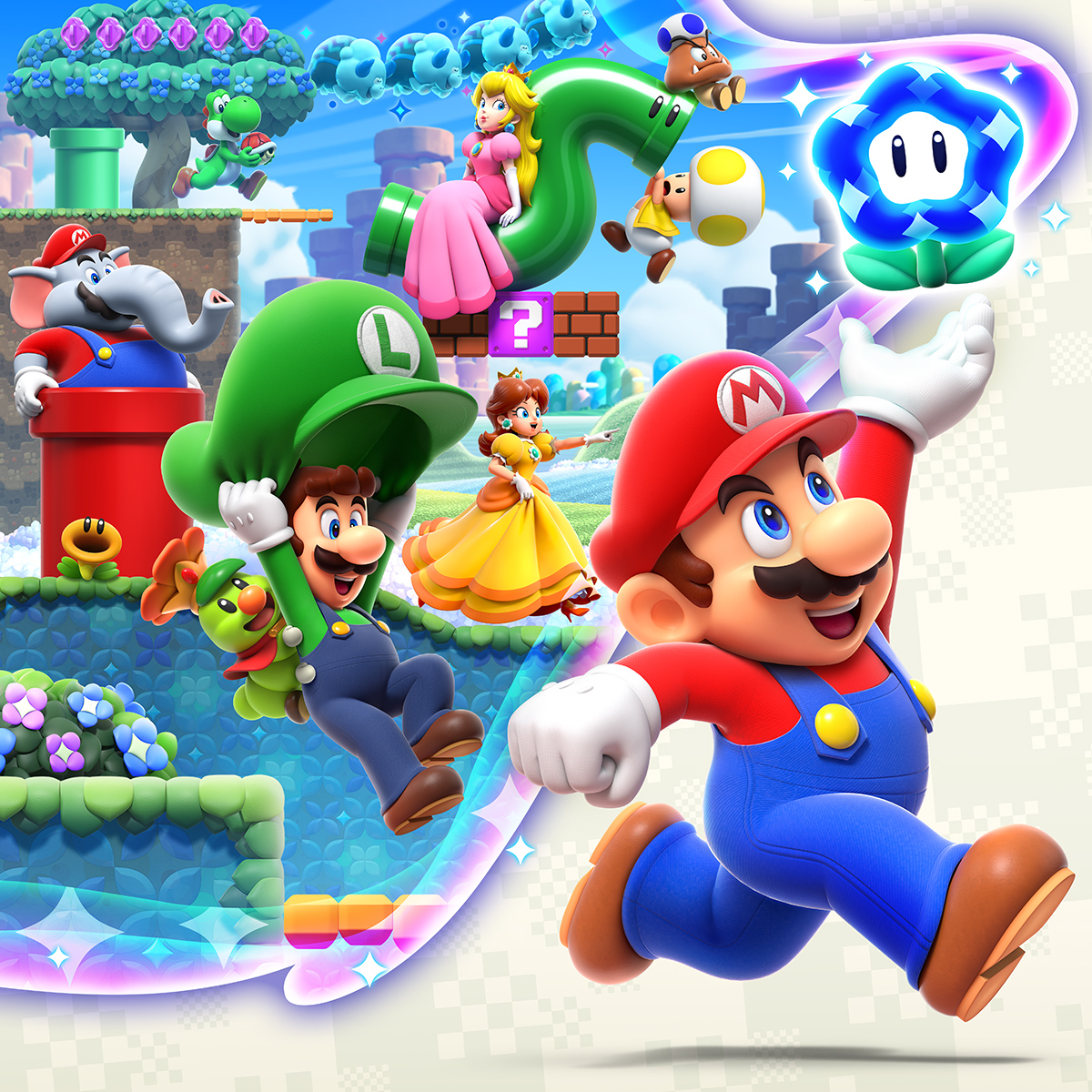
Many people still picture 2D Mario as “one player grinding alone,” but Super Mario Bros. Wonder designed its multiplayer as a complete system: offline, four players can crowd around one Switch for same-screen co-op; online, a full squad of four can run courses in real time; and the world map fills up with other players’ ghosts and standees. This page covers local co-op, online play, character selection, and the rescue mechanics — everything you need before starting a group run.
Multiplayer at a Glance#
| Item | Detail |
|---|---|
| Local co-op | Up to 4 players on one Switch, shared screen |
| Online co-op | Up to 4 players in real time, requires Nintendo Switch Online |
| World map lobby | Up to 12 players share one world map |
| Drop-in | Join anytime without restarting a course |
| Rescue mechanic | Hit players turn into bubbles; a teammate’s touch revives them |
Local and online run as parallel tracks: the same world map supports pure local same-screen play and online teams, with identical co-op rules in both — same-screen cooperation, bubble rescues, and bouncing off each other’s heads.
Local Co-op: Four Players, One Screen#
Basic Rules#
Local co-op is the core multiplayer scenario. All players share one screen through the course — no internet, no split-screen.
| Item | Detail |
|---|---|
| Max players | 4 |
| Internet needed | No |
| Controllers | Each player holds a Joy-Con set or one Pro Controller |
| Display | Shared screen, no split-screen |
Drop-In and Party Adjustments#
The multiplayer party isn’t locked at the start: open the player options menu on the world map and a new player can drop in (Drop-In) mid-session, with all progress fully preserved — no course restart. This design is a gift for families and parties: someone wants to join halfway through, hand them a controller; someone leaves for dinner, the rest keep playing.
What Same-Screen Co-op Feels Like#
With four players on one screen, the team should move as a unit, everyone keeping a comfortable middle distance:
- Spreading too far stretches the team into a long line that one mechanism can wipe at once;
- Clustering too tight interferes with each other’s jump rhythm, especially on narrow platforms;
- Have one route-savvy player lead while the rest follow.
Playable Characters: All 12 From the Start#
Co-op offers 12 selectable characters, every one available immediately — nothing to unlock:
| Group | Characters |
|---|---|
| Mario family | Mario, Luigi, Peach, Daisy |
| Toad family | Yellow Toad, Blue Toad, Toadette |
| Yoshi family | Yoshi, Red Yoshi, Yellow Yoshi, Light-Blue Yoshi |
| Special | Nabbit |
The four Yoshi colors and three Toad colors have identical performance — pick by preference.
Damage-Free Characters and Balance#
Yoshi and Nabbit are the game’s “damage-free characters”: enemy contact and most hazards don’t cost them a power state — they briefly turn invincible and escape instead. As the balancing cost, they differ in jump height and power-up forms. In short: choosing a damage-free character trades some mobility for forgiveness.
| Character Type | Traits | Best For |
|---|---|---|
| Standard characters | Standard jump height and power-up forms | Players with platformer fundamentals |
| Yoshi | Takes no damage, weaker jumps | Beginners, children |
| Nabbit | Takes no damage, unique handling | Beginners, children |
No Hidden Character Stat Sheets#
The game publishes no hidden tables of character speed or acceleration, and there’s no official data on “who runs fastest.” Character differences concentrate in two things: whether they take damage, and deliberate design differences in jumping and power-up forms. Don’t agonize over “who’s strongest” — decide who runs damage-free based on the party’s needs.
Online Co-op and the World Map Lobby#
Requirements#
| Item | Detail |
|---|---|
| Membership | Requires Nintendo Switch Online |
| Online co-op | Up to 4 players in real time |
| Lobby size | Up to 12 players on one world map at once |
Ghosts and Standees in the Lobby#
Once you’re playing online, the world map no longer belongs to you alone: up to 12 players share it, with everyone else appearing as ghosts or standees. You can read their progress — seeing a player who’s fully collected a region tells you it’s worth a sweep — and exchange reactions and items, capturing that “many adventurers are on this map right now” feeling.
Wonder Share#
Online co-op’s signature feature is Wonder Share: the instant another player triggers a Wonder Flower effect, and their action ghosts, stream live into your map and courses. In other words, every online player’s “Wonder moment” is visible to everyone — when some distant player’s course suddenly turns upside down on your map, that’s a Wonder Flower firing.
Badges Stay Consistent Online#
Badge behavior is identical in online play — no special multiplayer rules. Equip your build and it works exactly as it does solo, so a mixed team of badge setups doesn’t break anyone’s experience.
Bubbles and the Rescue Mechanic#
Hit Players Become Bubbles#
In co-op, a player hit by an enemy or hazard turns into a floating bubble instead of exiting the course. A teammate only has to touch the bubble to bring that player back. This dramatically softens multiplayer’s punishment — one person’s mistake doesn’t sink the whole team.
Stomping and Bounce Rescues#
Players can stomp on each other and bounce off teammates’ heads — both a movement technique and a rescue tool. Unreachable ledges and too-wide gaps all yield to a teammate-as-platform. Assign who plays “stepping stone” in a four-player squad and many precision sections get much easier.
Team Building Advice and Play Tips#
Pick Characters by Party Composition#
| Party Situation | Recommended Approach |
|---|---|
| Total newcomers aboard | Newcomers take Yoshi or Nabbit — damage immunity noticeably lowers frustration |
| Parent-child play | Child explores freely as a damage-free character; parent drop-ins take over anytime |
| Four veterans | Any composition works — try high-difficulty badge setups |
| Online teams | Confirm everyone’s membership is active before starting to avoid match disconnects |
Multiplayer Tips#
- Use drop-in to flex the party size — no need to restart to round out four players
- Front players open the route and trigger mechanisms; rear players watch for collectibles and rescues
- After becoming a bubble, don’t drift randomly — float toward teammates to get touched faster
- Online, watch the lobby’s other players — their progress and gifted items are useful information
- Damage-free characters aren’t a panacea: their weaker jumps make some jump-challenge courses harder — choose accordingly
FAQ#
| Question | Answer |
|---|---|
| How many players locally? | Up to 4 on one Switch, same-screen co-op |
| Can players join mid-game? | Yes — Drop-In from the world map’s player options menu, progress intact |
| What does online co-op need? | Nintendo Switch Online membership; up to 4 players in real time |
| Who are the other players on my map? | Ghosts or standees — up to 12 in a lobby, sharing progress, reactions, and items |
| Which characters suit beginners? | Yoshi and Nabbit — both damage-free, balanced by jump and power-up differences |
| A teammate got hit — now what? | They turn into a floating bubble; touch it to bring them back |
| Are there hidden stat differences? | No official stat sheets — differences are damage immunity plus jump and power-up forms |
| Do badges work online? | Yes — the badge experience is identical online |
Closing Note#
The multiplayer design philosophy here is “lower the barrier, raise the floor” — damage-free characters let anyone play, bubble rescues keep mistakes from ruining the experience, drop-in lets party size flex with actual attendance, and the online lobby adds a touch of fellow-traveler warmth to a solo-style game. Whether it’s weekend family time or remote co-op with friends, spend a few early worlds building chemistry first — agree on who leads and who sweeps the rear, and every co-op course after that runs far smoother.