Twenty-Four Years Later, Back Onto the Halo#
Hey everyone, Longzhui Ri here.
Halo: Campaign Evolved officially launched today. I put in a weekend plus one all-nighter and cleared all 13 missions - 10 remastered originals and 3 brand-new prequel missions, on Heroic, in roughly thirteen hours. I died plenty of times along the way, and plenty of those times in the exact same spot. But the guide isn’t what I want to talk about - the full walkthrough, covering every mission’s routing, every collectible location, every weapon verdict, and the cross-platform co-op tutorial, is already compiled in our Halo: Campaign Evolved hub, with Zixing’s PC optimization guide hanging right there too. I want to talk about something else.
The first time I played Halo was 2002, in a magazine’s office. The Xbox had launched not long before, the office had gotten hold of one, and the editors took turns carrying it home to “evaluate” it. The week it was my turn, I hauled the CRT television from the living room into the bedroom, killed the lights, and put on headphones.
There were no Chinese guides to consult back then, so I chewed through the English by brute force, knowing only that the green helmet was called Master Chief, and that the vehicle he drove was called the Warthog - which our editorial office had nicknamed “the monster truck.” The first time I ran into the Flood in the 343 Guilty Spark mission, I pulled off my headphones and breathed for a full ten seconds. I mentioned it at the next story meeting and got teased about it by the old editor-in-chief for the better part of a year - “you got scared by a video game?” I still remember that afternoon to this day: the whole office crowded around watching the Flood pour out of the ventilation shafts, and someone yelled, and the entire room jumped. That kind of fear isn’t piled up through enemy counts - it’s Bungie kneading pacing and atmosphere straight into your bones.
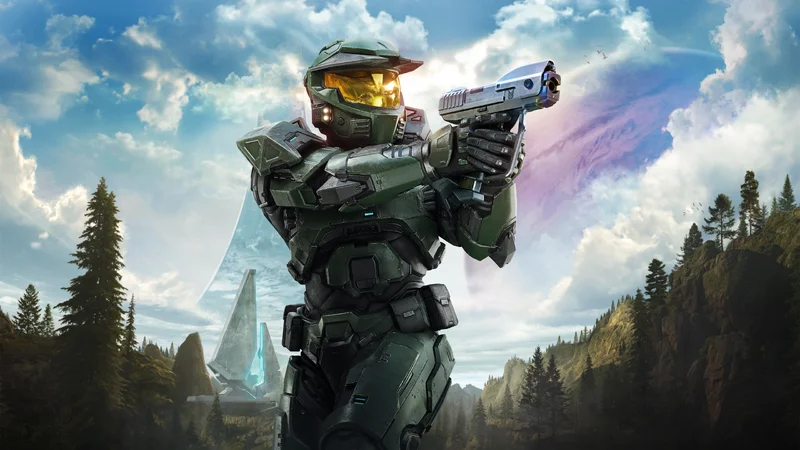
Opening Campaign Evolved today, walking out of the cryo bay aboard the Pillar of Autumn, with Unreal Engine 5’s light falling across that corridor - the exact same layout, the exact same doors, but everything is different. Honestly, for the first ten minutes I kept drifting off, not because it wasn’t fun, but because my head was replaying these twenty-four years. People say objects remind you of people; for me it was the ship reminding me of the years. That Pillar of Autumn being chased down by the Covenant, that AI Cortana who once said “sorry, I have to take the ship up” - standing in front of me again more than two decades later in nearly brand-new materials, I couldn’t tell whether to call it nostalgia or a reunion.
How many sequels has Halo shipped in those twenty-four years? Let me count: 2, 3, ODST, Reach, 4, 5, Infinite. Plus the two Gears of War mecha titles. Plus today’s remake. Has anyone ever tallied how many years Master Chief has been running across our screens? He’s certainly older than most university students. Back then I was the new hire sitting on the editorial office couch playing this game; now I sit here writing this column, and the younger editors outside the window have been swapped out batch after batch. Time really does play by no one’s rules.
Back to the remake itself. The smart thing Halo Studios did this time is that they resisted the urge to mess with the “2001 flavor.” That downhill stretch in Assault on the Control Room where you drive the Scorpion tank - back then I could drive it with my eyes closed, and today I can still drive it with my eyes closed. That looks like “no progress,” but it’s actually the hardest line to hold in remaking: the thing a remake fears most is not inadequate technology but a team that believes it understands the game better than the original crew did and insists on stuffing its own ideas inside. Fortunately, Halo Studios held the line - they preserved the original level pacing and spatial memory and upgraded only the materials, lighting, and shadows. That isn’t laziness. That’s respect. The nine new weapons slot in without any clash, the Energy Sword appears in the Combat Evolved campaign for the first time, and the Elite’s scream when it takes a blade is exactly the same as the original - that’s what a remake’s attitude should be.
That said, some things deserve criticism. What exactly is the deal with cutscenes locked at 30 fps? Every single time I switched from 90 fps gameplay to 30 fps cinematics, I had to wonder whether my graphics driver had crashed. And I genuinely resent not being able to turn off chromatic aberration and film grain - before the PC reviews even landed, Zixing was already shouting in our group chat that with Unreal Engine 5 games you have to watch whatever’s hard-locked by default, and sure enough he called it. He also kept a list at the time of which settings were “nominally adjustable, functionally inert” in the remake, and that list ended up saving several players a lot of grief. Hardware people are just built this way - they look at problems from an angle pure players don’t. We care about “is it fun”; he cares about “why exactly can’t this frame rate go all the way up.”
Speaking of Zixing - the editorial office argued about this for a week. Chasun argued that Quality mode’s 4K ray-traced reflections were worth the frame loss; I spent half a day countering that 1440p with DLSS at ultra-performance was the correct answer. Neither of us won, but he did fix several data errors in my PC optimization guide. That’s just our editorial office’s daily life - argue all you want, the work still has to be done right. Chasun’s method of “reverse-engineering design intent from mechanics and numbers” happens to be razor-sharp on remakes: to judge whether a remake was made with care, look at how much of the original’s numbers and levels were touched, and toward what purpose - and you’ll know.
The three prequel missions of Operation: METEORITE deserve a separate line: worth playing. These are not filler missions padding out a list. The infiltration stretch of Boarding Action and the Banshee space battle at the end of Heavy Burden are both above par. Total playtime runs roughly ten to fourteen hours, with the prequel portion taking up about three hours - that payload justifies the $49.99 price. Above all, the prequel missions stitch the storyline back into the original’s opening, letting you understand why Master Chief wakes aboard the Pillar of Autumn at all, and that bit of setup is handled with real care. It isn’t “three extra levels stapled on to inflate the runtime” - it’s the missing puzzle piece of the original narrative, slotted into place.
Let me end with something practical. I don’t know how many new players today would care about an Unreal Engine 5 remake of a 2001 game. If you’ve never touched Halo, Combat Evolved’s level design genuinely shows its age - repetitive corridors, symmetrical rooms, no navigation points, navigation by memory. But my position is: precisely because it feels old, you should play it once. Because so much of what this game defined is still the common language of first-person shooters today - regenerating shields, a two-weapon limit, the final countdown of an escape run. You’ll recognize these shadows in countless shooters that came after, and their home is right here.
You can treat this remake as a window onto how the entire shooter genre grew into its present shape, step by step. Master Chief never speaks, never removes his helmet, yet became one of the most recognizable protagonists in video games, and what got him there is “the restraint of Halo’s design language itself.” Today’s new games can’t wait to shove every emotion and every piece of lore directly into you, and Halo’s early habit of “show, don’t explain” has become a kind of luxury.
I’d also like to draw the line between this remake and our own hub coverage - strictly speaking, Halo: Campaign Evolved retells the story of Halo: Combat Evolved, and our hub guide follows the same logic, mapping the campaign, the lore, the weapons, the enemies, the collectibles, and the cross-platform multiplayer side by side. If you’re just starting out, reading through the hub’s mission-by-mission breakdowns in chapter order, with the level names from this piece as anchors, makes the mapping much easier. The tank run in “Assault on the Control Room” especially - the hub’s routing detail is far more precise than my “you can drive it with your eyes closed,” so read and play in tandem.
I mention this not to advertise our own guide - it’s to underline the remake’s real value for newcomers: it rewires “an old game’s interface” onto “a new player’s habits.” Every route that old-timers memorized by rote can now be laid out clearly in a written guide. That’s why I think remakes like this shouldn’t be underestimated: they don’t just give the nostalgic a reason to look back - they hand people who never lived through the era a fresh doorway.
If you’re an old player, there’s nothing more to say. You already know whether to buy it.
All I’ll add is this: seeing the Flood’s models redrawn in Unreal Engine 5 until they crawl down your spine again, seeing the Energy Sword leave its sheath for the first time in Combat Evolved’s corridors, I did feel that vertigo of an old dream relived. That’s probably what a remake is for - it can’t replace the original’s place in your heart, but it can confirm that the things that once made you gasp still hold up today.
I just want to use this occasion to say thank you: to that console our editorial office queued up to carry home, to the developers of an era that made games this clean, and to everyone who has played and talked Halo with me across these twenty-four years. People of our generation like to say “it’s just a game” - but every game we’ve played is a keepsake that time left behind.
— Longzhui Ri, NTGame Editor-in-Chief