AMD BC-250 Mining Card Modded to Run FSR 4: A Linux Gaming Console Built from PS5 Reject Chips by the Open-Source Community#
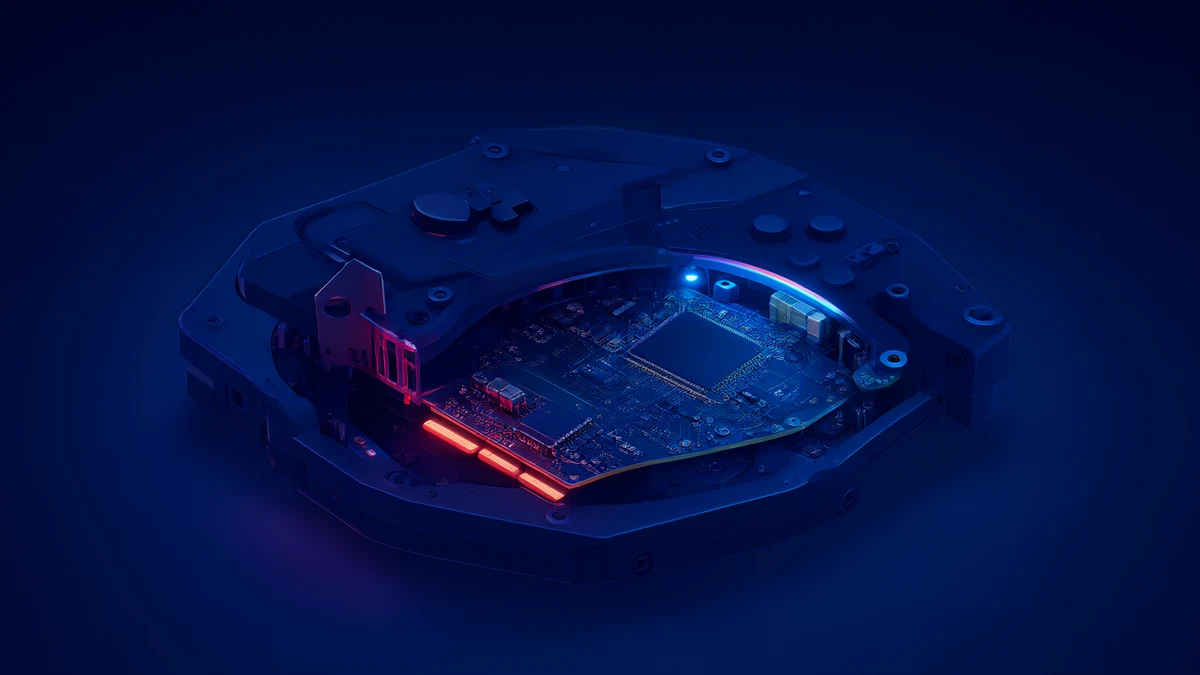
Hello everyone, I’m Zixing, and for this piece I brought Wubian along to chat. The trigger: the open-source community recently did something rather “absurd” and rather beautiful — they took a batch of AMD BC-250 cards built for cryptocurrency mining and modded them until they ran AMD’s own flagship AI upscaling technology, FSR 4. Graphics processing time at 1440p dropped from 11.51 milliseconds to 5.92 milliseconds — a reduction of over 50%. These cards were originally dumped at fire-sale prices by mining farms because they carry PS5 “reject chips,” and now they’re being converted in bulk into Linux gaming consoles.
I handle the hardware and performance numbers; Wubian covers AI upscaling and the open-source ecosystem. Let’s take this story apart piece by piece.
1. What Exactly Is the BC-250#
1.1 A “Failed Official Product” Mining Card#
The AMD BC-250 is a fascinating card. It was originally a dedicated mining card AMD launched for the cryptocurrency market, a derivative of the “Navi 10” core, essentially using RDNA 2 architecture silicon sourced from the same lineage as the PS5. The catch: this silicon failed PS5 quality standards at factory testing — either some compute units were disabled, or the frequency binning fell short, or certain units had flaws. In short, it’s the reject silicon Sony left behind.
AMD didn’t waste the chips; they put them into the BC-250 mining card with a “waste not” philosophy. The mining card’s design is extremely narrow: no video output (or a broken one), no gaming-optimized drivers, a locked BIOS, and power/cooling engineered for 7×24 mining marathons. Prices were once hammered to rock bottom, and after the mining boom collapsed, piles of them gathered dust on the secondhand market.
| Item | BC-250 mining card | Notes |
|---|---|---|
| Architecture | RDNA 2 (Navi 10 derivative) | Same lineage as the PS5 and RX 5700 series |
| Chip origin | PS5 reject chips | Compute units disabled or frequency binning below standard |
| Original purpose | Dedicated crypto mining | No full video output, locked BIOS |
| Driver support | Official drivers essentially unmaintained | Gaming scenarios all but abandoned |
| Secondhand price | Rock bottom (fire-sale prices) | Piles of surplus after the mining bust |
| Power/thermal design | Built for 7×24 mining runs | Large cooling headroom |
How can it run something as advanced as FSR 4? That requires explaining how FSR 4 actually works — Wubian’s territory.
2. How FSR 4 Upscaling Actually Works (Wubian’s Take)#
2.1 From “Handwritten Algorithms” to “Deep Neural Networks”#
Wubian’s opening line goes like this: FSR reached version 4.0 because it changed in kind, not in degree.
FSR 1.0 was pure spatial upscaling — edge detection and sharpening to stretch a low-resolution image upward. Fast, but the details don’t survive a close look. FSR 2.0 switched to temporal upscaling, using motion vectors from history frames to “accumulate” information; quality took a clear step up, but it was still a hand-written algorithm tuned by parameters.
FSR 4.0 changed tracks entirely: it became deep-neural-network-based upscaling. The core is a convolutional neural network or Transformer-like super-resolution model that takes the low-res current frame, history frames, motion vectors, and depth information, and outputs a high-resolution image. This model must be trained on huge volumes of high-quality game frames and native high-resolution frames to reconstruct detail, handle edges, and suppress ghosting close to native rendering.
At the algorithm level, FSR 4’s workflow breaks down roughly like this:
| Module | Role | Notes |
|---|---|---|
| Input preparation | Low-res frame + history frames + motion vectors | Supplies the spatiotemporal information for reconstruction |
| Feature extraction | The network’s convolution layers extract image features | Learns edges, textures, geometric structure |
| Temporal fusion | Combines history frames for motion compensation | Suppresses flicker and ghosting (temporal artifacts) |
| Upsampled reconstruction | The network generates high-resolution detail | Outputs the final image at target resolution |
| Sharpening and post-processing | Suppresses artifacts, improves the look | Handles unnatural high-frequency noise |
Wubian stresses one point: FSR 4 is fundamentally AMD using AI to “guess” the pixels that were thrown away. Rendering 1440p up to 4K means that, of every 9 pixels, 4 are AI guesses. How accurate the guesses are directly determines image quality — and directly determines whether this card still has any gaming value.
2.2 Why Neural Upscaling Eats GPU Performance#
This is also the fundamental reason FSR 4 has been slow to roll out widely: neural network inference requires massive matrix multiplications and convolutions, which are exactly the workloads GPU compute units are best at — and most starved for.
On RDNA 2 silicon like the PS5 and BC-250, there is no dedicated Tensor Core to accelerate AI inference. NVIDIA’s DLSS is strong because every card since the RTX 20 series has dedicated Tensor Cores for matrix math, so the upscaling model essentially rides along. On AMD’s side, RDNA 2 before the RX 7000 had no dedicated AI acceleration hardware, so FSR 4 has to be “chewed through” on generic shader units using general matrix multiplication.
That’s why, in AMD’s own roadmap, FSR 4 was initially reserved for the RX 7000 (RDNA 3) and RX 9000 (RDNA 4), which have AI acceleration units. The BC-250, an RDNA 2 mining card, was theoretically nowhere near the support list.
3. Why PS5 Reject Chips Can Run FSR 4 (Zixing’s Take)#
With the theory covered by Wubian, I get to pose the harder question: since RDNA 2 lacks AI acceleration units and FSR 4 was theoretically meant for RDNA 3/4, how on earth does the BC-250 run it?
3.1 “Reject” Doesn’t Mean “Crippled Beyond Use”#
First, clarify the term “reject chip.” The Navi 10 core in the BC-250 typically has a portion of its compute units (CUs) disabled, or weak frequency binning, or a flawed display engine/encoder. But the core instruction set, the general-purpose shaders, the rasterization pipeline, and the underlying general-purpose matrix math are largely intact.
In other words, what got disabled may be precisely the part that isn’t most critical for AI inference. As long as the model can run matrix multiplication on the generic shaders, a reject chip can still infer — just a bit slower.
The key insight: FSR 4’s inference depends on general matrix multiplication (GEMM) and convolutions, which on RDNA 2 shaders are done with general-purpose instructions — no dedicated AI unit needed. So if what was cut is gaming-oriented render units or frequency headroom, the impact on FSR 4 inference is limited.
3.2 The Open-Source Drivers’ “Brute-Force Adaptation”#
The community got FSR 4 running by wiring up a complete open-source toolchain. The BC-250’s official drivers were essentially abandoned, and the gaming scenario even more so. But the open-source Linux drivers (Mesa + RADV) support RDNA 2 extremely well, and the community stood up FSR 4’s inference pipeline on generic compute shaders (similar to a Vulkan compute pipeline).
Put another way, what the community actually did was: bypass the official drivers, use the open-source stack to unlock RDNA 2’s general-purpose compute, and write a “translation pipeline” that lets the FSR 4 model execute on generic shaders. That pipeline spreads the math that would normally need a dedicated AI accelerator across a large number of generic shaders running in parallel.
3.3 Why It Can Be Mass-Revived as a “Gaming Console”#
Zixing’s view: the reason these cards are being converted in bulk into Linux gaming consoles comes down to a few natural hardware advantages:
| Advantage | Notes |
|---|---|
| Architecture integrity is sufficient | Rasterization, shaders, general compute all still work |
| Big thermal headroom | Designed for 7×24 mining; gaming loads are easy |
| Open-source driver support | Mesa/RADV is very mature for RDNA 2 |
| No full video output | Needs a mod to connect a display, but feasible under Linux |
| Extremely cheap | Bought at fire-sale prices, so mistakes are affordable |
Combined with FSR 4 easing the high-resolution load, these cards can render at a low resolution and let AI upscaling carry the image to the target resolution — achieving the magic of “low-end hardware, mid-to-high-end image quality.”
4. Performance Optimization: 11.51ms → 5.92ms (Zixing’s Take)#
4.1 Where the Numbers Come From#
Wubian and I aligned on the basis of this data point. The 11.51ms and 5.92ms refer to the single-frame time of the entire FSR 4 upscaling graphics pipeline at a 1440p target resolution. The output is 1440p; the input is lower (possibly 1080p or below).
| Stage | Time before | Time after | Reduction |
|---|---|---|---|
| FSR 4 upscaling inference | 11.51 ms | 5.92 ms | -48.6% |
| Converted frame rate share | Time cost of about 87 fps | Time cost of about 169 fps | — |
Over 50% off. The raw number may not land, but convert it to frame rate and it becomes intuitive: at 11.51ms per frame, upscaling alone eats the equivalent of about 87 frames at 1440p; at 5.92ms, upscaling’s share of the frame budget nearly halves, letting the game itself spend more performance on real rendering.
4.2 Breaking Down the Optimization Techniques#
The community cut the time by more than half not through some magic trick but through sustained iteration in several directions. Zixing groups them into four categories:
| Direction | Specific technique | Effect |
|---|---|---|
| Operator fusion | Merging multiple small convolutions/matrix multiplies into one large computation | Reduces kernel launch overhead, improves parallel efficiency |
| Precision choice | Approximate inference with low-precision numbers (e.g., FP16/BF16) | Cuts computation; memory bandwidth pressure drops too |
| Operator reordering | Optimizing convolution layer execution order and memory access patterns | Improves cache hit rate, reduces memory stalls |
| Workgroup tuning | Adjusting compute tile (thread group) size and layout | Fills the shaders, reduces idle time |
Precision choice is the most immediately effective one. Neural upscalers actually tolerate some numerical precision loss; FP16 or lower precision loses nothing visible on many layers while multiplying down the compute pressure on generic shaders and the memory bandwidth demand. For reject chips — hardware that’s “tight on both compute and bandwidth” — this is nearly the single most cost-effective cut.
4.3 Why the Drop Is So Non-Linear#
Going from 11.51 to 5.92 isn’t a simple “twice the optimization, twice the speed” — it’s because these optimizations compound. Operator fusion cuts kernel scheduling overhead, precision choice slashes floating-point volume, and workgroup tuning spreads the remaining work more evenly. The gains multiply rather than add, which is how you get past the 50% mark.
5. Why 1440p Is the Practical Ceiling (Zixing + Wubian)#
5.1 The Hard Wall of Compute and Bandwidth#
Wubian jumps in first: “1440p is the practical ceiling” is, at bottom, a limit set jointly by compute and bandwidth. The higher FSR 4’s target resolution, the more pixels the AI must “guess,” and inference cost rises nearly proportionally. From 1440p to 4K, the number of reconstructed pixels roughly doubles-plus (1440p is about 3.7 million pixels, 4K about 8.3 million), and inference time climbs right along with it.
Zixing adds the second, hardware-level lock: the BC-250’s RDNA 2 reject silicon has memory bandwidth as a congenital weak point. High-resolution upscaling requires constant reads and writes of high-res intermediate frames, history frames, and feature maps; once bandwidth runs short, it becomes a brutal bottleneck. If the reject silicon’s bandwidth binning is also cut down, the data movement at 4K will crush performance outright.
| Target resolution | Reconstructed pixels | FSR 4 inference load | Verdict |
|---|---|---|---|
| 1080p | About 2.07 million | Low | Easy and smooth |
| 1440p | About 3.7 million | Medium | Acceptable after optimization; the practical ceiling |
| 4K | About 8.3 million | High | Bottlenecked on both bandwidth and compute; not practical |
5.2 The Reject Chip’s Silicon Ceiling#
The BC-250’s chips were the ones left after selection — frequency binning, compute unit count, and memory controller stability have all been discounted. Even modded to unlock more units, they can’t match a native flagship’s margin for abuse. Long-duration high load at 4K is unfriendly to weaker silicon, both thermally and for stability.
5.3 The Practical Conclusion#
So setting 1440p as the practical ceiling is a very pragmatic judgment: at 1080p, the BC-250 can game comfortably on FSR 4; at 1440p, after community optimization it delivers acceptable quality and frame rates; but at 4K, the twin ceilings of compute and bandwidth send the experience straight downhill. For these mining cards converted into Linux gaming consoles, 1440p is the “achievable and worthwhile” sweet spot.
6. Community Penetration of AI/ML Upscaling and the Open-Source Ecosystem (Wubian’s Take)#
6.1 From “Vendor-Exclusive” to “Community-Moddable”#
Wubian says this is the part that excites him most. Technologies like DLSS, FSR, and XeSS were essentially “black boxes” built behind closed doors by a few big vendors — which cards got support and how they were optimized was entirely the vendor’s call. FSR’s first two generations spread wide across games thanks to being open source, but FSR 4 being “reverse-ported” by the community onto RDNA 2 mining cards the vendor never planned to support is a different thing entirely.
It proves: when an AI technology exists as a model plus open-source drivers, the boundary of what’s possible is no longer drawn by the vendor — it’s drawn by what the community can do.
6.2 Why the Open-Source Ecosystem Is So Vital Here#
Wubian attributes it to several layers stacking up:
| Layer | Why it lets the community “make moves” |
|---|---|
| Open drivers | Mesa/RADV lets RDNA 2 hardware be tuned freely |
| Portable models | AI upscaling models run on generic shaders, not tied to dedicated hardware |
| Mature toolchain | VKD3D/Proton/Vulkan under Linux get games running |
| Dirt-cheap hardware | Fire-sale mining cards mean a very low cost of failure |
| Community culture | The open-source world willingly keeps investing in “niche hardware” |
6.3 What This Means for the Industry#
Wubian’s view: on the surface, the BC-250 running FSR 4 is “a bunch of hardcore gamers playing with discarded cards,” but underneath it pulls two trends of AI upscaling into view.
First, AI upscaling is moving from “flagship-exclusive” toward “universally accessible compute.” Once the upscaling model no longer depends on dedicated AI units and can run on generic shaders, theoretically any old card, budget card, or even mining card with enough compute has a shot at “AI image quality.” That drags the hardware barrier for AI upscaling way down.
Second, the open-source ecosystem’s penetrating power has been proven immense. As long as the model is obtainable, the drivers are modifiable, and the toolchain can be connected, the community can port a “vendor-limited” technology onto hardware the vendor would never have dreamed of. That kind of ecosystem vitality has, in a sense, already outrun the vendors’ own roadmaps.
6.4 Limits and Risks#
But Wubian isn’t all optimism — he pours some cold water too:
- FSR 4 running on generic shaders draws notably more power and heat than a dedicated AI unit would; the mining card’s thermal headroom now becomes an advantage.
- Reject silicon is, after all, binned-down silicon; long-term stability and lifespan under heavy load remain open questions — better as a “toy” than a “daily driver.”
- This kind of modding depends heavily on community maintenance; if one key open-source component stops being maintained, the entire modding chain could break.
- AI upscaling on low-end hardware still trails a flagship’s native high-resolution rendering — a compromise that “trades performance for image quality.”
7. Closing: An Experiment in “Reshaping Hardware Value”#
Zixing wraps up. The core message of the BC-250 running FSR 4 is actually simple: a chip banished to the mines for being judged “defective” never truly lost its value. It was only missing the right posture to set it free. Once the open-source community ported an AI upscaler like FSR 4 onto it, the reject chip’s general-purpose compute was reactivated, and paired with the pragmatic sweet spot of 1440p, these nearly-discarded mining cards earned the right to become Linux gaming consoles.
Wubian adds: the real story here is the open-source penetrating power of AI upscaling. FSR 4 is no longer just an image-quality feature; it has become a general capability the community can freely rewrite, reverse-port, even “downgrade-fit.” Once an AI technology takes root in the open-source ecosystem, its vitality is no longer dictated by the vendor’s spec sheet.
This Linux gaming console built from PS5 reject chips may never run 4K flagship image quality, but its 1440p performance already proves one thing: with open source and AI pulling together, hardware’s value will always be more imaginative than its factory price.
— Zixing (hardware) & Wubian (AI perspective), NTGame Editorial