Japan National Team Guide#
Basic Information#
| Item | Details |
|---|---|
| Federation | Japan Football Association (JFA) |
| Confederation | AFC (Asia) |
| World ranking | Around 20th |
| 2026 title probability | 1-3% |
| Best World Cup finish | Round of 16 (2002, 2010, 2018, 2022) |
| Best Asian Cup finish | Champions 4 times (1992, 2000, 2004, 2011) |
| Tactical tradition | Collective possession + discipline, technical football |
| Squad traits | Many Europe-based attackers, a young defence |
Japan’s playing value in Football Manager 2026 comes from being an “extremely high floor, ceiling set by game-breakers” side: the collective technical base is a tier above the rest of Asia, but the lack of a world-class striker and dominant centre-backs means they often control matches against European elites without winning them. The coaching mission has two steps: the near goal of escaping the World Cup group and reaching the last 16, and the long game of feeding Europe’s leagues from a huge academy base.
Recommended Formation: the 4-2-3-1 Possession System#
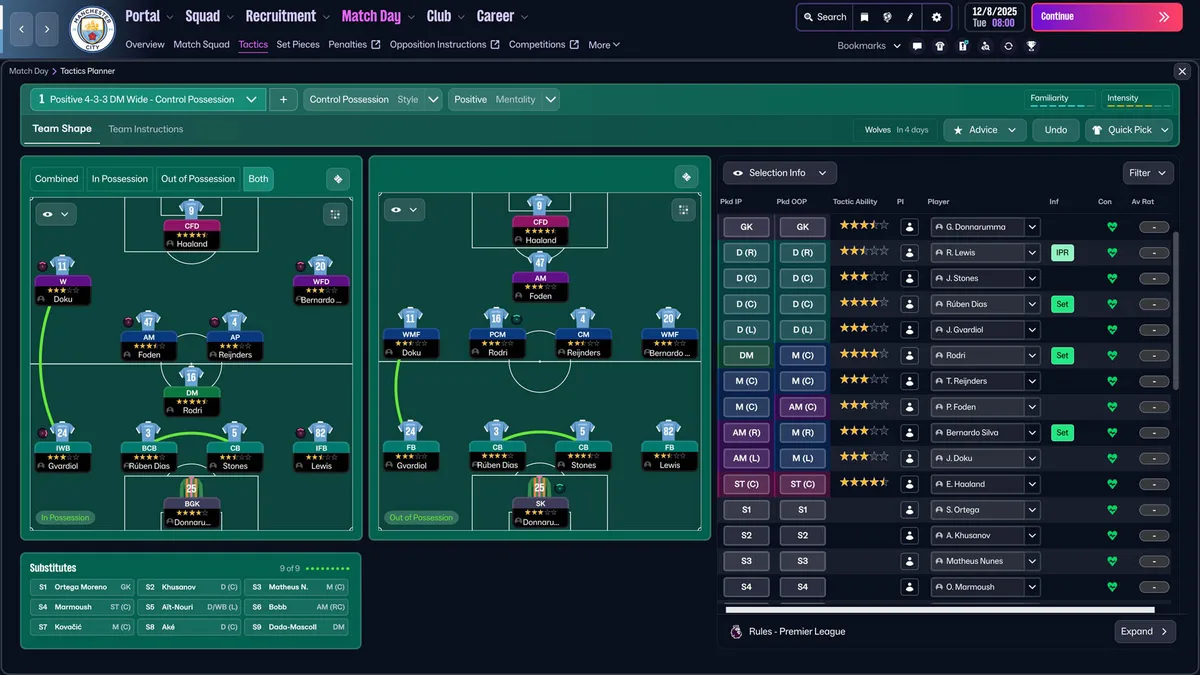
The best fit for Japan’s player profile: a double pivot shielding behind, an attacking midfielder linking, and the two most talented game-breakers owning the flanks.
| Position | First choice | Role |
|---|---|---|
| Goalkeeper | Shuichi Gonda | Goalkeeper-defend |
| Right-back | Yukinari Sugawara | Full-back-automatic |
| Centre-back | Takehiro Tomiyasu | Ball-playing defender-defend |
| Centre-back | Ko Itakura | Central defender-defend |
| Left-back | Yuto Nagatomo | Full-back-automatic |
| Defensive midfield | Wataru Endo | Anchor-defend |
| Defensive midfield | Ao Tanaka | Deep-lying playmaker-support |
| Right wing | Takefusa Kubo | Inside forward-attack |
| Attacking midfield | Daichi Kamada | Attacking midfielder-attack |
| Left wing | Kaoru Mitoma | Winger-attack |
| Striker | Ayase Ueda | Advanced forward |
The key is the double pivot’s division of labour: Endo sweeps and intercepts, Tanaka plays out of defence into attack. That frees the front three to the maximum, letting Japan hold high possession in structured play.
Key Players#
| Player | Position | Traits |
|---|---|---|
| Takefusa Kubo | Right wing | Technically elite wide creator, real cut-in shooting threat |
| Kaoru Mitoma | Left wing | Pace and dribbling both elite; the Brighton star, the left-side game-breaker |
| Takehiro Tomiyasu | CB/RB | Versatile defensive cornerstone with excellent positional sense |
| Wataru Endo | Anchor | The defensive leader, a Premier League regular with huge interception range |
In FM 2026, Kubo and Mitoma are the only two Japanese players who can break an elite defence individually. Design instructions around their favoured zones: feed Mitoma into the left channel for byline runs or cut-ins; send Kubo down the right to curl in from the edge of the box. Beyond them, Kamada’s forward passing from the CAM position is Japan’s main bridge from midfield to the box.
Youth Development and Prospects#
Japan’s academy output in FM 2026 leads Asia. The youth teams regularly produce players with first-tier Asian quality — but most ceilings land at “mid-tier European league starter” rather than “elite club core”. So the development direction is to send them abroad to play as soon as possible, not to keep them in the domestic league.
| Player | Position | Potential range | Development advice |
|---|---|---|---|
| Takefusa Kubo | RW | 160-170 | Fully formed — the attacking hub |
| Kaoru Mitoma | LW | 155-165 | Fully formed — the wide game-breaker |
| Ritsu Doan | RW | 150-160 | Keep feeding top-flight minutes in rotation |
| Hayato Suzuki | ST | 145-155 | Priority project to fix the striker weakness |
Tactical Setup#
| Instruction | Setting | Notes |
|---|---|---|
| Mentality | Balanced | Drop one notch vs elites; raise one notch vs Asian opposition |
| Defensive line | Standard | Do not push up rashly; deny the counter in behind |
| Passing style | Short | Japanese technique fully supports a possession game |
| Pressing | Press more | Strong discipline suits collective pressing |
| Tempo | Standard | Slow it against elites to drain them; speed it against minnows |
| Attacking route | Left flank first | Mitoma is Japan’s primary game-breaker |
Match Preparation#
| Preparation item | Advice |
|---|---|
| Mitoma pattern | Drill the left-side one-on-one and the cutback |
| Kubo cut-ins | The right-side cut-in is the second scoring route |
| Defensive organisation | Endo and Tomiyasu form the defensive spine |
| Set pieces | Heading is Japan’s weakness — strengthen set-piece defence |
World Cup Group Strategy#
| Opponent type | Mentality | Key strategy |
|---|---|---|
| European elites (seeds) | Defensive | Sit deep, counter with Mitoma’s pace in behind |
| Mid-tier sides | Balanced | Control possession, create through Kubo |
| African or Asian opponents | Attack | Overwhelm with technique and collective play |
The last 16 is Japan’s most realistic FM 2026 target. In the knockouts, the ceiling depends on three things: holding possession without losing it in structured play, whether Mitoma and Kubo win their duels, and whether the defence survives the physical bombardment. Winning even one knockout match makes the tournament a success.
Asian Cup and Continental Strategy#
| Opponent tier | Approach | Expectation |
|---|---|---|
| Asian elite (Korea, Australia, Iran) | Positive attack | Win possession and chances on technique |
| Asian mid-tier | Possession control | Dominate the ball heavily |
| Asian minnows | All-out attack | Score freely and rotate |
In Asia, Japan’s real edge is possession stability. Against physically strong but technically rough sides like Iran or Australia, do not trade blows — stretch their defence with patient lateral circulation, then suddenly accelerate into the gap. Against minnows, rotate boldly: rest Kubo and Mitoma and bank tournament experience for the youngsters.
The Europe-Based Core#
Nearly all of Japan’s attacking core plays in Europe — the source of the technical base.
| Player | League | Club |
|---|---|---|
| Kaoru Mitoma | Premier League | Brighton |
| Takehiro Tomiyasu | Premier League | Arsenal |
| Wataru Endo | Premier League | Liverpool |
| Takefusa Kubo | La Liga | Real Sociedad |
| Ko Itakura | Bundesliga | Borussia Monchengladbach |
| Ritsu Doan | Bundesliga | Freiburg |
One pleasure of managing Japan in FM 2026 is that these players’ clubs will keep demanding them back. Your job is balancing call-up intensity against player fatigue: dragging Premier League and La Liga stars home for friendlies and meaningless qualifiers raises injury and form risks. Concentrate on competitive windows and the Asian Cup; fill friendlies with domestic-league and young players.
Training Priorities#
| Module | Focus | Notes |
|---|---|---|
| Technique | Short-passing possession | Extends Japan’s technical advantage |
| Tactics | Collective pressing movement | Discipline is the core strength |
| Defence | Endo and Tomiyasu cover | Build the defensive spine |
| Set pieces | Heading and set-piece defence | Patch the height and aerial weakness |
Coaching Risks to Watch#
Japan produce and play attractive football, but FM 2026 hides several pits:
| Risk | How it shows | Response |
|---|---|---|
| Toothless striker | Dominant possession, no finishes | Score via wide cut-ins and long shots |
| Short defence | Loses set-piece and cross duels | Targeted line and marking settings |
| Slow tournament starts | Dropped points in the opener | Most stable balanced mentality + short passing in game one |
| Fatigue management | Europe-based cores over-called | Stagger call-up windows; rotate in friendlies |
The Long-Term World Cup Plan#
Plan Japan’s World Cup cycles in two-tournament blocks: 2026 rides the current Europe-based core toward the last 16; 2028-2030 completes the handover. The bridge: let prospects stabilise as starters at home, then send them to second-tier European leagues on loan or transfer. Keep the academy pipeline flowing and Japan’s place at the top of Asia sustains itself.